

Internet Security Risks and Hacker Motivations
- Approximately 30 million Americans use the internet, an information superhighway that connects computers belonging to individuals, universities, government agencies, and corporations 0s.
- Hackers pose a significant security risk to internet users by accessing private information, including credit and medical records, as well as sensitive corporate business strategies 0s.
- Alan Brill, who leads high-tech security efforts for Croll Associates, compares the risks of the internet to carjackings and dangerous rest stops, noting that companies remain at risk until they acknowledge these threats 32s.
- Recent hacker activity has resulted in the penetration of files at numerous top U.S. corporations and the U.S. National Weather Service 55s.
- The breach of the U.S. National Weather Service nearly resulted in the shutdown or damage of computer systems, which could have prevented pilots from receiving weather forecasts and potentially halted commercial aviation 1m8s.
Hacker Culture and Techniques
- Many hackers are described as young people obsessed with cyberspace who meet monthly in New York to share information about the internet, recent penetrations, and techniques for future break-ins 1m25s.
- Emanuel Goldstein, the publisher of a magazine for hackers, claims that 99.9% of hackers are motivated by curiosity rather than destruction and that they seek to understand how large computer systems operate 1m38s.
- Hackers often gain unauthorized access to computer files by obtaining passwords that companies use for protection 2m15s.
- Software originally developed for law enforcement has become available on the internet, allowing users to identify secret passwords by electronically analyzing files to find words that stand out 2m35s.
- Alan Brill demonstrated that such programs can uncover a password in seconds, granting an intruder full access to a user's files and the ability to impersonate them 2m48s.
Case Study of a Notorious Hacker
- John Lee, a young man from Brooklyn, began hacking after receiving a computer from his mother at age 12, having previously been involved with a street gang 3m5s.
- John Lee, a 22-year-old considered one of the nation's top hackers, previously led a group of telephone and internet hackers known as the Masters of Deception at age 16 0s.
- Lee served a one-year prison sentence for breaking into the computer systems of major corporations, including TRW, Bank of America, and Martin Marietta 35s.
- Lee claims that he possesses the knowledge to commit crimes via computer keystrokes that could result in a five-year prison sentence 12s.
- Hackers are capable of accessing and selling personal credit records, as well as altering credit ratings, which Lee describes as a relatively easy process 52s.
- Unauthorized access to computer systems allows individuals to make reservations, rent limousines, and book flights without being billed to any specific person 1m10s.
Economic Impact of Cybercrime
- Software developer James Lenain experienced a financial loss when his word processing program, Describe, was stolen by hackers and distributed for free worldwide, rendering it impossible to recover 1m30s.
- Lenain reported an investment of $10 million in his software, which had not yet generated any profit due to the theft 2m0s.
- Scott Charnie, head of the computer crime unit at the U.S. Department of Justice, notes that this technology is unique because it is in the hands of children while adults and teachers often lack the knowledge to understand or teach its use 2m10s.
- Lee explains that hackers can manipulate bank balances, access insider trading information, disrupt regional phone services, control utilities like gas and electricity, and tap communication lines 2m35s.
Military Vulnerabilities and Cyber Warfare
- While the 1983 film War Games depicted a teenager hacking into Pentagon computers, recent real-world events have involved successful unauthorized access to U.S. military computers 2m55s.
- Lee asserts that military computer systems are often less secure than those of universities or corporations 3m10s.
- Industry insiders report that Dutch hackers accessed U.S. military computers during Operation Desert Storm to obtain information regarding troop and personnel movements 3m20s.
- Although the Pentagon denies the specific claims regarding Operation Desert Storm, it acknowledges that hackers have accessed data concerning advanced aircraft design and ballistic missiles 3m30s.
- A 16-year-old in Great Britain was identified as the individual responsible for hacking into computers at the Griffith Air Force Base in New York State 0s.
- The United States Air Force employs internal security teams to test the vulnerability of their own installations by attempting to break into their systems 12s.
- Reports indicate that only 3% to 5% of the systems targeted by these internal security tests detect that an intrusion has occurred 20s.
The Evolution of Hacking and Law Enforcement
- Historically, many hackers operated out of curiosity or a desire to challenge their skills against existing security systems 27s.
- The nature of hacking is shifting as individuals become better organized, moving from ego-driven challenges to criminal activities involving the theft of secrets, interception of databases, and destruction of communications 42s.
- Law enforcement officials are undergoing training to address the rise in computer-based criminal activity, including fraud and property theft 56s.
- There is concern that future criminal figures, terrorists, and master spies will utilize hacking as a primary tool for their operations 1m15s.
- Foreign intelligence services are increasingly using industrial espionage to steal secrets and support their national economies without needing to leave their home countries 1m25s.
- The Computer Emergency Response Team (CERT) at Carnegie Mellon University, which is funded by the U.S. government, provides advice on preventing internet break-ins 1m45s.
Challenges in Internet Regulation
- The internet functions as a vast, decentralized web of universities, government institutions, private individuals, and companies, with no single entity or network manager in charge 2m0s.
- The United States is attempting to establish computer crime as a punishable offense worldwide, though prosecuting hackers operating from overseas remains difficult 2m15s.
- Because the internet lacks jurisdictional boundaries, hackers may operate from countries where their activities are not legally defined as crimes 2m35s.
- The initial development of the internet did not account for the risks or the potential for widespread computer crime 2m55s.
- Security experts suggest that while risks can be reduced, it is impossible to make a computer system perfectly secure, as hackers consistently develop new methods to bypass security measures 3m5s.
Misinformation and Online Hoaxes
- Some individuals who have engaged in hacking activities worldwide express that they would choose to repeat those experiences if given the opportunity 0s.
- The internet serves as a significant tool for communication and information, but it also functions as a powerful medium for the dissemination of rumors, scams, and hoaxes 12s.
- Examples of internet hoaxes include false claims about Microsoft purchasing the Catholic Church and stories regarding organ thieves kidnapping travelers to steal their kidneys 12s.
- Andrew Caner, senior editor of Internet World magazine, notes that the internet hosts thousands of sites related to topics like "fast cash" and questionable health advice, such as a purported arthritis cure involving raisins and gin 42s.
- The internet allows users to publish content without editorial oversight, enabling individuals to share personal opinions or stories publicly within seconds 1m15s.
Search Engines and Unverified Content
- A growing industry exists to assist entities ranging from large corporations to individuals working from home in creating professional-looking websites with layouts, photos, and graphics 1m35s.
- Search engines allow users to locate information by entering specific words or phrases, which then generate lists of relevant links 1m50s.
- Searching for specific topics, such as the TWA 800 jet crash, can lead users to websites that present conspiracy theories and conjecture as factual information 1m50s.
- J. Orland, a resident of Reno, Nevada, who holds a PhD from Harvard, operates a website that promotes various conspiracy theories, including claims regarding the death of Commerce Secretary Ron Brown and the involvement of the Israeli Mossad in the death of Vince Foster 2m25s.
- Orland asserts that his website allows him to compete with established news organizations like The New York Times 2m45s.
- Because search results may display articles from both professional news outlets and independent websites side-by-side, unsophisticated users may struggle to distinguish between verified journalism and unverified content 2m55s.
- The internet allows individuals to present unverified claims as absolute facts, such as the assertion that TWA Flight 800 was downed by a phosphorus-headed missile, without providing evidence or acknowledging the speculative nature of the information 0s.
Identity Spoofing and Corporate Rumors
- Users can easily misrepresent their identities online, including the ability to create web pages that appear to belong to other people, such as Mike Wallace 25s.
- Email systems are vulnerable to spoofing, allowing individuals to send messages that appear to originate from someone else 1m5s.
- By routing an email through a specific organization's computer system, such as CBS News or the White House, a sender can make a fraudulent message appear authentic to recipients who perform basic verification 1m35s.
- The ability to send emails appearing to come from high-profile entities like the President of the United States is technically feasible, and concerns have been raised regarding the lack of security measures to prevent such actions 2m15s.
- The prevalence of forgery and falsehoods on the internet has created a potentially dangerous environment, particularly for large corporations 2m45s.
- James Alexander operates a service called EWatch, which monitors hundreds of thousands of internet messages daily to provide reports to over 200 corporations regarding online discussions about them 3m0s.
The Spread of Online Misinformation
- While rumors about corporations have historically existed, the internet allows individuals to broadcast misinformation to millions of people instantly rather than to a small group 3m25s.
- Online news groups, which host thousands of conversation topics, serve as common breeding grounds for rumors 3m50s.
- A false report claiming that Mrs. Fields cookies donated sweets to O.J. Simpson’s victory party led to an organized online boycott effort that spread across eight major news groups over a single weekend 4m5s.
- Companies often struggle to respond to online rumors because they are frequently unaware of their existence until they cause tangible negative effects, such as unexplained drops in sales 0s.
- Monitoring services like EWatch allow organizations to track online discussions and identify false claims being circulated about them 12s.
- A false rumor surfaced online claiming that Mac Horn, a publisher of sex tour guides, was paid $50,000 plus travel expenses for an interview on 60 Minutes, a claim that was explicitly denied 18s.
- Once a rumor is posted on the internet, it can be rapidly disseminated by individuals, potentially spreading malicious lies or conspiracy theories globally in a very short amount of time 42s.
Debating Internet Regulation and Credibility
- Arguments against regulating the internet center on the lack of a trustworthy authority to decide what content should be removed and the technical impossibility of policing such a vast network 1m12s.
- Critics of an unregulated internet argue that it spreads inaccurate, irresponsible, and anti-government information that fosters fear and suspicion 1m24s.
- Proponents of an open internet suggest that the abundance of information forces users, including students, to develop critical thinking skills by evaluating the credibility of sources rather than accepting all information as fact 1m45s.
- The internet provides a platform for everyone to have a voice, which necessitates that consumers learn to discern between legitimate organizations and individuals simply spouting opinions 2m15s.
Online Surveillance and Data Tracking
- Investigations have confirmed that the internet is one of the least private environments, a finding that has been supported by subsequent government inquiries and media reports 2m45s.
- Internet entrepreneur Jason Catlet compares online surveillance to a scenario where a person is tagged with a barcode at a mall, allowing observers to track their movements and identity across different shops 0s.
- Advertising networks, which produce banner ads on websites, conduct this surveillance by monitoring user activity across thousands of sites and recording their interests in databases 25s.
- These networks track users through a tracking device known as a cookie, which is a small file created on a user's operating system without their knowledge 42s.
- Austin Hill, president of Zero Knowledge Systems, describes cookies as "digital tattoos" that allow networks to recognize and follow users when they return to the internet 55s.
- Ad networks use cookies to build detailed profiles of users, including their reading habits and health concerns, to deliver targeted advertisements 1m20s.
- Because ads are tailored to individual browsing histories and profiles, two people visiting the same website may see different advertisements 1m35s.
Data Integration and Privacy Concerns
- While cookie files typically contain only a serial number rather than a name, ad networks can link this data to personal information when users provide it to websites 1m55s.
- Many websites, such as those offering sweepstakes, collect personal details like names, addresses, and birthdays, which are then accessible to the parent companies of the ad networks, such as DoubleClick 2m10s.
- By matching personal information with the data collected via cookies, companies like DoubleClick can identify specific individuals across their network of thousands of sites 2m35s.
- Although some ad networks provide an option for users to opt out of tracking, many internet users are unaware of the existence of these companies or the fact that they are being followed 2m50s.
- Various entities, including mail-order firms, credit bureaus, and banks, are increasingly combining their offline databases with the data collected by online companies 3m10s.
- Lori Fina of the nonprofit watchdog group Trustee expresses concern that the integration of these databases creates comprehensive profiles that encompass everything from grocery shopping habits to personal health conditions and interests 3m20s.
The Value of Personal Data
- The integration of online and offline databases allows for the collection and utilization of personal information. 0s
- While some individuals view the collection of personal data as intrusive or akin to "Big Brother," others perceive it as a beneficial service. 3s
- Although participation online is voluntary, those who choose not to engage may miss out on various services and conveniences. 13s
- Companies offer customized services, such as localized weather, news, and travel information, in exchange for personal data. 18s
- In the 21st century, information is considered a form of currency or money. 35s
- Michael Sailor, the CEO of MicroStrategy, develops data mining software designed to extract valuable information from large datasets. 38s
- MicroStrategy is testing a service that uses personal travel plans to provide automatic alerts to users via computers or cell phones regarding flight changes or cancellations. 48s
- MicroStrategy has achieved a market value exceeding $3 billion, driven by the demand for personalized services and the company's focus on the trade-off between providing personal data and receiving tailored benefits. 1m3s
Privacy Risks and Data Permanence
- A significant concern exists regarding the millions of consumers who share personal information online without knowing the identity of the recipients or how the data will be utilized. 1m21s
- Services like deja.com archive discussions from internet newsgroups, creating permanent "posting histories" for individuals. 1m30s
- These archives can contain sensitive personal information, including discussions about health and emotional problems. 1m35s
- While users may employ handles, their actual email addresses are often visible, making it easy to associate posts with specific individuals. 1m53s
- Approximately 30 million people have participated in internet forums, leaving behind permanent records of their discussions. 2m3s
- Employers currently use online data supermarkets to conduct background checks, allowing them to access information regarding a candidate's physical and financial condition. 2m18s
- The lack of rules or barriers regarding who can access personal data contributes to ongoing privacy concerns. 2m33s
Self-Regulation and Privacy Protection
- Aside from a law protecting children's online privacy, there are currently no formal regulations governing the internet because companies have opposed government oversight. 0s
- Internet companies have instead utilized voluntary programs like TRUSTe, which functions as a seal of approval for privacy policies. 7s
- The presence of a TRUSTe seal indicates that a website has a privacy policy, but it does not guarantee that a company will refrain from sharing or selling user information. 15s
- Lorie Fina acknowledges that self-regulation is insufficient, noting that there is no safety net for consumers when companies choose not to participate in voluntary notice, consent, access, and redress programs. 35s
- Michael Saylor, whose company profits from personal data, expresses support for "enlightened" government regulation, comparing it to traffic laws that make the highway safer and encourage more usage. 55s
- Michael Saylor suggests that the government needs to become educated on internet operations to ensure the environment is safe for users. 1m15s
- Privacy technology, such as the product "Freedom" from Austin Hill's company, allows users to create up to five untraceable aliases to protect their identity while browsing. 1m25s
- The concept behind the "Freedom" product is that the company itself does not know the true identity of the users behind the aliases, removing the need for users to trust the service provider. 1m45s
- Michael Saylor argues that internet companies must earn user trust by ending unauthorized tracking and explicitly asking for permission to collect and use personal data. 2m5s
Trust and Legislative Oversight
- There is a significant concern that even if a company collects data for a specific purpose, they may sell that information to third parties who use it in unknown ways. 2m25s
- Internet data collectors are compared to banks, which rely on the trust of their depositors; if that trust is violated, the institution risks collapse. 2m35s
- Currently, 50% of internet users abandon websites that require extensive registration forms, and another 25% provide false information. 2m50s
- The Federal Trade Commission (FTC) proposed new laws to protect online privacy, prompting internet companies to attempt to preempt legislation with new self-policing initiatives. 3m0s
- The FTC and at least two states have initiated investigations into the data collection practices of DoubleClick. 3m15s
The Feminization of the Internet
- The internet, originally created by and for men, is undergoing a "feminization" as women increasingly use the platform for online shopping. 3m25s
- The website ivillage.com was founded by Nancy Evans and Candace Carpenter to cater specifically to women 0s.
- The proportion of women in the internet audience grew from 8% at the site's inception to over 40% approximately one year prior to the discussion 12s.
- It is estimated that 50 million additional women will go online within the following year, and women are currently shopping online at twice the rate of men 25s.
- Women are considered a highly valuable demographic, as they are responsible for 80% of all consumer spending and are the target of 70% of all advertising 34s.
- Websites like ivillage.com collect data on user tastes, which is then used by other companies for market research and to gain access to the site's audience 44s.
- Ford Motor Company utilized ivillage.com to consult with its community of over 7 million women regarding vehicle design preferences, such as seat belt comfort and cup holder functionality 56s.
Market Research and Female User Behavior
- Through overnight polls, ivillage.com provides research capabilities that are comparable to studies costing millions of dollars 1m20s.
- Research conducted by the site indicated that women generally view the computer as an appliance and a time-saving tool rather than a medium for surfing or searching 1m30s.
- Women expressed a preference for functional website design, showing a dislike for flashing or "whizzy bang" elements and slow download speeds 1m42s.
- The core of the ivillage.com business model is built around community interaction, featuring 1,500 message boards and 800 chats per month 2m0s.
- While the site features numerous advertisements, it had not yet turned a profit at the time of the discussion 2m25s.
- The founders compare the site's business trajectory to that of a cable network or magazine, projecting profitability within five years through market research, advertising, sales commissions, and proprietary product sales 2m35s.
- Upon going public in March, ivillage.com reached a valuation of over $2 billion 2m50s.
- User chats on the site cover a wide range of topics, including politics, household tips, business advice, and medical information 2m55s.
- Users report using the internet differently than their spouses, often prioritizing social connection and community building over simple information retrieval 3m5s.
- The internet, originally created by men, has been humanized by women who are utilizing the technology for purposes different from its original intent 3m15s.
Gender Disparity in Technology Careers
- While women are increasingly involved in using the internet, the technical roles behind the scenes remain dominated by young, white men 0s.
- Anita Borg, head of the Institute for Women and Technology at Xerox, expresses concern that a lack of diversity in the high-tech workforce will result in women's needs being overlooked in future technological developments 15s.
- The percentage of women earning undergraduate degrees in computer science has declined from a peak of approximately 37% in 1984 to less than 20% 55s.
- The Department of Commerce projects a need for over 1 million computer engineers, systems analysts, and programmers in the United States over a six-year period 1m15s.
- If women and minorities had pursued computing degrees at the same rate as men starting in 1984, the current workforce shortage in the technology sector would not exist 1m25s.
- Young women are often deterred from computer science careers by the "nerd" stereotype, which is perceived as an unattractive image 1m40s.
- Research suggests that young women prioritize the potential impact of their work as much as their earning potential 2m5s.
Encouraging Girls in Technology
- Douglas College at Rutgers University hosted a program for 24 Girl Scouts to encourage interest in technology careers through hands-on activities, such as disassembling and reassembling computers 2m20s.
- Programming exercises, such as writing instructions for making a peanut butter and jelly sandwich, were used to demonstrate that computers follow instructions literally and to teach the importance of precise programming 2m55s.
- Evidence from the Girl Scouts program suggests that girls may participate in technology at the same rate as boys when they are in an environment where they do not feel threatened or challenged by boys 3m20s.
- Edith Harell, the founder of mamdia.com, is developing learning games and an internet playground specifically designed to engage young girls in technology 3m55s.
- Digital platforms provide girls with opportunities to engage with technology through creative storytelling and the use of digital gadgets, similar to how boys engage with construction kits 0s.
- Mama Media reports that one million children under the age of 12 log on to its platform monthly, allowing for the study of children's technological preferences 15s.
- Research indicates that girls typically decide whether they enjoy computers by the third grade, and positive early interactions with technology can increase the likelihood of them pursuing technical careers 25s.
- Providing equal access to technology at a young age fosters a shared passion for learning and playing with digital tools among both boys and girls 42s.
- Anita Borg, a former computer scientist at Digital Equipment Corporation, works at Xerox to increase female participation in the technology field 55s.
- Workshops led by Anita Borg encourage technical and non-technical women to brainstorm future technological needs, such as voice-activated home systems or health-monitoring implants 1m10s.
- The inclusion of women in technology design is argued to be essential for creating products that appeal to the female market and for introducing diverse perspectives that improve the quality of technological output 1m45s.
National Security and Critical Infrastructure
- The National Security Agency reports that over 100 governments possess the capability to access, attack, or disable American computer systems 2m25s.
- White House National Security Adviser Sandy Berger emphasizes that the threat to critical infrastructure—including power grids, oil refineries, telecommunications, and the stock market—comes from foreign governments rather than individual hackers 2m35s.
- Military leaders are concerned about the potential for cyber warfare, where individuals could cause significant disruption to the United States from remote locations using only a laptop 2m55s.
- An experimental cyber team at the Sandia National Laboratory, with an average age of 19, works to develop methods for attacking and defending computer systems 3m15s.
- Intruders can gain unauthorized access to computers by discovering passwords and hijacking systems to launch attacks, a process that can take less than one minute 0s.
- Senator John Kyle of Arizona identified that the increasing reliance on digital connectivity makes the United States more vulnerable to cyber warfare 23s.
- The United States power grid relies on computerized switches that are susceptible to hacking, which could lead to blackouts or the redirection of power 33s.
- According to the President's Commission on Critical Infrastructure Protection, malicious commands sent to power station control computers could cause damage comparable to physical explosives 53s.
- If an attacker gains control of a network by posing as a systems administrator, they could theoretically manipulate the system to perform any function 1m5s.
Cyber Warfare Threats and Capabilities
- Richard Clark, the White House coordinator for security, infrastructure protection, and counterterrorism, suggested that entities like drug cartels could potentially use information warfare to threaten U.S. cities 1m13s.
- Critical infrastructure, including refineries, power plants, and water systems, increasingly relies on supervisory control and data acquisition (SCADA) systems 1m36s.
- These centralized SCADA systems allow for the potential disruption of essential services, such as water flow or refinery operations, from remote locations 1m45s.
- Cyber attacks are considered a potential alternative to traditional military force, such as cruise missiles or bombs, while achieving similar destructive effects 2m0s.
- Anonymity is a primary advantage of cyber warfare, as attacks can be launched from anywhere in the world, making the perpetrator difficult to identify 2m10s.
- The Pentagon’s Defense Information Systems Agency conducts internal tests where military personnel attempt to penetrate defense computers, succeeding in more than half of their attempts 2m20s.
- General John Campbell, head of the Pentagon's Joint Task Force on Computer Network Defense, reported that incidents of unauthorized probing of Pentagon computers rose from approximately 5,000 in 1998 to 22,000 in 1999 2m35s.
- During a cyber war exercise known as "Eligible Receiver," a Pentagon red team used publicly available internet tools to theoretically disable power in major cities, including Los Angeles, Chicago, Washington, and New York 2m50s.
- In the "Eligible Receiver" exercise, the red team successfully accessed 4,000 out of 40,000 targeted Pentagon systems, including those used for unclassified and classified email 3m5s.
- The red team demonstrated the ability to alter the content of military communications, specifically changing an order to execute an activity into an order to cancel it 3m20s.
Defending Against Cyber Attacks
- The Pentagon constructed a facility inside Cheyenne Mountain, Colorado, 40 years ago by removing 700,000 tons of granite to protect nuclear command systems from physical attack 4s.
- Despite the facility's steel doors being designed to withstand a 30-megaton blast, the military's computer systems remain vulnerable to cyber warfare 15s.
- A virus successfully infiltrated the Pentagon's most secure, classified computer system—which is not connected to the internet—via a disc inserted into a laptop 23s.
- Admiral Herbert Brown, Deputy Commander of Space Command, is tasked with preventing a "cyberspace Pearl Harbor" 32s.
- Virtually any country with access to a computer has the potential to engage in disruptive cyber warfare 42s.
- Experts argue that the vulnerability of critical infrastructure, such as power grids, to computer failure is a reality rather than a theory, comparing it to the reliance of modern automobiles on computer chips 1m5s.
Global Cyber Espionage and Reconnaissance
- China is identified as a country focusing on cyber warfare, having already engaged in digital sparring with Taiwan 1m35s.
- The Chinese Army Daily has publicly warned of potential future scenarios involving the disruption of phone systems, hacking of computers, and the emptying of state treasuries 1m42s.
- Bill Triplet, a Capitol Hill staffer specializing in the Chinese military, suggests that China likely possesses the most significant program for attacking United States infrastructure because cyber warfare is an inexpensive and effective strategy 1m55s.
- The United States military has previously utilized information warfare, including a campaign to confuse and disable the Yugoslav air defense system to protect NATO aircraft 2m20s.
- Following a finding issued by President Clinton, the CIA was authorized to conduct cyber warfare against President Milosevic 2m38s.
- Reports suggest that the United States or NATO may have accessed President Milosevic’s bank accounts to move or threaten to move his funds as a pressure tactic 2m45s.
- Officials neither confirm nor deny reports regarding the targeting of President Milosevic’s personal finances 2m55s.
- The Pentagon has been monitoring probes into sensitive defense computers originating from Russia, an operation referred to by the code name "Moonlight Maze" 3m45s.
- There is ongoing debate regarding whether recent cyber activities are acts of Russian espionage or if Russia is merely a waypoint in a broader hacker trail, with the White House monitoring the situation closely 0s.
- Experts characterize the current global cyber landscape as a period of "pre-war reconnaissance," where at least half a dozen nations are mapping the networks and vulnerabilities of other countries 12s.
Vulnerability of Modern Infrastructure
- Jeff Fay, a top hacker and adviser to the National Security Agency who works for Infrastructure Defense, asserts that it is possible to gain access to any computer system 25s.
- Fay claims he can identify a vulnerability in most systems within 30 minutes and can move through a network, such as the CBS network, without detection 35s.
- Using automated software tools, Fay states he can crack encrypted passwords and retrieve original passwords within 24 hours 50s.
- The Pentagon may remain as vulnerable as it was three years prior, when a "red team" exercise called "Eligible Receiver" successfully disrupted Pacific Fleet operations 1m5s.
- During the "Eligible Receiver" exercise, the red team successfully breached 4,000 out of 40,000 targeted sites 1m15s.
- Fay believes computer networks are becoming less secure over time because there are now more methods for intrusion, and the process of scanning and breaking into thousands of machines can be fully automated 1m25s.
- Critical infrastructure, including air traffic control systems, is considered vulnerable to interference, such as the alteration of radar images, the removal of planes from screens, or the insertion of false weather data to misdirect pilots 1m50s.
- While some view these threats as science fiction, experts maintain that a state-sponsored cyberattack is a current reality 2m5s.
- The White House notes that the government cannot defend the nation's infrastructure alone because private entities own and operate the electric power grids, pipelines, banks, and railroads 2m15s.
- Because the military does not own or operate these critical systems, it cannot provide total defense against potential foreign cyber threats 2m25s.
Early Internet Setup and Adoption
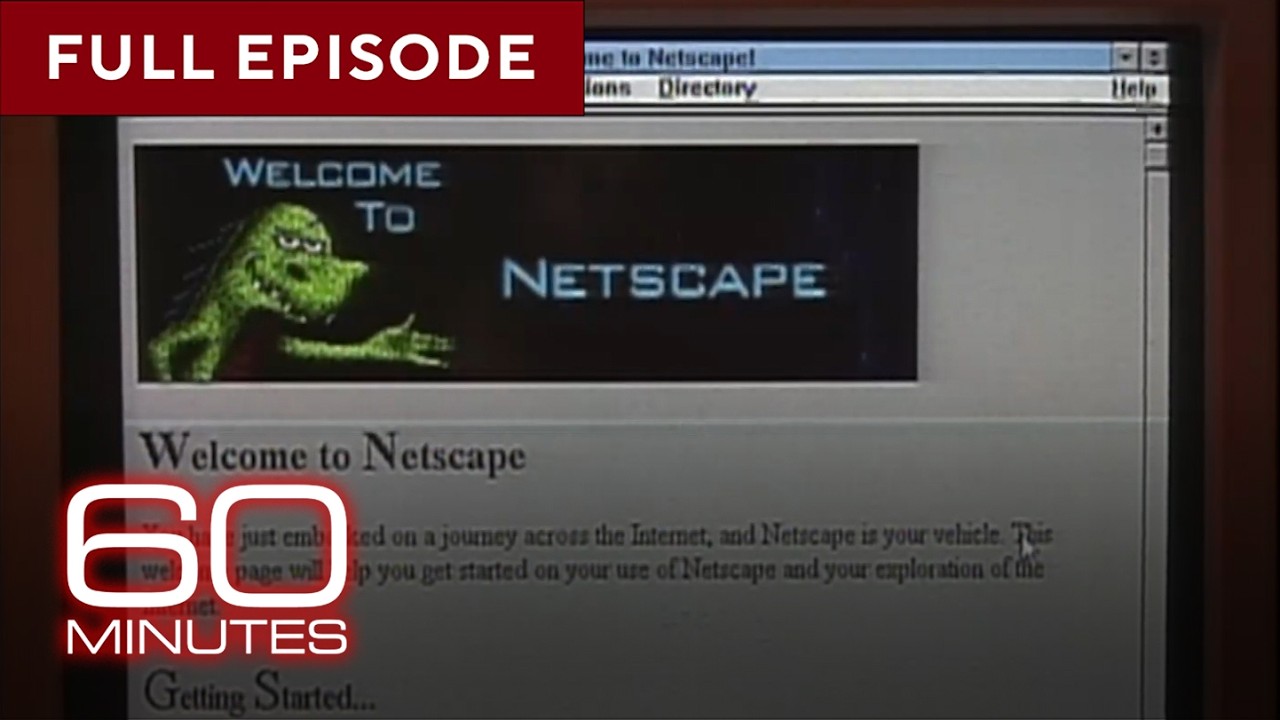
- A segment of the report explores the process of getting online in the mid-1990s, involving the use of installation discs for services that promised fast access 2m35s.
- Setting up an internet connection during this period required configuring modems, which involved technical tasks such as setting up COM ports within the Windows 3.1 or Windows 95 operating systems 3m0s.
- Computers could be connected to printers and utilized specific protocols and communication ports to perform various services. 0s
- The internet was described as a source for vast amounts of information, including recipes and the ability to form electronic relationships or friendships. 5s
- Accessing the internet required specific hardware and the knowledge of what to look for, which was identified as a significant barrier for average users. 25s
- The internet was characterized as a "house under construction" during this period of early adoption. 35s
- Ken Morurell, an expert from the computer store CompUSA, was consulted to assist with the technical setup process. 40s
- Starting the internet connection involved using a batch file, which is a startup routine that the computer reads from a disc upon being turned on. 55s
- A web page was defined as a site on the internet that individuals could create for themselves. 1m5s
- The login process for America Online served as the gateway for users to access the internet. 1m20s
- Despite initial perceptions that the internet was too complicated, the process of getting up and running was described as relatively easy once the initial setup was complete. 1m35s