
The Rise of Ocean Farming
- Seaweed is increasingly viewed by scientists, fishermen, and food experts as a valuable resource for food production, job creation, and environmental restoration, rather than a nuisance 0s.
- Ocean farming is being explored as a solution to address the challenges of a growing global population and limited agricultural land 25s.
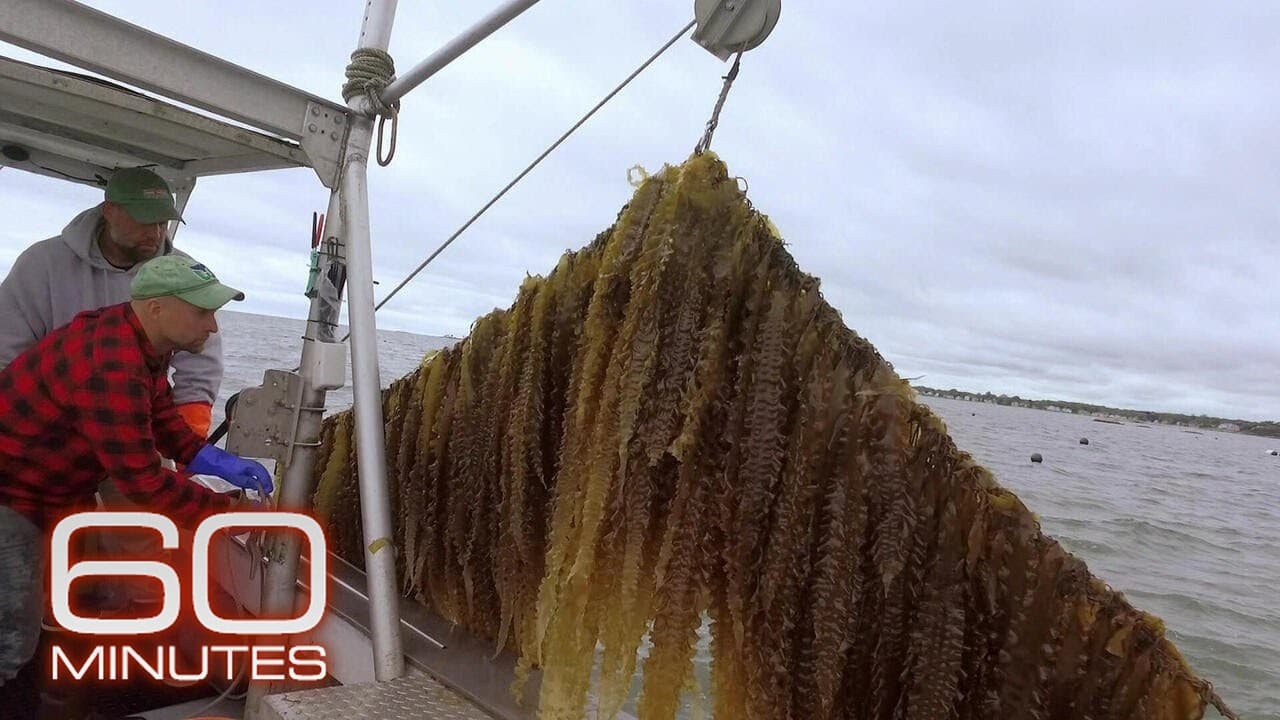
- Bren Smith, a prominent advocate for ocean farming, cultivates sugar kelp on a 20-acre farm located in the waters of Connecticut 35s.
- The farming process involves suspending horizontal ropes eight feet below the surface, marked by buoys, where baby kelp plants are attached 55s.
Characteristics and Cultivation of Sugar Kelp
- Sugar kelp is described as one of the fastest-growing plants on Earth, capable of reaching lengths of 15 to 18 feet within five to six months 1m15s.
- Seaweed is categorized as a "zero input" crop because it requires no fresh water or fertilizer to grow 1m25s.
- Since Smith began leasing his plot in 2012 as the first commercial seaweed farm in Connecticut, the industry has grown to include nine farms with several more in development 1m45s.
Bren Smith's Transition to Seaweed Farming
- Smith previously worked in industrial fishing, an experience he now characterizes as destructive to ecosystems and unsustainable due to the depletion of fish stocks 2m15s.
- After the collapse of cod stocks and the destruction of his oyster crops by hurricanes, Smith faced potential bankruptcy 2m45s.
- Smith consulted with Charlie Yarish, a professor of marine biology at the University of Connecticut, to identify new opportunities in marine cultivation 3m5s.
Species Selection and Processing
- While there are thousands of seaweed species, only about 20 are currently farmed globally, as some varieties are inedible or toxic 3m15s.
- Sugar kelp was selected for farming because it is a local species, has a mild flavor, and serves multiple purposes, including use as fertilizer and animal feed 3m30s.
- Smith operates a large seaweed hatchery that produces kelp spores and processes harvests for sale, including fresh, frozen, and noodle-based products 5s.
- The kelp is blanched in 170-degree water to achieve a vivid green color before being distributed to customers such as Google, Yale University, and various wholesalers 12s.
Mitigating Ocean Acidification
- A test farm located in the waters outside Seattle is investigating whether seaweed can mitigate ocean acidification caused by rising carbon dioxide levels 26s.
- Approximately 25% of atmospheric carbon dioxide, generated by fossil fuel emissions and deforestation, is absorbed by the world's oceans 35s.
- The absorption of carbon dioxide leads to chemical changes in the ocean, specifically increasing acidity and reducing the availability of carbonate ions necessary for marine species to build shells and skeletons 53s.
- According to the 2017 Climate Science Special Report, ocean surface waters have become 30% more acidic over the last 150 years, a problem exacerbated in the Pacific Northwest by currents that bring carbon-rich water to the surface 1m3s.
- Kelp and other seaweeds absorb carbon dioxide from the water to perform photosynthesis, which may provide a counter-effect to the negative impacts of acidification on shellfish 1m17s.
- Scientists are using mooring buoys to measure water chemistry changes within kelp fields and to determine if shellfish grown alongside kelp show improved shell development 1m45s.
3D Ocean Farming Methods
- Bren Smith utilizes a method called 3D ocean farming, which involves stacking crops vertically in the water column to maximize efficiency and food production 2m6s.
- The 3D farming system incorporates kelp, mussels, scallops, and oysters, allowing for the simultaneous cultivation of multiple species within the same ocean plot 2m20s.
- Smith, who identifies as a farmer rather than a fisherman, harvests mussels and kelp concurrently as part of his agricultural operations 2m45s.
Supporting New Seaweed Farmers
- Ocean farmers are transitioning from traditional fishing to cultivating seaweed, a shift that allows them to maintain their independence, own their boats, and continue the work of feeding the country 0s.
- The nonprofit organization GreenWave was established to encourage and support new seaweed farmers in adopting this practice 15s.
- Jay Douglas and Suzy Flores, a husband and wife team, are among those who have begun seaweed farming after learning the process on an established farm 22s.
- Douglas, a former Marine, spent a year securing a permit for an ocean plot in Connecticut and constructed 36 anchors to support his farming operation 30s.
- GreenWave provides new farmers with free seed and a guarantee to purchase 80% of their harvest during the first two years of operation 45s.
- Initial startup costs for a new seaweed farm are estimated between $10,000 and $20,000, with the potential to earn a small profit in the first year and over $100,000 in subsequent years 50s.
Promoting Seaweed Consumption and Benefits
- Prospective seaweed farmers often face skepticism from others who are unfamiliar with the concept of kelp farming 1m5s.
- Chef and author Barton Seaver advocates for the consumption of seaweed, suggesting that the term "seaweed" should be replaced with "sea greens" to improve its appeal 1m25s.
- Seaver promotes integrating sea greens into familiar dishes, such as those that traditionally use spinach, to encourage wider adoption among American consumers 1m40s.
- Kelp is noted for being a nutritional source of calcium, fiber, iron, and antioxidants 2m0s.
- Seaweed farming is presented as an opportunity to grow food while simultaneously soaking up carbon and nitrogen, creating jobs, and fostering small business development 2m10s.
- The pursuit of seaweed farming is driven by a desire to maintain a career and lifestyle centered on working at sea 2m25s.