
Principles of Effective Note-Taking
- The primary bottleneck in note-taking is the speed of thought rather than writing speed or the specific application used, as learning occurs within the brain 25s.
- Note-taking facilitates learning by offloading cognitive effort, allowing individuals to track thoughts and organize information externally rather than relying solely on mental processing 42s.
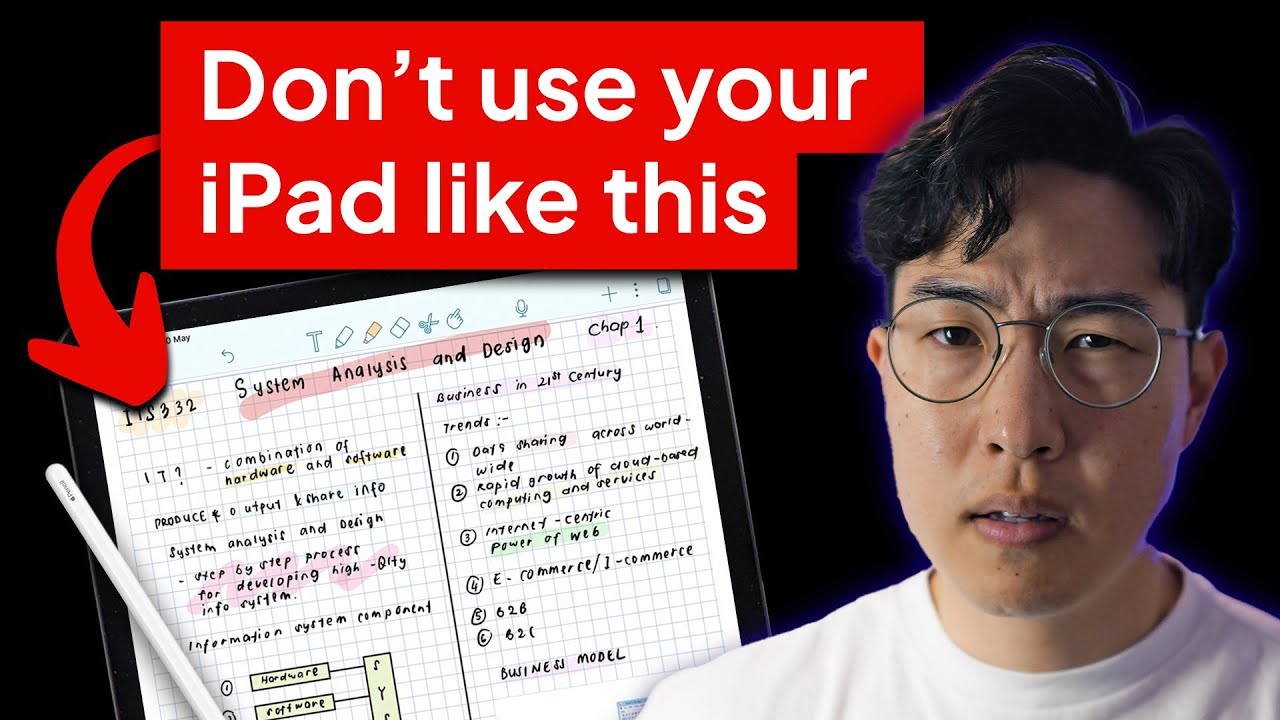
- Writing notes in full sentences as a speaker talks does not represent active thinking or effective organization 1m2s.
- If the sole purpose of note-taking is to create a reference for later, it is more efficient to use recordings or AI-generated summaries rather than manual note-taking 1m15s.
Cognitive Strategies for Learning
- Effective note-taking involves identifying key words and understanding their purpose to develop a big-picture perspective, which leads to better questions, stronger conclusions, and increased expertise 1m30s.
- Notes should demonstrate the relationships between ideas and provide a flow of thought, functioning as a "mind map" that can be updated as new information is acquired 1m55s.
- Research indicates that higher word counts in notes correlate with lower performance, as extensive writing often indicates verbatim transcription rather than active learning 2m15s.
- Writing fewer words allows more time for processing and connecting ideas, which is essential for deep learning 2m35s.
- Using key words and visual indicators, such as arrows to show connections, is more effective than writing full sentences because it forces the brain to engage with the meaning of the information 2m45s.
- Typing notes is often slower for learning purposes than handwriting because typing prioritizes the speed of getting words onto a page over the cognitive processing required to retain and use information 3m10s.
- Note-taking is only one component of effective learning, and other factors may influence how efficiently an individual learns. 0s
Infinite Canvas and Visual Tools
- An infinite canvas is recommended for note-taking because it accommodates the messy, non-linear nature of the learning process. 1m15s
- Traditional note-taking formats, such as narrow A4 columns or single pages, can limit the ability to connect ideas and expand knowledge as it grows. 1m25s
- Using an infinite canvas allows for the organic exploration of topics, which can lead to improved information retention and deeper expertise. 2m25s
- The Freeform app is a free tool available on iPads with the latest iOS that provides an infinite canvas for note-taking. 2m35s
Doodle Anchoring and Dual Coding
- Doodle anchoring involves drawing small images or visuals alongside written notes to leverage the brain's superior speed in processing visual information. 3m5s
- Dual coding is a learning strategy that combines verbal or written information with non-verbal imagery to increase effectiveness. 3m25s
- Artistic skill is not required for doodle anchoring, as even simple, crude drawings can serve as effective memory cues to help anchor topics in the mind. 3m40s
- Doodling at key topical landmarks helps anchor concepts in memory while simultaneously increasing focus and reducing boredom during study sessions. 0s
Lasso Tool and Information Organization
- The lasso tool is a highly effective iPad note-taking feature that allows users to select, move, and rearrange written content. 15s
- Using the lasso tool eliminates the pressure of deciding where to place new information immediately, as notes can be repositioned later when a better organizational structure becomes apparent. 35s
- Frequent rearranging and reorganizing of notes is a critical cognitive process that facilitates deep learning, memory retention, and the development of expertise. 1m5s
- The process of organizing information is compared to tidying a messy room; by actively sorting and placing items, one gains a comprehensive understanding of the material that eliminates the need for rote memorization tools like flashcards. 1m15s
- Efficient learners may spend 50% to 60% of their note-taking time using the lasso tool to simplify and reorganize information. 1m45s
Zoom Toggling and Big-Picture Context
- Zoom toggling is a technique used to maintain a connection between specific details and the broader, big-picture context of a topic. 2m0s
- Experts are characterized by their ability to explain complex topics simply, a skill derived from their capacity to see how individual pieces of information fit into a larger framework. 2m5s
- When using infinite canvas applications, zooming in too closely limits the field of view, making it difficult to see how new concepts relate to existing information. 2m20s
- Zoom toggling involves actively zooming out after adding each new concept to evaluate how that information connects to or should be rearranged with the rest of the material. 2m35s
Refining Knowledge Through Restructuring
- Restructuring and reorganizing information makes content more intuitive and simpler to understand, which aids in memory retention. 0s
- The process of organizing notes can be compared to tidying a room, where each item is evaluated to determine its most logical placement. 3s
- Efficient learners frequently engage in "zoom toggling," a process that involves alternating between viewing the big picture and focusing on specific details. 13s