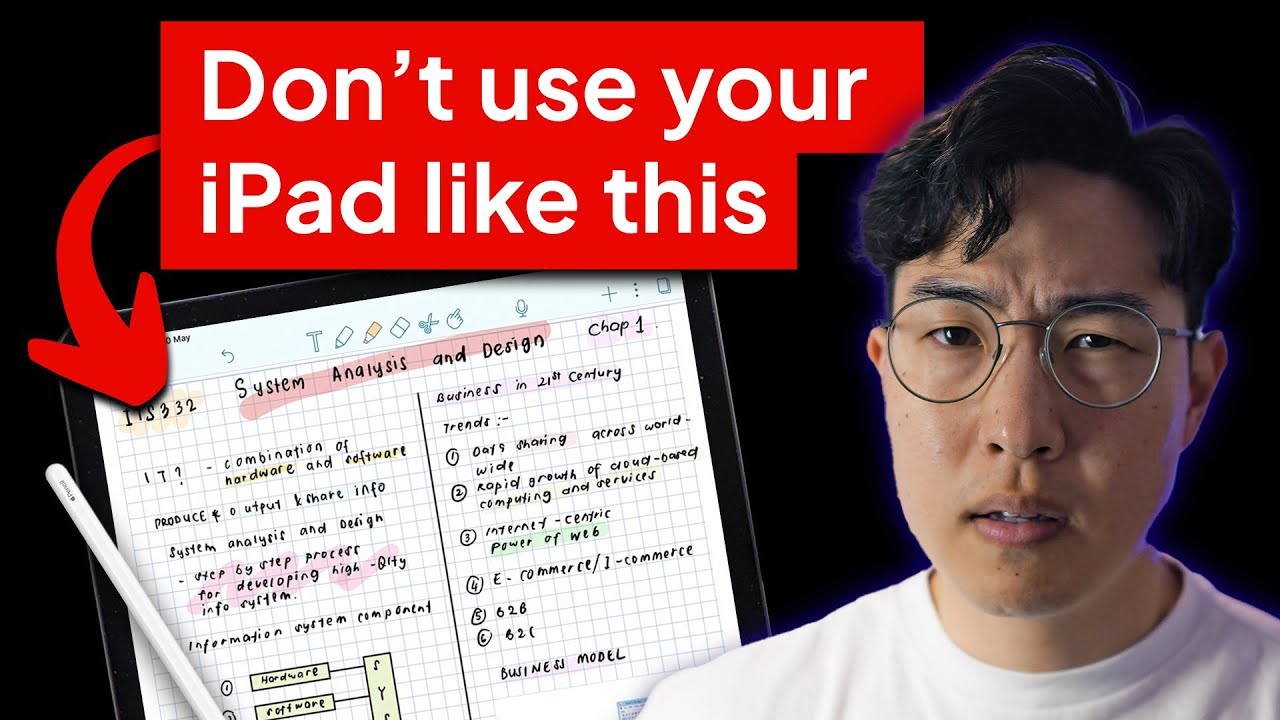

Cognitive Functions of Note-Taking
- Note-taking is not a singular, static technique, but rather a visual representation of an individual's thought process that must align with how they process information 25s.
- The primary functions of note-taking are to document information for future reference and to facilitate cognitive processes by reducing unnecessary mental load 55s.
- The human brain has a fixed capacity, and note-taking serves to offset the cognitive burden of holding information, allowing the brain to focus on deeper, more important learning tasks 1m15s.
- Attending a lecture without taking any notes is ineffective because the brain spends its limited resources attempting to retain everything, which prevents deep thinking 1m30s.
Ineffectiveness of Passive Transcription
- Simply transcribing information as it is heard is ineffective because it fails to utilize the mental resources freed up by the note-taking process 1m50s.
- Writing down every detail without active engagement is counterproductive because it bypasses the learning process entirely and creates an excessive volume of notes that requires more time to process later 2m5s.
Principles of Information Organization
- Once mental resources are freed through effective note-taking, the focus should shift toward higher-order thinking, which involves comparing ideas against one another 2m25s.
- Effective note-taking involves grouping, categorizing, and relating information within a network to create a map that is clean, simple, and intuitive. 0s
- Information grouping can be logical, such as the structures found in textbooks or lectures, but logical organization does not always equate to intuitive organization. 15s
- Grouping information in a way that is not intuitive requires additional cognitive resources, as the learner must expend effort to remember both the information itself and the specific way it was categorized. 32s
Intuition and Expertise in Categorization
- Intuitive groupings are those that feel obvious and require little to no mental effort to process, such as pairs like outer versus inner, up versus down, left versus right, before versus after, or cause versus effect. 55s
- The level of expertise influences what is considered intuitive; while an expert might find technical groupings like pericardium versus myocardium obvious, a novice would not. 1m20s
- A balance must be struck between logical organization, which is meaningful within the context of the subject, and intuitive organization, which minimizes the effort required to recall the structure. 1m45s
- Categorizing information based on arbitrary criteria, such as dividing the alphabet at the letter G, may be intuitive but lacks logical or meaningful relevance to the subject matter. 2m0s
- The process of determining how to group and categorize information is a complex skill that often involves confusion and feelings of being overwhelmed, which are normal indicators of the brain engaging in high-quality learning. 2m20s
Limitations of Linear Note-Taking
- Note-taking methods are effective as long as they facilitate the process of thinking through and organizing information. 2m45s
- Linear note-taking, which involves writing sequentially from left to right and down the page, is inherently limited because knowledge itself is not linear. 3m5s
Challenges with Digital and Typed Notes
- Research on note-taking methods is extensive and often overwhelming, making it difficult to draw definitive conclusions because note-taking is a reflection of an individual's unique thinking process 0s.
- The effectiveness of note-taking is influenced by numerous variables, meaning that typing notes can be more effective than handwriting if the typing process involves active engagement with the material 0s.
- Recent research into the relationship between note-taking and cognitive load is considered more promising and transferable than previous studies 0s.
- Typing is generally discouraged because current technology often limits users to linear and sequential note-taking 0s.
- Relational note-taking applications, such as Notion, are limited because the software often creates the relationships for the user, preventing the user from performing the higher-level cognitive task of discriminating and prioritizing information 0s.
Advantages of Freehand Note-Taking
- Representing every possible relationship between pieces of information is counterproductive because knowledge is inherently non-linear and relational; attempting to map everything leads to overwhelming and purposeless notes 0s.
- The process of manually deciding how to represent relationships—such as the placement of items on a page, the thickness of connecting arrows, or the direction of those arrows—forces a deeper level of critical thinking 0s.
- Freehand note-taking is superior for demonstrating complex relationships and is more efficient than software for making nuanced decisions about how information is connected 0s.
- The slower speed of freehand writing is advantageous because it forces the note-taker to be more selective and concise 0s.
- Studies indicate that higher word counts in notes are associated with lower performance, likely because verbatim typing requires less cognitive processing than summarizing information 0s.
Digital Tools for Non-Linear Learning
- Freehand note-taking using a digital stylus is recommended because it allows for an infinite canvas, which better reflects the non-linear nature of knowledge compared to the constraints of A4 pages 0s.
- An infinite canvas provides the flexibility to restructure and move information around, which is more conducive to high-quality learning than being limited by page formatting 0s.
- The application "Concepts" is suggested for note-taking because it offers an infinite canvas, although it is considered an over-featured tool originally designed for architects and artists 35s.
Synthesizing Knowledge for Complex Retrieval
- While typing notes is faster for simply recording information, it is considered more difficult to perform well if the goal is high-quality learning, retention, and the ability to retrieve information for complex or "curveball" exam questions 1m15s.
- Linear note-taking, including typed notes, often results in isolated and fragmented information, making it difficult to synthesize or adapt knowledge when faced with complex or nuanced questions 1m45s.
- To achieve fluid knowledge retrieval, the method of studying must match the level of complexity and nuance required for the final application of that knowledge 1m45s.
- The most efficient way to record information verbatim is to use transcription software on audio recordings, but this process does not facilitate the deep thinking required for effective learning 1m15s.
Transitioning to Effective Note-Taking Methods
- Transitioning students from typing to handwriting is a significant challenge that often requires coaching or instruction to navigate successfully 55s.
- Note-taking should be approached with an awareness that the primary goal is the quality of thinking engaged in, rather than simply accumulating information on a page. 0s
- Relying solely on the volume of written notes is ineffective for performance, as the act of writing notes does not inherently guarantee better results. 0s
- Maintaining an awareness of the desired cognitive outcome while continuing to use typed note-taking can create a sense of frustration, which serves as motivation to change methods. 0s
- A transitional strategy involves keeping a separate piece of paper nearby to jot down keywords, connect ideas, and group concepts while continuing to use typed notes. 0s
- Transitioning to freehand note-taking requires a leap of faith and can be difficult, but it is achievable with practice and optimization. 0s
- After approximately two to three hours of tinkering with freehand note-taking, individuals can often achieve results comparable to those gained through typed note-taking. 0s
Overcoming Insecurity and Building Mastery
- Many people experience insecurity when moving away from digital note-taking apps because they rely on the dense volume of stored information for a sense of security. 0s
- The focus should shift from the quantity of stored information to the quality and accessibility of knowledge retained within the brain. 0s
- Beginners often struggle to determine if they are using a new note-taking method correctly until they have experienced the results multiple times. 0s
- External guidance or coaching can help beginners recognize the benefits of improved note-taking methods, such as better retention, increased confidence, and more fluid thinking. 0s
Higher-Order Learning and Complexity
- Higher-level learning is characterized by knowledge that feels intuitive, obvious, and interconnected, whereas lower-order learning often leaves information feeling isolated. 0s
- Learning progress exists on a spectrum, ranging from an inability to manipulate information to the ability to start anywhere and move in any direction with the material. 0s
- Retrieval practice should be conducted at higher levels of complexity to prepare for exams that test beyond basic recall. 15s
- Challenging oneself with difficult questions, such as those found in past papers or created by peers, helps identify gaps in understanding. 25s
- Higher-level learning involves integrating multiple concepts and analyzing how changing specific variables affects the relationship between those concepts. 40s
- Adding more variables to a problem creates more complex scenarios, which mimics the methods examiners use to create difficult questions and distinguish top-performing students. 55s
Confidence and Self-Testing Metrics
- Mastery is indicated by the ability to confidently manipulate information and flow through concepts in any direction. 1m15s
- Confidence is a critical metric in self-testing; answering a question correctly without feeling confident suggests the result may have been due to luck rather than true knowledge. 1m35s
- Relying solely on whether an answer is right or wrong can be misleading, as a lack of confidence in a correct answer indicates a potential vulnerability to similar questions presented in different ways. 1m55s
- Developing high confidence in an answer that turns out to be incorrect reveals a fundamental gap in understanding, such as missing an entire perspective or failing to account for a specific variable. 2m15s
Analyzing Reasoning Errors and Structural Flaws
- Failing to answer a question correctly, even in an open-book setting, indicates a flaw in the underlying method of thinking rather than just a lack of information. 0s
- Methods of thinking are transferable, meaning a specific error in reasoning is likely to cause mistakes across various other concepts and question types. 0s
- Relying on an answer sheet without assessing one's own confidence levels leads to inconsistent performance, where success becomes a matter of chance rather than mastery. 0s
- Incorrect answers often stem from a failure to properly structure information, specifically regarding how data is grouped and how relationships between concepts are defined. 0s
- When a perspective or variable is missing, it is often because the information was organized in a way that felt intuitive but lacked sufficient logical rigor. 0s
- If information is logical but not intuitive, the primary consequence is difficulty in remembering the structure or relationship, rather than an inability to apply it correctly. 0s
- Intuition is valuable for holding onto information and facilitating thought, but logical structure is necessary to navigate relationships between concepts with high accuracy. 0s