

Introduction 0s
- The Huberman Lab podcast discusses science and science-based tools for everyday life.
- Hosted by Andrew Huberman, a professor of neurobiology and ophthalmology at Stanford School of Medicine.
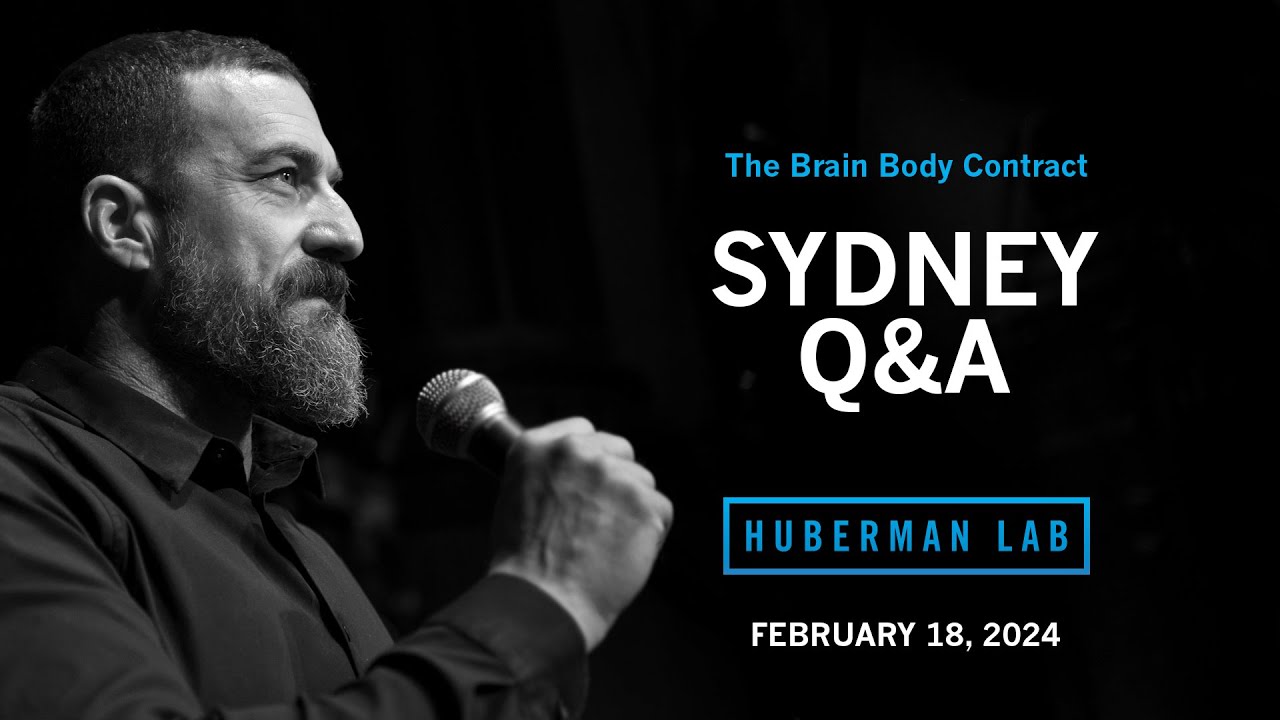
Live Event Recap: The Brain Body Contract 15s
- The Huberman Lab podcast hosted a live event called "The Brain Body Contract" at the ICC Theatre in Sydney, Australia.
- The event featured a lecture followed by a Q&A session with the audience.
Sponsors: AG1 & Eight Sleep 32s
- The event was sponsored by Eight Sleep and AG1.
- Eight Sleep makes smart mattress covers with cooling, heating, and sleep tracking capabilities.
- AG1 is a vitamin, mineral, probiotic drink that also contains adaptogens and other critical micronutrients.
Q&A Session Begins: Napping and Sleep Quality 3m30s
- Keep naps shorter than 90 minutes to avoid disrupting nighttime sleep.
- Avoid naps if they disrupt nighttime sleep or cause sleep inertia (feeling groggy after waking up).
- Non-sleep deep rest (body still, mind awake) can replenish dopamine levels, restore mental and physical vigor, and enhance nighttime sleep.
- Non-sleep deep rest may also improve creativity and make up for lost sleep.
- 10-minute, 20-minute, and 30-minute non-sleep deep rest protocols narrated by Dr. Huberman will be released on the YouTube channel.
- The visuals for the protocols will feature the beautiful sunrise over Sydney.
The Power of the Placebo Effect 6m34s
- The placebo effect is real and our beliefs about what we've taken or what is happening to us have a powerful effect on our physiology.
- Belief effects are specific to certain types of information, while placebo effects are more general.
- A recent study showed that the placebo effect can be dose-dependent, with people who believed they had a higher dose of nicotine performing better in a cognitive task even though they consumed zero.
- The study also found that the levels of activity in particular areas of the brain that are relevant for cognition changed according to what the people believed.
- Our belief system, including our understanding of the mechanisms that are likely driving certain effects of drugs or protocols, plays a powerful role in whether or not we get the desired effect.
Entering Rest and Digest State: Techniques and Tools 11m31s
- The fastest way to enter the rest and digest state is through physiological sighs, repeated 2-3 times.
- Combine physiological sighs with panoramic vision to reduce the nervous system's "autonomic RPM".
- Prioritize getting enough sleep each night to reduce stress levels.
- Non-sleep deep rest (NSDR), a form of self-directed relaxation, can be a powerful tool for managing stress.
- NSDR involves keeping the mind active while the body is still and has been shown to have numerous benefits.
- The term "NSDR" was chosen to avoid esoteric names that might deter people from trying the technique.
- Self-directed relaxation, such as NSDR, should be the first line of defense against chronic stress.
- Consider incorporating physiological sighs and modern medicine, such as prescription drugs, if the fight or flight state persists.
- Supplements like theanine and magnesium can be helpful in some cases but should not be the primary approach.
Muscle Growth, Learning & the Brain 15m35s
- Muscles grow stronger after a proper stimulus and rest.
- Resistance training provides a window into adaptation due to enhanced blood flow during the workout.
- Cognitive learning follows a similar principle: optimal learning occurs when the difficulty is set at around 85% correct trials and 15% error trials.
- Focused and deliberate attempts to learn something create a sense of agitation that triggers neuroplasticity.
- The nervous system doesn't distinguish between successful and failed trials; it relies on neuromodulators like adrenaline and norepinephrine released during agitation to trigger neuroplasticity.
- Neuroplasticity, the actual rewiring of neurons, occurs during deep rest or non-sleep deep rest.
- Agitation, stress, and the underlying neurochemicals are the stimulus for learning.
- The speaker wishes this had been taught in school instead of just warnings like "don't drink and drive."
- The two important principles are:
- Agitation and stress are the stimulus for learning.
- Neuroplasticity occurs during rest.
Hallucinogens: Personal Experiences & Clinical Insights 20m13s
- Dr. Andrew Huberman advises against the use of LSD and psilocybin, especially during adolescence, due to their potential negative impact on brain development.
- Psychedelic clinical trials on adults with psychiatric conditions like depression and bipolar disorder have shown promising results, leading to a reevaluation of their therapeutic potential.
- Psilocybin, with its shorter trip duration compared to LSD, is more suitable for clinical research within a reasonable workday.
- Iboga, a psychedelic known for inducing high-resolution recall of past events, is being studied for its potential to change behavior and reshape relationships with those experiences.
- Kentucky's allocation of a $40 million settlement from the opioid crisis to fund iboga trials reflects the growing interest in psychedelic research in the United States.
- Psilocybin's effectiveness in treating major depression is attributed to its ability to enhance connectivity between previously disconnected brain areas.
- Microdosing psilocybin requires further research to determine its efficacy compared to macrodosing.
- MDMA (ecstasy) carries potential risks due to contaminants and the presence of methamphetamine.
- The combination of serotonin and dopamine caused by MDMA may provide a neuroprotective effect, and early reports of its neurotoxicity have been retracted.
The Misunderstood Effects of MDMA 27m28s
- A study initially reported the effects of MDMA, but it was later discovered that methamphetamine was mistakenly used instead.
- The news agencies did not report this retraction.
Exploring the Potential of MDMA in Clinical Settings 27m42s
- MDMA, when used in a clinically supported context, can act as an empathogen.
- It can help people develop empathy for themselves and relieve trauma.
- Clinical trials show up to 67% remission of PTSD with proper dosing, frequency, and support.
- This involves more than just recreational use; it requires introspection, communication, and support.
- MDMA can help develop empathetic states toward oneself, promoting self-love and self-compassion.
- The high levels of serotonin and dopamine can lead to indiscriminate empathy, requiring careful management.
The Complex World of Psychedelics & Mental Health 29m25s
- The speaker's stance on psychedelics has changed in recent years.
- Federally funded research on psychedelics is now being conducted at Stanford and other institutions.
- Psychedelics are essentially potent neuromodulators that adjust levels of serotonin, dopamine, etc. in the brain.
- Caution is necessary due to their potency.
Ketamine: From Misconception to Medical Use 30m7s
- Ketamine, previously demonized as PCP, is now legal in the US.
- Ketamine is a potent NMDA receptor blocker that blocks neuroplasticity in the short term but enhances it in the long term.
- The goal of using these compounds is not simply plasticity but plasticity directed toward a positive outcome.
- Maladaptive plasticity is a potential risk, hence caution is advised.
The Fascinating Science of DMT 31m53s
- DMT leads to lower threshold for impulsivity.
- DMT is a high-speed freight train into your consciousness.
- Studies on DMT are limited and challenging due to the short trip and massive neuromodulator release.
- Robin Carhart-Harris at the University of California, San Francisco is extensively studying DMT.
Supporting Science: Funding & Future Directions 33m11s
- The podcast provides support to Robin Carhart-Harris's laboratory for the study of DMT and other exciting topics.
- A significant portion of the proceeds from the podcast's premium channel funds studies on DMT and other important areas.
- The goal is to fill in important blanks in the study of DMT and other topics, such as eating disorders.
- Funding for science on advanced topics is challenging, so the podcast is trying to accelerate the process by pulling together donors and funding human studies.
The Gut-Brain Axis: A Key to Overall Health 34m48s
- The gut-brain axis is a significant area of research, with the gut microbiome playing a crucial role in brain health.
- Enhancing the diversity of gut microbiota positively impacts the nervous system, potentially relieving certain neuropsychiatric conditions.
- Fecal microbiota transplants and consuming fermented foods (e.g., kimchi, sauerkraut, kefir) support the gut-brain axis, while probiotic supplements can be beneficial when access to fermented foods is limited.
- Improving sleep has positive effects on mental health, physical health, and performance, while sleep deprivation leads to deficits in multiple areas.
- The gut microbiome plays a crucial role in mental health, physical health, and performance, and its diversity is essential. Overuse of antibiotics can disrupt the microbiome, so it's important to counter their effects with probiotics.
- Quality of sleep is crucial for overall well-being.
Sleep Patterns and Chronotypes: Personalizing Rest 40m41s
- Chronotypes are real and affect sleep preferences.
- Some people feel better going to bed and waking up early, while others feel better staying up late and waking up late.
- The total duration and regularity of sleep are important.
- Try to go to sleep and wake up at the same time each day, within plus or minus 1 hour.
- Deviations from regular sleep schedules should not impact you negatively.
Addressing ADHD & Focus in the Modern World 42m50s
- Attention Deficit Hyperactivity Disorder (ADHD) is a real condition that affects some individuals and can cause difficulty with focus.
- Behavioral tools and prescription drugs can be used to improve focus, and the best approach varies for each person.
- Training oneself to focus on visual targets for short periods can activate neural circuits that enhance focus for 10 to 20 minutes afterward.
- Individuals with ADHD often have a high focusing capacity when engaged in enjoyable activities, indicating that the ability to focus is present but harder to access.
- Focus is a skill that takes time to develop and is not a constant state.
- Creating a focused environment by removing distractions and setting realistic expectations is important.
- Focus can be improved over time by finding activities that bring joy and practicing gradual training.
Closing Remarks & Gratitude 49m27s
- Dr. Huberman expresses his gratitude to the audience for attending the event and listening to the discussion on science and health.
- He emphasizes that the information shared during the event, including tools, protocols, and mechanisms, are primarily the discoveries of others, and he gives credit where it is due.
- Dr. Huberman encourages the audience to pass on the knowledge and tools they have learned to others, without associating it with his name or the podcast.
- He stresses the importance of sharing information and helping one another to relieve suffering and improve mental health, physical health, and performance.
- Dr. Huberman concludes by thanking the audience for their interest in science.