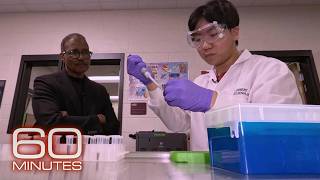
Ultrasound Treatment for Brain Disorders
- Dr. Ali R. is a pioneering neuroscientist who is researching treatments for Alzheimer's disease and addiction.
- Dr. R. is using ultrasound to attempt to delay the progression of Alzheimer's disease.
- Ultrasound is a non-invasive method that can be used to open the blood-brain barrier, allowing drugs to reach the brain more effectively.
- The blood-brain barrier is a protective layer that prevents toxins from entering the brain, but it also makes it difficult for medications to reach the brain.
- Dr. R. believes that ultrasound can help to overcome this barrier and allow drugs to reach the brain more effectively.
- Dr. R. is working with a team of doctors to test this new approach to treating Alzheimer's disease.
- The team is targeting areas of the brain that are affected by Alzheimer's disease.
- The team is using ultrasound to open the blood-brain barrier in these areas, allowing drugs to reach the brain more effectively.
- The team is carefully monitoring the patients to ensure that the treatment is safe and effective.
- The team is hopeful that this new approach to treating Alzheimer's disease will be successful.
- Dr. Rai, a brain surgeon, has been working on using ultrasound to treat brain disorders.
- Dr. Rai was among the first to implant a pacemaker-type device in the brain to treat Parkinson's disease.
- Dr. Rai's team used focused ultrasound to treat tremors in a patient named Dan Wall.
- The ultrasound treatment destroyed a small area of tissue in the thalamus, which was believed to be responsible for the tremors.
- Dr. Rai believes that focused ultrasound can be used to treat other brain disorders, including Alzheimer's disease.
- Dr. Oli Rai has received FDA approval to use ultrasound to try and restore brain cell function lost to Alzheimer's.
- Dr. Rai is also conducting a study to investigate whether ultrasound can reverse brain damage caused by Alzheimer's.
- Dr. Rai is also exploring the use of ultrasound to treat drug addiction.
Focused Ultrasound Treatment for Alzheimer's Disease
- Dan Miller, a 61-year-old man with Alzheimer's disease, participated in a trial using focused ultrasound to slow the progression of the disease.
- Miller was given an IV treatment of aducanumab, a drug that reduces beta-amyloid plaque, before the procedure.
- Miller was then fitted with a helmet that directed ultrasound energy to a specific target in his brain.
- The ultrasound energy caused microscopic bubbles in an IV solution to vibrate and open the blood-brain barrier, allowing therapeutics to enter the brain.
- The blood-brain barrier remained open for 24 to 48 hours, giving therapeutics a chance to reach the brain.
- A new treatment for Alzheimer's disease using focused ultrasound was tested on three patients.
- The ultrasound waves were used to open the blood-brain barrier, allowing a drug to reach and reduce beta-amyloid plaques in the brain.
- The treatment resulted in a 50% reduction in beta-amyloid plaques in the areas targeted by ultrasound compared to areas treated with infusion alone.
- The patients were given the treatment once a month for six months.
- The patients reported no changes in their ability to perform daily activities after the treatment ended.
- Two of the three patients who received the limited Alzheimer's treatment have experienced some decline since the initial report in January.
Focused Ultrasound Treatment for Drug Addiction
- Dr. Rai, a neurosurgeon, has been working on a new treatment for drug addiction using focused ultrasound.
- The treatment targets the reward center of the brain, the nucleus accumbens, which is responsible for cravings and anxiety.
- Focused ultrasound beams are directed to this area of the brain, causing a change in electrical and chemical activity, effectively resetting the brain and reducing cravings and anxiety.
- The treatment is not a cure but an augmentation of therapy, allowing patients to better engage with their therapists.
- Dr. Rai's team treated Dave Martin, a patient who had been using drugs since the age of 7.
- During the procedure, Martin was shown images of drug use to stimulate his cravings.
- After the focused ultrasound treatment, Martin reported a significant reduction in cravings and anxiety.
- Martin stated that he did not experience the same urge to use drugs after the treatment.
- The entire procedure takes approximately one hour.
- Martin reported that he was able to resist the urge to use drugs even when around people who were using.
Brain Surgery for Drug Addiction
- Buck Halter, a former addict, struggled with addiction for over 15 years, experiencing multiple overdoses and relapses.
- Dr. Oli Rosai, a neurosurgeon, developed a new brain surgery to treat severe addiction, inspired by technology used for Parkinson's disease treatment.
- Dr. Rosai believed that addiction is a brain disease caused by electrical and chemical abnormalities in the brain's reward center.
- The surgery involved implanting a device with electrodes into the brain's reward center to regulate cravings and anxiety.
- Buck Halter became the first patient in the US to receive this brain implant, undergoing a 7-hour surgery where he was awake to allow for precise mapping of the brain.
- The implant sends electrical pulses to the brain, aiming to suppress cravings.
- The device can be adjusted remotely using a tablet computer.
- Buck Halter reported an immediate change after the implant was activated.
- Dr. Oi Rosai is conducting ultrasound therapy on addiction patients.
- The therapy has been approved by the FDA.
- Dr. Rosai is also researching the use of ultrasound therapy for obesity.
Sealand: A Self-Proclaimed Micronation
- Sealand is a micro-nation located in the North Sea, seven miles off the coast of England.
- Sealand declared its independence in 1967.
- The current monarch of Sealand is Prince Michael Bates.
- Sealand has a population of one and a land mass the size of two tennis courts.
- Sealand was originally a World War II fort called His Majesty's Rough's Tower.
- The fort was used to prevent German bombing raids on London.
- Sealand was later used by a pirate radio station called Radio Essex.
- Radio Essex was one of many pirate radio stations operating in the North Sea in the 1960s.
- The pirate radio stations were popular with young people in Britain who wanted to hear more rock music.
- Roy Bates, Prince Michael's father, took over the fort and started Radio Essex.
- Radio Essex was the first 24-hour radio station in Britain.
- Roy Bates, the founder of Sealand, was forced to shut down his pirate radio station due to a new British law.
- Instead of surrendering, Bates seized another fort, Ruff's Tower, which was outside UK territorial waters.
- On September 2nd, 1967, Bates declared Sealand an independent state and himself its Prince.
- The Bates family, including Roy, his wife Joan, and their children Michael and Penny, established their home on Sealand.
- The family had ambitions to turn Sealand into a tax haven, luxury island, and casino.
- Michael and Penny spent months on Sealand, defending it from rivals and buccaneers.
- The British government viewed Sealand as a nuisance and even considered taking it by force.
- In 1978, a group of German and Dutch lawyers and diamond merchants launched a coup on Sealand, taking Prince Michael hostage.
- Michael was released after three days, and his father and a group of supporters staged a successful counter-coup.
- One of the plotters, Alexander Achenbach, was imprisoned and fined for treason.
- A German diplomat visited Sealand to negotiate Achenbach's release, which implied de facto recognition of Sealand as a state.
- Sealand met the four requirements for statehood: a government, a defined territory, a permanent population, and recognition by another state.
- The Bates family, who reside on Sealand, a self-proclaimed micronation, have taken on various ventures to maintain their independence.
- In the early 2000s, they partnered with internet entrepreneurs to establish Sealand as an offshore data haven, hosting websites like gambling and porn sites.
- They also considered hosting an organ transplant company, but ultimately rejected the proposal.
- Currently, the family generates revenue through the online sale of noble titles, allowing individuals to purchase titles like Lord, Lady, Duke, or Duchess for a fee.
- The family has also embraced the internet, with Prince James and Prince Liam running a business and Princess Penny operating a Botox clinic.
- Prince Michael, the current head of the family, married Mayi, a former artillery major in China's People's Liberation Army.
- The family is committed to maintaining Sealand's independence and is currently working on a digital citizenship program to fund the refurbishment of the platform into a tourist destination.