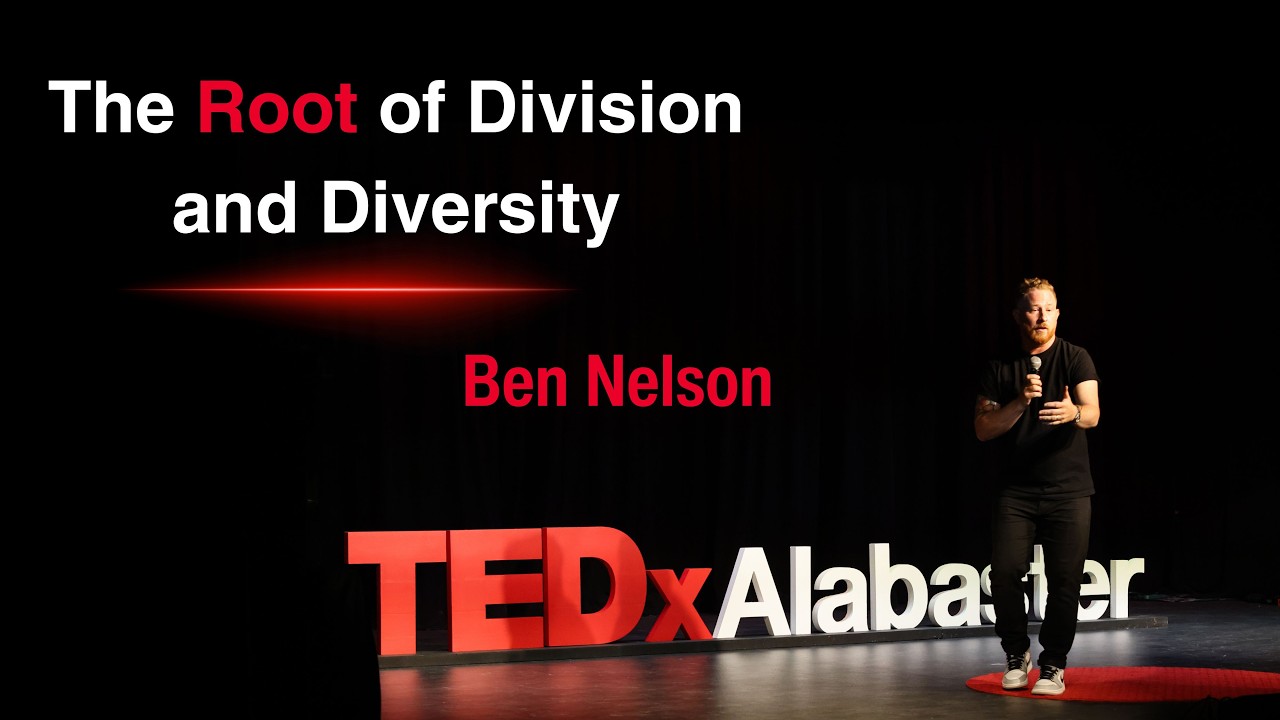


The Nature of Human Division
- Many personal relationships end or change significantly due to disagreements regarding politics, family, upbringing, or worldviews, often starting with tense conversations and leading to decreased communication 0s.
- While it is commonly suggested that differences are the root cause of division, differences are actually a given, whereas division is an optional choice 1m5s.
- Partial truths, described as believable lies, are dangerous because they are accepted as reality and subsequently dictate how individuals navigate their lives 1m25s.
- Differences can lead to either division or diversity, and the outcome depends on the choices individuals make regarding those differences 1m45s.
Historical and Societal Patterns of Marginalization
- In Bulgaria, the Roma people—the largest ethnic minority in Europe—have been marginalized due to real differences in race, background, upbringing, worldview, and levels of trust 2m15s.
- Division occurs when differences remain unmanaged for generations, creating a progression where differences turn into suspicion, suspicion leads to distance, and distance evolves into contempt 2m45s.
- Contempt can result in the implementation of laws, regulations, and rules that remove voices, deny people a seat at the table, and negatively impact their futures 3m5s.
- The same pattern of differences leading to suspicion, distance, and contempt was observed in the United States, mirroring the dynamics seen in Eastern Europe 3m25s.
Initiatives for Unity and Human Connection
- Efforts were made to create organizations and communities that intentionally included diverse groups to demonstrate that differences could lead to positive outcomes rather than division 3m55s.
- These initiatives successfully allowed people to set aside differences in politics, race, upbringing, and faith to focus on shared humanity and see the person rather than just their opinion 4m15s.
- The year 2020, characterized by a pandemic and a divisive political season, intensified societal divisions despite previous efforts to foster unity 4m35s.
- Societal tensions surrounding vaccines, social media, and race issues led to a decision to prioritize human connection over labels and headlines 0s.
- A commitment was made to avoid labeling individuals before getting to know them, fostering the belief that disagreement does not require the disappearance of the other person 18s.
Perception and the Definition of Others
- An interaction with a four-year-old son named Kai regarding traffic lights highlighted how people often define others by the traits that cause the most inconvenience or frustration 33s.
- Just as a traffic light is often labeled by its red phase because that is when it forces a stop, people frequently define others by their least favorable qualities rather than their inherent dignity and value 1m35s.
Distinguishing Unity from Uniformity
- Differences are a component of human interaction, but the outcome depends on how those differences are approached 2m6s.
- Meeting differences with fear results in division, while meeting them with control leads to uniformity 2m15s.
- Uniformity is defined as enforced sameness where belonging is contingent upon becoming like someone else, whereas unity allows for doing life together despite differences 2m25s.
- Unity involves refusing to be divided and choosing to see others as humans rather than as their worst opinions or greatest differences 2m45s.
- Division is an optional outcome, and individuals must decide whether to use their differences to create diverse, beautiful environments or to retreat into isolation 3m5s.
- Silence is not equivalent to unity; it is often a form of isolation, which serves as another method of division 3m25s.
Practices for Navigating Disagreements
- There are three specific practices that can be used to navigate differences through conversation rather than mere declaration 3m45s.
- Choosing curiosity over certainty is a primary method for improving disagreements, as certainty assumes prior knowledge of another person's thoughts and motivations 5s.
- Curiosity functions by asking individuals to explain their perspectives and the experiences that led them to their conclusions 15s.
- Prioritizing honor over winning an argument is essential, as winning a debate at the expense of losing a relationship is considered a net loss 25s.
- Choosing repair over resentment allows for the possibility of reconciliation even after a division has already begun 33s.
- Repairing a relationship involves taking personal responsibility, offering apologies, and asking what steps are necessary to move forward 40s.
Applying Reconciliation in Relationships
- Individuals are encouraged to identify one person in their life with whom they are experiencing division and evaluate if there is still an opportunity to apply curiosity and honor 50s.
- It is possible to maintain a disagreement without the relationship disappearing 1m5s.
- While differences in opinions, voting, and perspectives are inevitable in families, neighborhoods, and workplaces, division is described as an optional outcome 1m15s.