7 Best Perplexity Alternatives in 2026, Ranked by Use Case
Perplexity finds new web sources; it does not build a personal archive that compounds. We ranked seven alternatives by how answers compound after the search: Recall for a personal AI knowledge base that gives your AI context from sources you already trust, ChatGPT for general AI, Claude for writing, and NotebookLM for a bounded source set.
Last updated: August 2026
What are the best Perplexity alternatives?
The best Perplexity alternatives in 2026 are Recall for a personal AI knowledge base that gives your AI context from sources you already trust, ChatGPT for broad general AI, Claude for careful reasoning and long-form work, Google Gemini for Google-native workflows, NotebookLM for a defined source set, Microsoft Copilot for Microsoft 365, and Grok for real-time X context.
Perplexity is excellent at a specific job: fast open-web research with links you can inspect. The alternatives are worth considering when the answer should come from a different source of truth, especially personal context: articles, videos, PDFs, and notes you have already saved; a project corpus you choose; your Google or Microsoft work; or a more capable general assistant for writing and reasoning after the research is done.
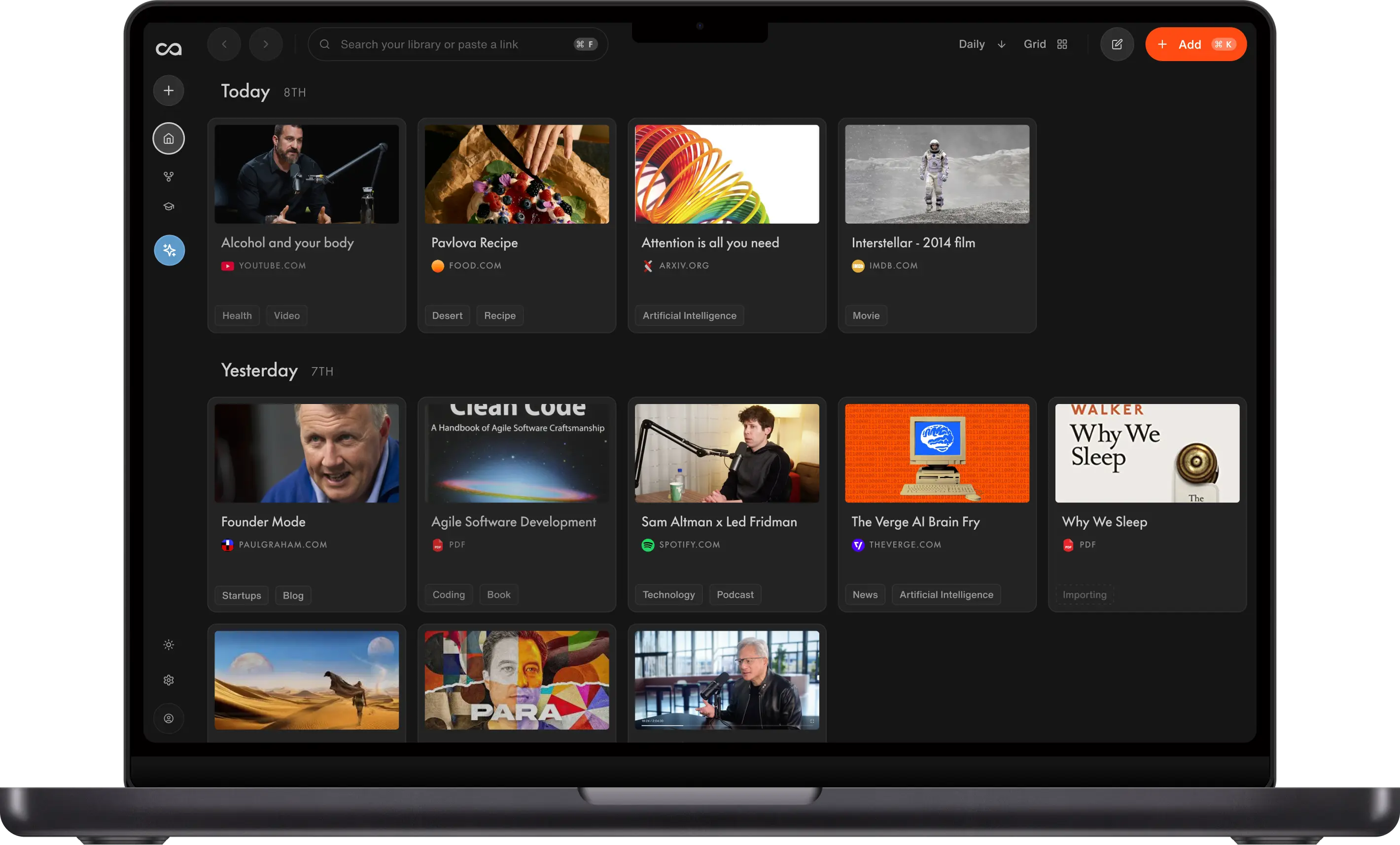
Choose Recall when research needs to compound. Recall is a personal AI knowledge base: it turns the sources you save into a connected library, then lets you use deep research and chat with that library, the web, or both. You can choose leading AI models for the task without moving your knowledge to a new chatbot.
The strongest overall replacement is Recall plus Claude via Recall MCP. Perplexity is excellent at finding new web sources. Recall keeps the sources you trust. Claude is the reasoning and writing layer. Together, you can discover, save, and then write from durable context instead of starting another blank search. Perplexity remains the better pick for quick, disposable open-web searches where citations are the whole job.
What to use when
- Recall if answers should be grounded in your saved articles, videos, PDFs, podcasts, notes, and trusted research, with deep research and model choice.
- Use Recall + Claude if you want the best overall replacement: Recall stores the research, and Claude writes and reasons over it through Recall MCP.
- ChatGPT if you want a polished, broad general AI assistant for research, drafting, brainstorming, analysis, voice, and everyday tasks.
- Claude if the research needs to become careful reasoning, long-form writing, document analysis, or an agentic workflow.
- Google Gemini if your documents, email, calendar, Android device, and work habits already live in the Google ecosystem.
- NotebookLM if you want answers tied to a small, defined set of project sources you upload or select.
- Microsoft Copilot if the useful context is in Word, Excel, PowerPoint, Outlook, Teams, and Microsoft 365.
- Grok if the question depends on real-time X conversations, trends, or social context.
- Perplexity if you need a quick answer from the open web with visible citations and do not need a lasting research library.
Get started with Recall for free
See why Recall is the best Perplexity alternative: research grounded in your saved library, with deep web research and the AI model you choose.
Best Perplexity alternatives compared (2026): ranked by context source, how answers compound, AI features, and the main tradeoff.
| Alternative | Best for | Context source | How answers compound | AI features | Main tradeoff |
|---|---|---|---|---|---|
| Recall | Personal AI knowledge base | Saved articles, videos, PDFs, notes | Summaries, graph, and chat across the library | Summaries, chat across sources or the web, and MCP | Needs a save habit; not the fastest disposable search |
| ChatGPT | Broad general AI | Chat, uploads, and web | Memory and custom GPTs, then context fades | General chat, uploads, web, and custom GPTs | Weak as a durable knowledge base |
| Claude | Reasoning, writing, and long documents | Chat, Projects, and uploads | Projects and artifacts carry work forward | Long-context reasoning, Projects, and artifacts | Not a lasting personal library |
| Google Gemini | Google Workspace and multimodal work | Google files, uploads, and web | Context stays inside Google Workspace | Google Workspace AI and multimodal chat | Weak outside Google files |
| NotebookLM | One bounded research project | Sources you define | Answers stay inside one notebook | Chat, study guides, and audio overviews in one notebook | Not a growing personal archive |
| Microsoft Copilot | Microsoft 365 work | Microsoft apps and web | Context stays inside Microsoft 365 | Copilot inside Microsoft 365 | Weak outside Office files |
| Grok | Real-time X context and trends | X and the live web | Fresh trends, not your saved sources | Real-time X and web chat | Useful now, not a lasting library |
| Perplexity | Fast open-web research with citations | Open web | New searches, not a compounding archive | Cited open-web answers | Does not build a personal library |
Scroll horizontally on small screens. Verify current plan limits and pricing on each vendor's site.
Best overall setup: Recall + Claude
The best overall Perplexity replacement is not another search box, it is a stack. Perplexity is excellent at discovering web sources. Pair Recall, your personal AI knowledge base, with Claude as the reasoning and writing layer. Recall MCP connects the two so Claude can work from sources you already saved and trust.
Perplexity answers from the open web, then the thread ends. Recall keeps the articles, videos, PDFs, and notes you decide are worth saving. Claude is strong at turning that material into careful writing, long-document analysis, and multi-step work. Together they give you discovery that compounds, plus stronger execution than a single research chat.
Why Recall + Claude is the best overall Perplexity alternative:
- Useful sources become a durable library instead of a disposable search thread.
- You can chat across saved sources, the web, or both inside Recall.
- Claude can reason and write from context you actually trust.
- Recall MCP makes the same library available to Claude, ChatGPT, Cursor, and other compatible assistants.
- You separate the knowledge layer from the model layer, so you are not locked into one chatbot.
Pricing: Recall is free to start, with Plus from about $10/mo on annual billing. Claude is free to use, with Pro from $20/mo. See Recall pricing for current plans.
Knowledge type: Your saved library in Recall, plus Claude's prompt, Projects, and tools.
How answers compound: Recall keeps sources durable; Claude carries the work forward through Projects, artifacts, and MCP. Tradeoff: it is a two-tool workflow. If you only need a fast cited web answer, Perplexity is simpler.
Perplexity vs Recall + Claude: Perplexity gives you one research chat with citations. Recall + Claude separates the jobs: Recall holds the knowledge you trust, and Claude reasons over it through Recall MCP, so later writing and research can reuse the same sources.
The rest of this guide ranks the best Perplexity alternatives as individual tools, starting with Recall.
What is Perplexity?
Perplexity is an AI answer engine that searches the web, synthesizes an answer, and shows linked sources alongside its claims. It sits between a search engine and a general chatbot: you ask a natural-language question, then use the citations to open and assess the underlying pages.
Main features of Perplexity
- Web-first answers: It is designed to find current information from the open web rather than answer from chat history alone.
- Linked citations: Sources are visible with the response, making it easier to verify claims and continue the research.
- Follow-up research: You can refine a question in the same thread instead of starting another search from scratch.
- Focused search modes: Depending on the plan and product version, you can narrow research toward particular source types or workflows.
- Model options on paid plans: Perplexity can offer access to different frontier models for research tasks.
Perplexity use cases
Perplexity is especially useful for:
- Fast fact checks: Finding an answer and the pages behind it quickly
- Market and competitor scans: Discovering current companies, products, announcements, and comparisons
- Source discovery: Building an initial reading list on an unfamiliar subject
- Current events: Researching information that changes faster than a static knowledge base
- Citation-led briefings: Producing a short answer that a reader can audit through links
Perplexity limitations and why people seek alternatives
- The source set is mostly the open web: It is less useful when your best evidence is your own saved library, private notes, or a curated long-term archive.
- Research can be disposable: A useful search thread does not automatically become an organized, reusable knowledge system.
- Citations still need judgment: A linked source is not automatically authoritative, current, or representative.
- Limited workplace context: The answer engine is not the same as working directly inside Google Workspace or Microsoft 365.
- Not every task is research: Long-form writing, analysis, coding, and workflow automation can benefit from an assistant optimized for those jobs.
Why personal context matters
Everyone can ask Perplexity the same question and get a similar cited answer from the open web. The edge is no longer who has access to a research chatbot. It is whose context the answer can see.
Open-web context is not neutral. Tinuiti's Q1 2026 AI Citation Trends Report found that Reddit alone accounted for about 24% of all Perplexity citations in January 2026. That is useful when you want public consensus. It is a weak default when the answer should come from what you already read, saved, and verified: the paper you trusted, the video you finished, the notes you wrote, the contradictions you already resolved.
Personal context matters in research because:
- The open web is shared. Anyone can run the same Perplexity search. Your saved library is not shared.
- Cited is not the same as trusted. A linked source can still be popular, outdated, or off-topic. Your keepers are sources you chose.
- A search thread is disposable. The useful pages from yesterday's query do not automatically answer next month's question.
- "What did I already learn?" is a different job from "What does the internet say?" Discovery still matters. Compounding needs a personal AI knowledge base.
This is why Recall ranks first on this list. Perplexity is still the faster tool for a one-off cited search. Recall is the personal AI knowledge base that keeps the sources you trust, then lets you research from that library, the web, or both.
7 best Perplexity alternatives in detail
1. Recall
Recall is best for: people who want a personal AI knowledge base so research starts from saved, trusted sources, not a fresh open-web search every time.
Recall is a personal AI knowledge base for the material you read, watch, and want to use again. That personal context is the point: the next answer can start from sources you already chose, instead of whatever the open web ranks today. Save articles, YouTube videos, podcasts, PDFs, newsletters, web pages, and notes; Recall summarizes and connects them, then makes the library searchable and chat-ready. When you need new information, you can also chat with the web, or combine web research with your saved context.
Recall features:
- Capture-first research library: Save web pages, videos, PDFs, podcasts, and notes into one long-term library.
- AI summaries on save: Turn a source into a useful starting point before you forget why it mattered.
- Library-grounded chat: Ask questions across one item, a focused collection, or your broader saved knowledge.
- Deep research with durable context: Use the research you have already vetted as part of the next answer instead of rebuilding context from scratch.
- Model choice: Use leading AI models on the same library, choosing the model that fits research, writing, or reasoning.
- Automatic organization and review: Find related content through semantic search, connections, and spaced repetition.
Recall pricing: Recall has a free tier with unlimited saves and limited AI usage. Recall Plus starts from about $10 per month on annual billing. See Recall pricing for current plans.
Knowledge type: Saved articles, videos, podcasts, PDFs, and notes, plus the live web when you want it.
How answers compound: Summaries, connections, and library-wide chat make trusted sources answer later questions. Tradeoff: it is most useful once you have a save habit, and it is not the fastest disposable web search.
Recall vs Perplexity: Perplexity is better for a fast, cited answer from the open web. Recall is better when the answer should build on material you have already saved and trust, while still giving you the option to research the web. A practical workflow is to discover sources with Perplexity, save the useful ones in Recall, then use Recall to connect them with the rest of your library over time.
Go deeper: Full Perplexity alternative comparison: Recall vs Perplexity
2. ChatGPT
ChatGPT is best for: people who need one broad assistant for research, drafting, brainstorming, analysis, coding help, and everyday questions.
ChatGPT from OpenAI is a general-purpose AI assistant rather than a search-first answer engine. It can help research topics, work with uploads, draft documents, analyze information, and continue a collaborative conversation across many types of tasks. Its value is breadth: it can take you from a question to an outline, a spreadsheet analysis, a draft, or a plan in the same workspace.
ChatGPT features:
- General AI chat for writing, analysis, coding, and planning
- Web search and research capabilities in supported experiences
- File uploads and data analysis
- Voice and multimodal features on supported plans
- Custom GPTs and project-style organization
ChatGPT pricing: ChatGPT offers a free tier. Paid personal plans typically start around $20 per month, with separate business and enterprise offerings.
Knowledge type: Chat, uploads, memory, and web search.
How answers compound: Memory and custom GPTs help across chats, then context still fades. Tradeoff: it is weak as a durable knowledge base of what you read and saved.
ChatGPT vs Perplexity: Perplexity is more purpose-built for web research with citations. ChatGPT is more flexible for turning research into work, such as drafting, analysis, brainstorming, and working with files. Choose Perplexity when source visibility is the priority; choose ChatGPT when you need a general assistant after or alongside the search.
3. Claude
Claude is best for: turning research into careful reasoning, strong long-form writing, document analysis, and complex workflows.
Claude from Anthropic is a capable general AI assistant with a strong fit for long documents and thoughtful, iterative work. Claude Projects can keep related material together, and its artifact and workflow features make it useful for moving from research to a report, plan, prototype, or repeatable process.
Claude features:
- Long-context document reading and analysis
- Strong drafting, editing, and structured reasoning
- Projects for keeping a recurring body of work together
- Artifacts for working with documents, code, and structured outputs
- Agentic and tool-use workflows in supported plans and environments
Claude pricing: Claude has a free tier, with Pro typically starting around $20 per month. Higher-usage and team plans are also available.
Knowledge type: Chat, Projects, uploads, and connected tools.
How answers compound: Projects, artifacts, and tool use carry work forward inside Claude. Tradeoff: that context is not a lasting personal library unless you add one.
Claude vs Perplexity: Perplexity is faster for discovering web sources and showing citations. Claude is stronger when the hard part is reasoning through a large source packet, writing a nuanced document, or completing a multi-step workflow. For reusable personal context, connect Claude to a Recall library through Recall MCP.
4. Google Gemini
Google Gemini is best for: people who work in Gmail, Docs, Drive, Calendar, Android, and Google Search.
Gemini is Google's general AI assistant. It is particularly useful when your research and work already live in Google's ecosystem, because the practical value comes from the surrounding tools and multimodal inputs, not only from a standalone answer window.
Google Gemini features:
- Google ecosystem and Workspace integrations on eligible plans
- Multimodal text, image, and file workflows
- Google-native research and document assistance
- Useful Android and Google app integration
- Free access with higher limits and features on paid plans
Google Gemini pricing: Gemini has free access, while advanced capabilities and higher limits are available through paid Google plans. Pricing varies by country and bundle.
Knowledge type: Google files, uploads, and the live web.
How answers compound: Context stays useful inside Google Workspace. Tradeoff: it is weaker when the sources that matter live outside Google files.
Google Gemini vs Perplexity: Perplexity is the cleaner choice for a cited open-web answer. Gemini is the stronger fit when the research needs to flow into Google Docs, Drive, Gmail, or Android workflows. It is also useful when multimodal input matters as much as source discovery.
5. NotebookLM
NotebookLM is best for: studying or researching a defined source collection for one project.
NotebookLM is a source-grounded AI notebook from Google. You add the documents, links, transcripts, and other materials relevant to a project, then ask questions against that defined corpus. It is useful for a course, a client brief, a legal packet, a manuscript, or a tightly scoped research assignment.
NotebookLM features:
- Answers grounded in a source set you choose
- Citations back to the selected materials
- Project-oriented notebooks for keeping research separate
- Summaries, study aids, and source synthesis
- Google-native workflows and higher limits on eligible paid plans
NotebookLM pricing: NotebookLM is free to use with limits. Higher limits may be available through Google AI plans.
Knowledge type: A source set you upload or select for one project.
How answers compound: Answers stay grounded in that notebook. Tradeoff: it is not a growing personal archive across years.
NotebookLM vs Perplexity: Perplexity searches broadly across the current web. NotebookLM answers from the sources you explicitly provide. Use NotebookLM when the boundaries of the research are important. Use Recall instead when you want one growing library across many projects and subjects, rather than separate project notebooks.
6. Microsoft Copilot
Microsoft Copilot is best for: research and AI assistance inside Microsoft 365 and Windows.
Microsoft Copilot is most useful when it can work in the apps where the work already happens: Outlook, Word, Excel, PowerPoint, Teams, Edge, and Windows. Rather than replacing an open-web research tool, it helps turn business context and documents into emails, presentations, meeting follow-ups, and analyses.
Microsoft Copilot features:
- Microsoft 365 integration on eligible business plans
- Assistance in Word, Excel, PowerPoint, Outlook, and Teams
- Enterprise controls for Microsoft-centered organizations
- Web and workplace-context assistance
- Windows and Edge integration
Microsoft Copilot pricing: A free consumer experience is available. Copilot Pro and Microsoft 365 business offerings have separate pricing, eligibility, and feature sets.
Knowledge type: Microsoft 365 apps, files, and the web.
How answers compound: Context stays useful inside Microsoft 365. Tradeoff: it is weaker when the sources that matter are articles, videos, and PDFs you saved yourself.
Microsoft Copilot vs Perplexity: Perplexity is usually better for independent open-web research with citations. Copilot is better when the useful context is already in Microsoft 365 and the goal is to act on it inside the Microsoft tools your team uses.
7. Grok
Grok is best for: questions shaped by real-time X conversation, trends, current events, and social context.
Grok from xAI is a general AI assistant with a distinct advantage when the conversation on X is part of the evidence. That can be useful for monitoring fast-moving news, product reactions, public discussion, and emerging topics where traditional web pages lag behind the live conversation.
Grok features:
- Real-time X context in supported experiences
- Live-web and current-event orientation
- General chat, writing, and question answering
- Direct, conversational response style
- Access through Grok and some X plans, depending on availability
Grok pricing: Availability, free access, and paid limits vary. Some X Premium tiers include access to Grok features.
Knowledge type: X conversations and live web context.
How answers compound: Fresh public signal. Tradeoff: useful now, not a lasting library of what you already trusted.
Grok vs Perplexity: Perplexity is better for a research trail of linked web sources. Grok is more useful when the important evidence is happening on X right now. Neither replaces a durable personal research library, so save the sources and conclusions you want to reuse in Recall.
Best Perplexity alternative by use case
Best Perplexity alternative for research from your own sources
- Recall for a growing library of saved web content, PDFs, videos, and notes, plus deep research and model choice.
- NotebookLM for one tightly bounded project source set.
- Claude for analyzing a large packet of documents after you have assembled it.
Choose Recall when your research should become reusable knowledge across projects. Choose NotebookLM when the project has a fixed, deliberately limited corpus. Choose Claude when the main challenge is reasoning and writing from long documents.
Best Perplexity alternative for general AI work
- ChatGPT for the broadest everyday assistant experience.
- Claude for long-form writing and reasoning.
- Google Gemini for Google-native tasks and multimodal work.
Choose ChatGPT when you want a flexible assistant that can research, draft, analyze, and brainstorm in one place. Choose Claude for more deliberate long-context work. Choose Gemini when Google Workspace and Android are central to your workflow.
Best Perplexity alternative with citations from selected sources
- NotebookLM for a defined, project-level source set.
- Recall for a long-term library of sources you save and trust.
- Perplexity for fresh citations from the open web.
The important distinction is source control. NotebookLM starts from a corpus for one project. Recall starts from a personal library that can grow for years. Perplexity starts from the broader web, which is ideal when discovery matters more than maintaining a source collection.
Best Perplexity alternative for workplace research
- Microsoft Copilot for Microsoft 365.
- Google Gemini for Google Workspace.
- Recall for preserving valuable external research beyond the workplace suite.
Choose the assistant that lives beside the documents and communications your organization already uses. Use Recall alongside it when web research, articles, videos, and PDFs should remain part of a portable personal knowledge base instead of being scattered across chat threads.
Bottom line
The strongest overall setup is Recall plus Claude: Recall stores the sources you trust, and Recall MCP lets Claude write and reason from that library. Recall is the best single Perplexity alternative when research needs to be grounded in the library you have built from articles, videos, PDFs, and notes, while still letting you conduct deep research on the web and choose the best model for the task. ChatGPT and Claude are better for broad general AI and turning research into finished work. NotebookLM is excellent for a bounded source pack. Gemini and Microsoft Copilot make the most sense inside their respective workplace ecosystems, and Grok fits real-time X context.
When to keep Perplexity
Keep Perplexity when:
- Fast, current open-web research is the whole job
- You need to see linked citations beside the answer immediately
- You are discovering sources on a topic you do not already have in your library
- You want a quick market scan, fact check, or reading list without maintaining a research workspace
- The answer is a one-off, and you do not need it to compound into long-term knowledge
Use a Perplexity alternative when the answer needs personal context, a curated project corpus, workplace files, stronger writing and reasoning, or real-time social context.
FAQs
Best Perplexity alternative by use case
How to choose a Perplexity alternative
About Perplexity
When to choose each alternative
See more tools on the Recall comparison hub or the full comparison table.
Ready to get started?
Save, summarize and chat with your content.
No credit card required · 30 Day Refund on Premium · 24 Hour Support