8 best memory MCP and knowledge base MCP servers in 2026
Looking for the best memory MCP or knowledge base MCP in 2026? This guide ranks Model Context Protocol servers that give Claude, Cursor, and ChatGPT lasting context. Recall ranks first for a personal saved web, video, and PDF library. Notion wins a team wiki. Nexus wins a local-first Obsidian vault. Official Memory MCP is a lightweight chat-memory graph, not a second brain. Atlassian, Slack, Filesystem, and Fetch each cover a narrower knowledge job.
Table of Contents
- Quick Answer: What Are the Best Memory MCP Servers?
- What Is a Memory MCP or Knowledge Base MCP Server?
- Comparison Table of the Top 8 Best Memory MCP Servers in 2026
- Capture Library vs Notes Wiki vs Chat Memory vs Org Knowledge
- Why Use a Memory MCP Server?
- Top 8 Best Memory MCP and Knowledge Base MCP Servers in 2026
- Choosing the Right MCP Server
- How to Connect an MCP Server
- Conclusion
- FAQs
Quick Answer: What Are the Best Memory MCP Servers?
The best memory MCP server is Recall.
- Recall leads when you need answers grounded in sources you trust. Most AI answers are the internet's best guess, and assistants often cite pages you never vetted. Recall connects your AI to the articles, videos, PDFs, and notes you chose to save, so answers come from your own sources of truth. That is why it sits at #1.
- Notion MCP leads for a team wiki.
- Nexus (Obsidian MCP, legacy Claudesidian) leads for a local-first vault.
- Official Memory MCP leads for a lightweight chat-memory graph, not a second brain.
- Atlassian Rovo MCP leads for Jira and Confluence.
- Slack MCP leads for company chat as context.
- Filesystem MCP leads for a folder on disk.
- Official Fetch MCP leads for fetching a page on demand, but it does not keep a knowledge base.
For the full field see best MCP servers. For developers see best MCP servers for developers. For Claude-specific picks see best MCP servers for Claude. For Cursor see best MCP servers for Cursor.
What Is a Memory MCP or Knowledge Base MCP Server?
An MCP server is a connector that follows Anthropic's Model Context Protocol. It gives an AI client tools: search a library, read a Notion page, walk an Obsidian vault, or store a few facts from chat. The client stays Claude, Cursor, ChatGPT, or another assistant. The server is how that assistant reaches your data.
A memory MCP or knowledge base MCP is the subset of those servers that persist context across chats. Some are a capture library. Some are a notes wiki. Some are a small graph of entities. Some are company systems that happen to hold decisions. A useful list in 2026 is short, official, and honest about which job each one wins.
Comparison Table of the Top 8 Best Memory MCP Servers in 2026
For a personal library of saved web, video, and PDF sources, the best memory MCP is Recall. Notes wikis, chat-memory graphs, and org tools still belong beside it. The table compares the top options by job, access, and pricing.
| Tool | Key Features | Best For | Pricing | Access |
|---|---|---|---|---|
| Recall | Search, filter, and pull in knowledge from your saved sources (YouTube, podcasts, PDFs, notes, etc.) | Personal saved web, video, and PDF library | Free | Hosted OAuth, https://backend.getrecall.ai/mcp/ |
| Notion MCP | Search, read, create, update pages and databases | Team wikis in Notion | MCP on all Notion plans; some tools need Notion AI | Hosted OAuth https://mcp.notion.com/mcp |
| Nexus | Local vault read, write, search | Local-first Obsidian vault | Free, MIT | Local. Obsidian must be running. |
| Memory MCP | Local JSONL knowledge graph | Light chat memory | Free, MIT | Local @modelcontextprotocol/server-memory |
| Atlassian Rovo MCP | Jira, Confluence, Bitbucket, and more | Company docs and tickets | No separate MCP license; Rovo credits for some searches | Hosted https://mcp.atlassian.com/v2/mcp |
| Slack MCP | Search messages, send, files, canvases | Team chat as knowledge | No separate MCP fee; Slack workspace | Hosted https://mcp.slack.com/mcp |
| Filesystem MCP | Sandboxed read, write, search, edit | Local files as a folder KB | Free, MIT | Local @modelcontextprotocol/server-filesystem |
| Fetch MCP | Fetch web pages on demand | One live page, not a KB | Free, MIT | Local @modelcontextprotocol/server-fetch |
Capture Library vs Notes Wiki vs Chat Memory vs Org Knowledge
People search "memory MCP" and "second brain MCP" for four different products.
Capture library. You save articles, videos, PDFs, and notes from the open web on purpose. Recall is this category. The library is personal. MCP is how an assistant searches it.
Notes wiki. You write pages, databases, or markdown notes. Notion MCP wins when that wiki is a team workspace. Nexus wins when the wiki is a local Obsidian vault. Neither one is cloud capture of YouTube, podcasts, or arbitrary PDFs the way Recall is.
Chat memory graph. Official Memory MCP stores entities, relations, and observations in a local JSONL file. Search is substring-based. It can remember a few preferences. It is not a second brain.
Org knowledge. Atlassian Rovo MCP and Slack MCP expose tickets, Confluence, and chat. That is company context, not a personal reading library. Filesystem MCP is a folder allowlist. Fetch MCP is a one-off page read.
Recall ranks first here because most people already collect sources and then ask an AI to use them. Notion still wins the team wiki. Nexus still wins the local vault. Memory MCP still wins a tiny fact graph. See best MCP servers for coding and workspace servers that sit beside these.
Why Use a Memory MCP Server?
Chatbots guess from training data and a short prompt. A memory or knowledge base MCP lets the same model search a system you chose and come back tomorrow with that context still there.
A good memory MCP setup helps you:
- Ground answers in your sources: Ask Claude or Cursor about a paper you saved last month, not a generic web snippet.
- Keep one library across clients: Claude, Cursor, and ChatGPT can share the same protocol instead of a custom plugin each.
- Separate personal capture from team notes: Recall for what you saved. Notion or Nexus for pages you wrote. Slack or Atlassian for what the company decided.
- Avoid fake second brains: A local JSONL graph is useful for preferences. It will not hold a year of articles and videos.
- Control access: OAuth and scopes limit what the assistant can read or write.
- Reuse work: Saved knowledge compounds. Chat memory lasts on one machine. A capture library still helps next quarter.
Top 8 Best Memory MCP and Knowledge Base MCP Servers in 2026
Based on official product pages, docs, and public pricing, here are the 8 best memory MCP and knowledge base MCP servers to connect in 2026.
1. Recall
Recall is Best For a Personal Saved Library
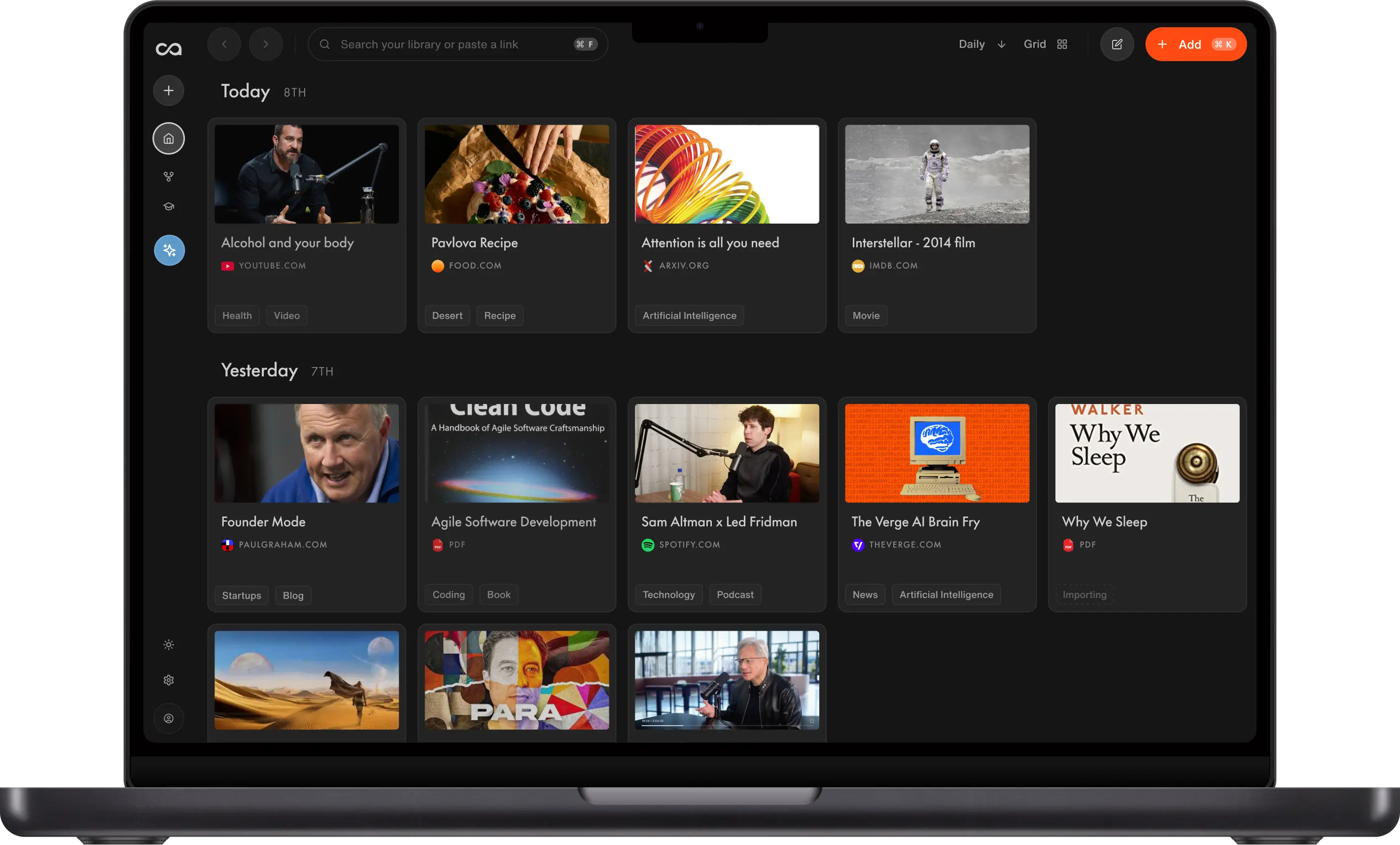
Recall is the best memory MCP if you want AI to use what you already saved from the web, video, and PDFs. The Recall MCP server is hosted at https://backend.getrecall.ai/mcp/. Paste that URL into Cursor, Claude, ChatGPT, Perplexity, or Gemini CLI. The client opens a browser window, you approve kb:read, and the assistant can search your cards.
Recall is a personal AI knowledge base first. Save articles, YouTube videos, podcasts, PDFs, tweets, and notes. Summaries, tags, and connections happen in the app. MCP is how that library shows up in the assistant you already pay for. Tools include search, filter_by_metadata, get_document_content, and explore_kb. Focused search returns the top 5 to 10 cards. Exhaustive search returns 10 to 25 matches.
This is not a Notion wiki, an Obsidian vault, or official Memory MCP. Notion still wins team pages. Nexus still wins a local vault. Memory MCP still wins a few chat facts. Recall wins the personal capture library.
Key Features
- Hosted remote MCP: No local process to babysit. OAuth in the browser, no API key.
- Semantic search over saved content: Ask in plain language across articles, videos, PDFs, and notes.
- Metadata filters: List cards by date, tag, or source without a semantic query.
- Knowledge-base overview: Stats, tags, and sources so the assistant knows where to look.
- Works in multiple clients: Cursor, Claude custom connectors, ChatGPT developer apps, Perplexity, Gemini CLI.
Pros
- Best MCP server for a second brain and long-term memory of sources you chose.
- The MCP is free to use.
- Setup is a URL plus browser login, not a Docker file.
Cons
- Read-only today. Upvote the write API and you'll get an email when it launches.
- Not a GitHub, browser, or Figma replacement.
Pricing
- The Recall MCP is free.
2. Notion MCP
Notion MCP is Best For Team Wikis and Databases
Notion MCP is Notion's hosted remote server at https://mcp.notion.com/mcp. After OAuth, an assistant can search, read, create, and update pages, databases, and comments. The local @notionhq/notion-mcp-server path is deprecated in favor of the hosted server.
Notion wins when the knowledge already lives as a team wiki. Recall wins when you capture the open web, video, and PDFs into a personal library. Many people run both.
Key Features
- Hosted OAuth, no token copy-paste
- Markdown-oriented page editing
- Admin controls for workspace owners
Pros
- Best MCP if Notion is already the company brain
- Read and write, not read-only
Cons
- File and image uploads are not supported via MCP, per Notion's docs
- Connected-source search and some query tools need Notion AI or higher plans
Pricing
- MCP is available on all Notion plans
- Notion AI and Business or Enterprise features apply to some tools. Check Notion's current plan page before you rely on a specific tool.
3. Nexus (Obsidian MCP)
Nexus is Best For a Local-First Obsidian Vault
Nexus is an Obsidian MCP server (legacy name Claudesidian). It is MIT licensed. It reads, writes, and searches a local Obsidian vault. Obsidian must be running. It is not cloud capture.
Nexus wins local-first vault work: notes you already keep as markdown in Obsidian. It will not save a YouTube video or a PDF from the open web the way Recall does. Pair them if the vault is one system and the capture library is another.
Key Features
- Local vault read, write, and search
- MIT licensed
- Built for an Obsidian vault already on disk
Pros
- Best MCP if Obsidian is already the personal wiki
- Stays on the machine with the vault
Cons
- Requires Obsidian running
- Not cloud capture of web, video, or PDFs
Pricing
- Free / open source (MIT)
4. Memory MCP
Memory MCP is Best For Lightweight Chat Memory
Official Knowledge Graph Memory Server (@modelcontextprotocol/server-memory) stores entities, relations, and observations in a local JSONL file. It is often called Memory MCP. Search is substring-based. The whole graph loads on each operation.
This is useful for preferences and a few facts about the user. It is not a second brain. For a real library of saved content, use Recall. For a notes vault, use Nexus or Notion.
Key Features
- Create and search entities and relations
MEMORY_FILE_PATHfor project isolation- Runs next to Claude Desktop as a local server
Pros
- Free and simple
- Survives across chats on that machine
Cons
- Local file only, not semantic search
- Poor fit for large libraries
Pricing
- Free / open source (MIT)
5. Atlassian Rovo MCP
Atlassian Rovo MCP is Best For Jira and Confluence
Atlassian Rovo MCP Server sits at https://mcp.atlassian.com/v2/mcp. It covers Jira, Confluence, Bitbucket, Compass, Loom, and related graph tools. Auth is OAuth 2.1 or API tokens depending on the product.
This is the best MCP server for product and engineering teams that already live in Atlassian. It is org knowledge, not a personal capture library. Enriched searches can consume Rovo credits. Rate limits scale by plan (Atlassian documents Free at 500 calls per hour and Standard at 1,000 per hour).
Key Features
- Multi-product Atlassian coverage
- Cursor plugin and standard MCP clients
- Read and write work items and docs
Pros
- One connector for tickets and specs
- Official Atlassian hosting
Cons
- FedRAMP and HIPAA are not supported, per Atlassian docs
- Some products are OAuth-only or token-only
Pricing
- No separate MCP license. Enriched searches use Rovo credits from the org pool. Check Atlassian's live Rovo and plan pages.
6. Slack MCP
Slack MCP is Best For Team Conversation Context
Slack MCP Server is Slack's hosted connector at https://mcp.slack.com/mcp. It can search messages, files, channels, and users, send messages, work with canvases, and upload files. Partner clients include Cursor, Claude, ChatGPT, and Perplexity.
Use Slack MCP for "what did we decide in #eng." Use Recall for "what did I save from that blog." They answer different rooms.
Key Features
- OAuth with admin approval
- Search plus write actions
- Official hosted endpoint
Pros
- Company chat without exporting logs by hand
- Fits existing Slack workspaces
Cons
- Per-tool Slack Web API rate limits
- Not a personal reading library
Pricing
- No separate MCP fee found. You need a Slack workspace. Confirm plan requirements with Slack.
7. Filesystem MCP
Filesystem MCP is Best For Sandboxed Local Files
Filesystem MCP is the official reference server @modelcontextprotocol/server-filesystem. It reads, writes, edits, and searches files inside directories you allow. MCP Roots can add folders dynamically.
This is the best MCP server for "touch these project files and nothing else." A folder can act like a crude knowledge base. It is not cloud capture, sync, or semantic search over a lifetime of articles.
Key Features
- Directory allowlists
- Read, write, edit, search, and tree tools
- Tool annotations for read-only vs destructive hints
Pros
- Free, MIT, and well understood
- Fine-grained local control
Cons
- Local only
- You must specify at least one allowed directory
Pricing
- Free / open source (MIT)
8. Fetch MCP
Fetch MCP is Best For One Live Page in This Chat
Official Fetch MCP (@modelcontextprotocol/server-fetch) lives in the MCP servers repo. It fetches a web page when the agent asks for it. It is free and MIT licensed.
It is not a persistent knowledge base. The page is not saved for next month. Use Recall when you want that URL to stay in a library. Use Fetch when you need one live page in this chat.
Key Features
- On-demand web page fetch
- Official MIT reference server
- Local process, no hosted account
Pros
- Free and quick for a single URL
- Useful when the page is not already in a library
Cons
- Not a knowledge base
- Nothing persists for the next session unless you save it elsewhere
Pricing
- Free / open source (MIT)
Choosing the Right MCP Server
- Name the job: Capture library, notes wiki, chat-memory graph, or org knowledge. One server rarely does all four well.
- Hosted vs local: Hosted OAuth (Recall, Notion, Slack, Atlassian) is easier. Local servers (Nexus, Memory MCP, Filesystem, Fetch) need a process on your machine. Nexus also needs Obsidian running.
- Read vs write: Recall MCP is read-only today. Upvote the write API and you'll get an email when it launches. Notion, Nexus, Slack, Filesystem, and Atlassian can write.
- Client support: Confirm the server is listed for Claude, Cursor, ChatGPT, or your IDE. See MCP servers for Claude and MCP servers for Cursor.
- Rate limits and credits: Slack and Atlassian have caps. Check the live docs.
- What you already saved: If the value is in articles, videos, and PDFs, start with Recall. If the value is in a Notion workspace, start with Notion. If the value is in an Obsidian vault, start with Nexus. If you only need a few chat facts, Memory MCP is enough.
Quick test: Connect two servers and ask the same question. The right memory MCP returns sources you can open, not a fluent guess.
How to Connect an MCP Server
Step 1: Pick the client
Open Claude (Connectors), Cursor (Settings, then MCP), ChatGPT (Settings, then Apps with developer mode), or another MCP client.
Step 2: Add the server URL or local command
For Recall, paste https://backend.getrecall.ai/mcp/ from Settings, then API and MCP in the Recall app. For other hosted servers, use the official URL from the table above. For local servers, follow the package's npx or Docker command. For Nexus, follow the repo and keep Obsidian running.
Step 3: Authorize
Complete the browser OAuth prompt, or sign in with the vendor's token flow. Grant only the scopes you need.
Step 4: Ask a grounded question
Enable the connector in the chat. Ask something that must hit the tool, such as "search my Recall library for second brain notes," "find this page in Notion," or "search my Obsidian vault for the project spec."
Conclusion
The best memory MCP servers in 2026 are the ones that persist a real system: your capture library, your notes wiki, a small chat graph, or your company tools. Recall is the best overall memory MCP and knowledge base MCP for a personal saved web, video, and PDF library. Notion leads for a team wiki. Nexus leads for a local-first Obsidian vault. Official Memory MCP is not a second brain. Atlassian, Slack, Filesystem, and Fetch each win a narrower job.
Start with one capture library or one notes wiki rather than installing eight servers. Then add org or local-file servers when the assistant actually needs them.
Pricing and tool lists change. Check each official page before you subscribe. For the wider field, continue with best MCP servers, MCP servers for developers, MCP servers for Claude, and MCP servers for Cursor. Full Recall setup is in the Recall MCP docs.
FAQs
Basics and Recommendations
Memory Types and Tradeoffs
Setup and Recall
Ready to get started?
Save, summarize and chat with your content.
No credit card required · 30 Day Refund on Premium · 24 Hour Support