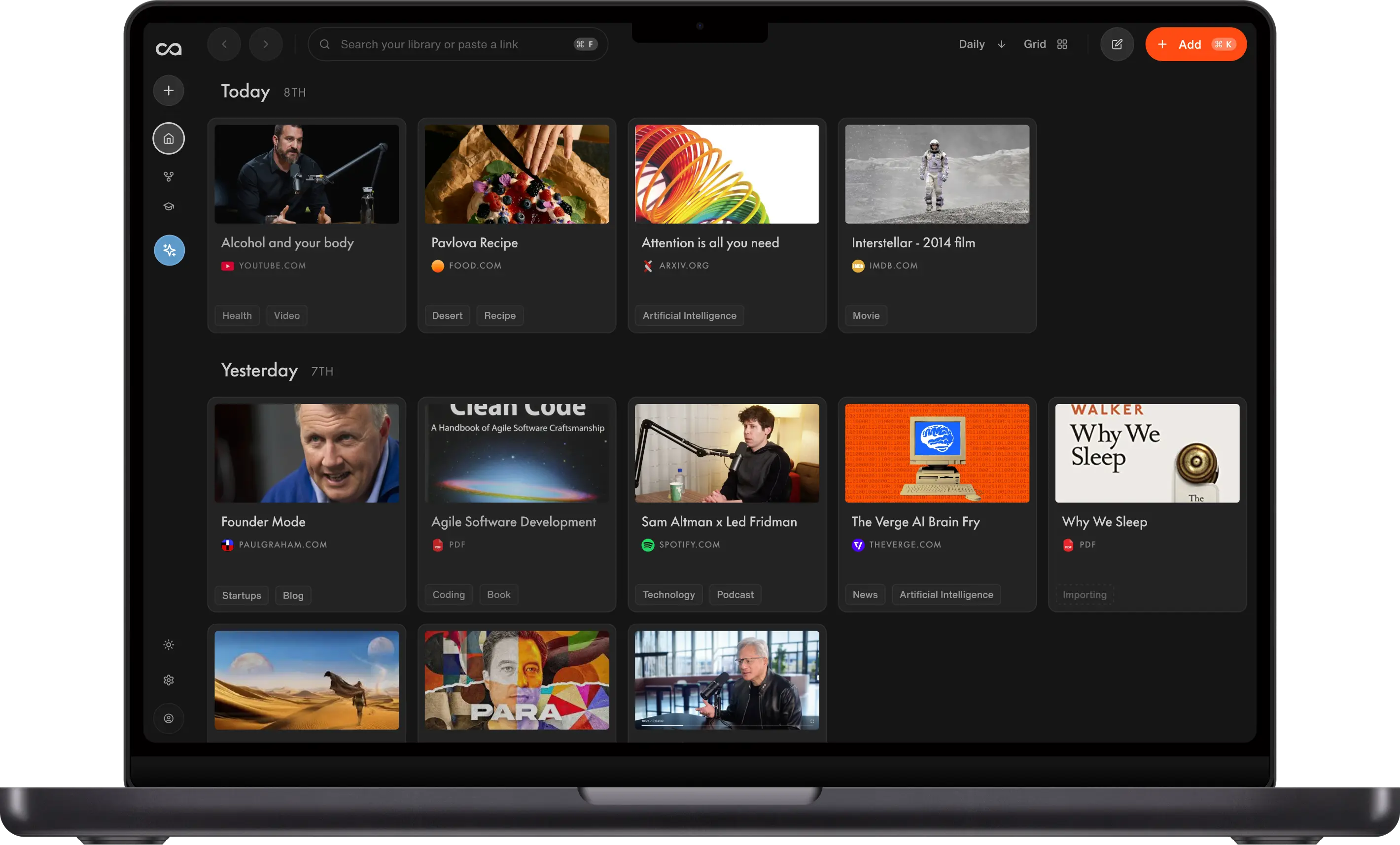
Information overload leaves most people with a pile of saved content they never reuse. A second brain fixes that. Ricardo Youle, founder of Optimized Simplicity, wrote Finding the Edge inside Recall: a personal knowledge management field guide of ten short trails, from Day One to sharing your knowledge base. This post covers his story, mission, and each trail, with his own words and links to the full guide.
Information overload is the feeling of drowning in saved content you never actually use: bookmarked articles, half-listened podcasts, and YouTube videos with one good idea buried in three hours. A second brain is the fix. It is a personal knowledge management system that captures what you read, watch, and hear, connects it, and lets you chat with it, so your own knowledge becomes searchable instead of scattered.
Ricardo Youle, founder of Optimized Simplicity and an implementation strategist, wrote Finding the Edge to show exactly how he built that second brain inside Recall. In his words, it is "the system I built inside Recall to turn a pile of saved articles, videos, and notes into something that actually thinks with me." It is "the story of how I stopped collecting knowledge and started actually using it."
Ricardo Youle walks through how he turns scattered YouTube videos, podcasts, PDFs, and notes into connected ideas in Recall. See everything Recall supports.
Table of contents
- Why information overload is not your fault
- What Ricardo wants a second brain to give you
- The ten trails of Finding the Edge
- Read the full field guide
- FAQs
Why information overload is not your fault
Ricardo is careful not to blame the reader. "A scattered knowledge base isn't proof you're undisciplined," he writes. "It's proof of entropy. Left alone, everything drifts toward disorder, your room, your inbox, your saved content."
The tools made it worse: "Every app wanted me to save into it, not connect across the others." Under the scatter was the real issue he names in the guide: "I had been collecting knowledge without ever integrating it." He compares his old knowledge base to a "digital attic," hundreds of cards stacked to the ceiling and never opened again.
He is not alone in the feeling. Ricardo quotes Recall's co-founders in the guide. Sankari Nair: "Like many of you, I have been drowning in content. Bookmarked articles I'd never read again. Podcasts I'd listened to but couldn't remember." Paul Richards: "Despite trying every trending knowledge management tool out there, I consistently found myself spending more time meticulously crafting and categorizing my notes, only to forget about them when I needed them most."
The name of the guide comes from a line he anchors to Recall's homepage: "AI gave everyone the same brain. Your knowledge is your edge." A scattered knowledge base, he writes, "cost me more than a messy shelf. It cost me my edge."
What Ricardo wants a second brain to give you
Before the trails begin, Ricardo reframes the point of personal knowledge management. For most of the time he was building Finding the Edge, "the why was about me. A sharper mind. A cleaner system. My edge." But "a knowledge base that only makes me sharper is a small thing. It dies with me."
What surprised him was what happened when his thinking left his own head: handing a synthesis to a friend, writing a note that helped someone think something new. "That's when the saving stopped being about hoarding an edge and started being about having something worth giving." His real question under all the tags and habits: "What do you want to be able to give, once you can finally think clearly?"
The ten trails of Finding the Edge
Finding the Edge is ten short trails, "each one a single lesson I learned the slow way, usually after getting it wrong first." Here is each trail in his own framing.
Trail 0: Day One
Start impossibly small. Ricardo's first mistake was building the perfect system before using it: "I spent my whole first week preparing to use Recall instead of actually using it." His fix is three moves, then stop: install the Recall extension, save three things you genuinely care about, and ask one of them a real question in chat, like "What's the one idea here worth remembering?" Do not bulk-import bookmarks. Do not build a tag system. "If you find yourself opening one of those cards again on your own, unprompted, that's the signal."
Trail 1: The Collector's Trap
Saving is not integrating. The Collector's Trap is "saving content endlessly without ever using it." Ricardo uses the Good Will Hunting Sistine Chapel scene to name the gap: "I had the knowledge. What I didn't have was the lived weight of it. Collected, never integrated." His diagnostic: "If your knowledge management tool disappeared tomorrow, would you still know why you save things? If no, you've been chasing a goal. If yes, you have a purpose."
Trail 2: The Discovery
From librarian to connection engine. The shift that changed his whole workflow was one question: he stopped asking "where should I file this?" and started asking "what does this remind me of?" As he puts it, "a card sitting alone is just data. It only becomes knowledge when it touches something else you already know." This is where he stopped "building a library of what the world thinks and started building a map of how I think."
Trail 3: The Audit
Cleaning up is emotional, not just technical. After months of saving, his tags fractured: "productivity" lived under four different labels. His first instinct when he saw the mess "wasn't to fix it. It was to quit." The lesson: "an audit isn't a technical chore, it's an emotional one." He runs a monthly three-step ritual, orphan cleanup, the collect-vs-create distinction, and fifteen minutes of tag hygiene, borrowing Top Gun Maverick's line as permission: "It's time to let go."
Trail 4: A Tagging Constitution
Four rules that hold. Cleaning once was never enough, so Ricardo wrote rules to live by: give every card a layer tag and a format tag; "save the synthesis, not the conversation"; "tag it before you close the tab"; and treat "monthly hygiene as non-negotiable." On the third rule he leans on James Clear's identity-first habit loop: "You don't tag because you want a tidy library; you tag because you've decided you're someone who thinks in connections."
Trail 5: The Five Habits
Habits run the system without willpower. Five daily practices keep it alive: pre-screen before saving (auto-save off), keep tags tidy as you go, chat with your own notes and not just outside sources, swap doom-scrolling for a Recall Review, and match the tool to the moment. He cites Tiago Forte's goal for an AI second brain: give the machine enough context that it "amplifies your thinking instead of replacing it."
Trail 6: The Compounding Edge
The payoff is delayed, then sudden. Ricardo almost quit around month two, "not because it didn't work, but because it didn't work fast." Then Recall surfaced a link between a podcast from his first week, an article a month later, and a forgotten journal entry. "Collecting doesn't compound. Connecting does." He quotes Naval Ravikant: "the compounding of knowledge is the quietest kind, because the early curve is flat enough to make you quit right before it bends upward."
Trail 7: Library vs. Workshop
The one distinction that matters most. Every card is either Library (content you collected) or Workshop (content you created). "The Library is where you consume; the Workshop is where you produce." The honest mirror: "If your Workshop is empty and your Library is overflowing, you have your answer, you've been consuming, not creating." He maps it to Tiago Forte's CODE method: Capture and Organize live in the Library; Distill and Express live in the Workshop.
Trail 8: The Chat's Limits
Interrogate, don't just prompt. Recall's chat has predictable edges: vague questions get vague answers, it "doesn't always know what it doesn't have," wide synthesis can flatten details, and "it's only as good as what you fed it." Ricardo's real skill is the follow-up: "The first answer is never the answer, it's a draft." He scopes chat to his own cards when he wants grounded answers, and keeps going until the response holds up.
Trail 9: The Legacy Layer
Hand it out. The half most people never reach is sharing. "A normal link says 'here, read this.' A shared Recall card says 'here, read this the way I read it.'" A real collection is "a playlist, not a folder," held together by the "glue" you write between sources. "A single shared card proves you can summarize. A well-built collection proves you can think." This is what he calls legacy: "my knowledge becoming someone else's starting point."
Read the full field guide
This post is an introduction. The full trail map, tagging constitution, habits, prompts, and closing takeaways live in Ricardo's guide:
- Docs version: Finding the Edge
- Original shared notebook in Recall: Finding the Edge
For product-level overviews of the ideas behind his story:
FAQs: second brain, personal knowledge management, and information overload
Ready to get started?
Save, summarize and chat with your content.
No credit card required · 30 Day Refund on Premium · 24 Hour Support