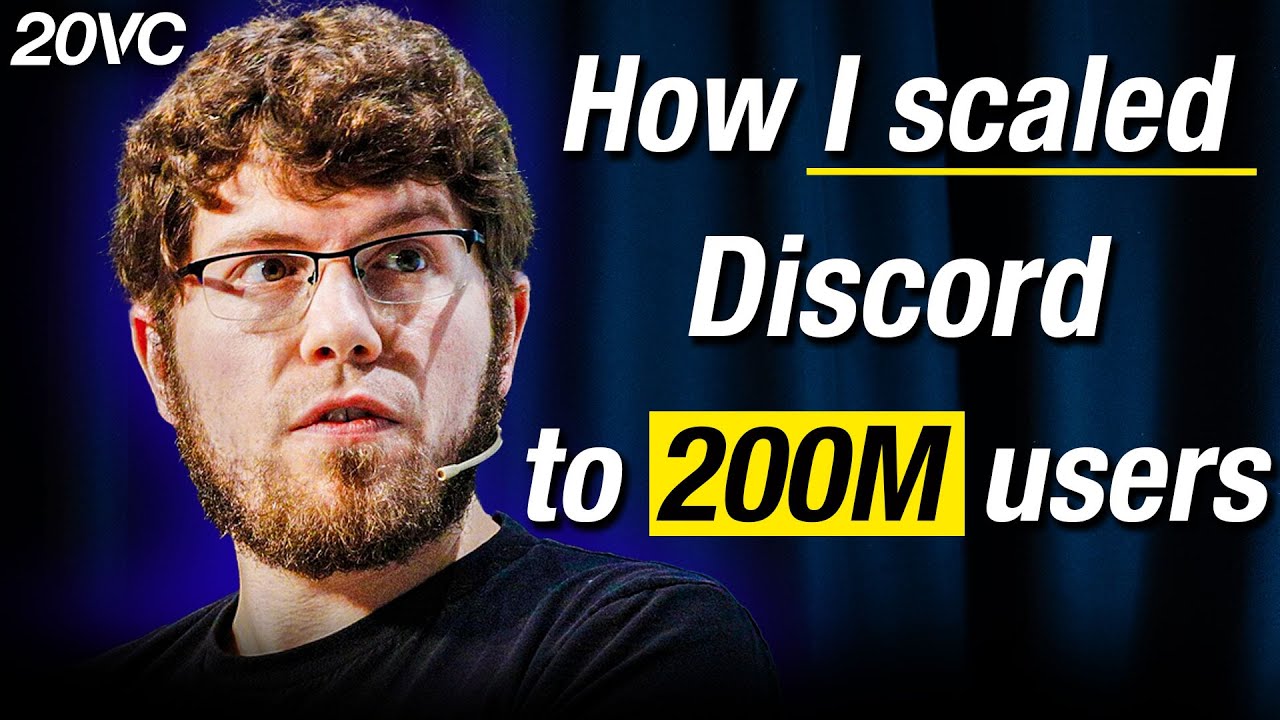


Intro 0s
- Jason Citron, Co-Founder and CEO of Discord, experienced a period of rapid growth from 200 to 1,000 employees in 2.5 years, during which he made the most management mistakes at the company 7s.
- During this time, Jason hired a bunch of executives, set the vision, and delegated work to them, but everything came to a halt 13s.
- Certain words, such as "empowerment," "alignment," and "ready to go," trigger Jason and are shadows of this period 20s.
- The host is excited to have Jason on the show, having heard good things about him from Danny Rhymer at Index 36s.
- Jason is grateful to be on the show, and the host mentions that he has interviewed around 800 of the best CEOs over the last 10 years 41s.
- The host notes that there is a commonality amongst many of the CEOs he has interviewed 50s.
How Gaming Skills Translate to Leadership 51s
- Gaming skills can be good preparation for CEO leadership as games provide a sandbox environment where players encounter challenges, try to solve them, fail, and learn from their mistakes, fostering a growth mindset 53s.
- Playing games with friends and others teaches important skills such as cooperation, task division, leadership, and being a good follower or winner, all of which are essential in real-life situations 1m30s.
- Games offer a safe space to learn and practice these skills, which can be translated to running a company, as they allow players to repeat and learn from their experiences without realizing they are acquiring new skills 1m58s.
- The levels in games, which get progressively harder, can be compared to the challenges of company building, with each level bringing new and different challenges that require constant problem-solving and adaptation 2m19s.
- As a CEO and founder, Jason Citron faces new and challenging dynamics at each level of company growth, but his confidence in himself and his team's ability to figure things out helps him navigate these challenges 2m53s.
- Citron's growth mindset allows him to approach challenges with the mentality that he and his team can figure things out with hard work, even when faced with unfamiliar situations 3m29s.
The Impact of Financial Cushion on Founders 3m49s
- Having a financial cushion can help alleviate existential worries, allowing founders to focus on building their company without the burden of immediate financial concerns 3m49s.
- The financial cushion can provide the freedom to turn down acquisition offers and aim for a more significant outcome, making it easier to build a more impactful and important company 4m17s.
- Being a second-time founder can bring advantages, such as easier fundraising and hiring, due to prior experience and established connections 5m2s.
- Despite the benefits of being a second-time founder, cracking product-market fit remains a challenging task, requiring focus and effort to get the specifics right 5m9s.
- Prior experience can help founders focus more on critical tasks, such as achieving product-market fit, by reducing the overwhelm of managing day-to-day operations 5m28s.
- Jason Citron's experience selling his previous company for $104 million provided a financial cushion, allowing him to approach building Discord with a different mindset and focus on creating a generational company 3m59s.
The Core Idea Behind Building Discord 5m35s
- The initial unique insight behind Discord was that building a durable company in gaming required an established distribution advantage, leading to the idea of a group chat app focused on gaming that helps developers bring their content to life 5m45s.
- The thesis was formed in 2012, and 12 years later, the company is still working towards that goal 6m12s.
- When speaking to investors in the early days, the number one reason they said no was because they didn't think the initial multiplayer game, Fates Forever, would be successful 6m47s.
- The game was built to bootstrap the network of the group chat app, but it didn't amass the following needed to achieve this goal 7m1s.
- Despite the game not being a hit, the process of building it helped identify a path to market with a group chat app that didn't need a game to bootstrap it 7m6s.
- Discord was eventually built in 2015, and the journey involved being stubborn on the vision but flexible in the details 7m17s.
- The initial approach involved twists and turns, but ultimately led to the creation of Discord as it is known today 6m29s.
How Quickly Did Discord Find Its Market Fit 7m28s
- Discord found its market fit relatively quickly, with friends showing excitement about the app within two months of starting work on it in January 2015, but it wasn't exactly correct at first, requiring multiple rebuilds of the voice chat engine 7m36s.
- Despite initial excitement, the app struggled to gain users, with only 20 daily active users who weren't part of the development team within three or four months, and the team had a hard time figuring out how to get more people to use the product 7m56s.
- The team disagreed with the principle of "build it and they will come," as it didn't work for Discord, and instead, they had to find a way to get the word out and get people to try the app 8m3s.
- The unlock for Discord was inviting people to give feedback on the app, rather than trying to sell it to them, and they did this by posting on the Final Fantasy 14 subreddit on Reddit and engaging with users 9m8s.
- This approach led to 50 new users on the first day, which turned into 100 the next day, and the app started to grow from there, with the team using this playbook for about six months 9m59s.
- Discord did experience a plateau in growth, where it slowed down, and the team had to go back to the drawing board to think about how to continue making the product more useful and appealing to new users 10m12s.
- The team's approach to overcoming the plateau involved a combination of making the existing product better for current users and trying to make it more approachable for new users, which sometimes involved exploring new features and areas, but also required refocusing on the core product and user base 10m29s.
Reflecting on Discord’s Growth Journey 11m12s
- Discord expanded into more verticals to attract more people, which introduced the platform to a large number of users, many of whom continue to use it today, despite not yielding the desired business impact 11m13s.
- During this period, the company grew significantly, and the number of employees increased from 200 to 1,000 in about two and a half years, which was a challenging experience 11m44s.
- The rapid scaling led to the most management mistakes, including hiring many people and executives, setting a vision, and delegating work, which resulted in a halt in progress and a disconnection from customers 12m26s.
- It took about two years to realize the mistakes and start fixing them, which involved undoing some of the common best practices for running a company 13m5s.
- The experience led to a reevaluation of certain concepts, such as delegation, empowerment, and alignment, which are now seen as potential obstacles to progress 13m19s.
- The realization moment came when it became clear that the company was no longer shipping great products, and the stories being told didn't make sense, making it hard to get things done 14m8s.
- The solution involved moving away from "manager mode" and back to a more founder-driven approach, focusing on highly opinionated people making decisions and being accountable for them 13m50s.
Approaching Delegation 14m27s
- Delegation is crucial for scaling, but it's essential to be careful about how it's done to avoid micromanaging or giving people too much space without direction 14m41s.
- Today, Jason has a process where he manages work by identifying problem spaces and expected solutions, and then his teams come back to him with project ideas that he picks and allocates resources for 15m1s.
- Jason takes a top-down approach to strategy and resource allocation, picking all the projects to ensure coherence for users, which is different from his approach a couple of years ago when he gave more empowerment to his team 15m52s.
- To create an environment of ownership, Jason gives teams specific ideas and directions but allows them to use their creativity and energy to explore and ideate within a defined problem space 16m29s.
- Teams have ownership and accountability for the work they do, but not necessarily for deciding whether to work on a particular project, which is decided at a higher level in the organization 17m7s.
- Jason believes that delegating decisions to the wrong level in the organization was a mistake he made in the past 17m26s.
- Jason currently has seven direct reports, and the company is organized functionally with departments such as engineering, marketing, finance, and more 17m30s.
- The product review process involves frontline workers preparing video recordings, usually using Loom, to walk through a feature, which are then sent to the CEO for feedback 17m44s.
- The CEO watches the video recordings, often at 2x speed, and responds with their own video recording, providing feedback and discussing the feature 18m20s.
- This asynchronous process has been transformative, allowing the CEO to give feedback on many things and freeing up time, as meetings are only held if there are questions or concerns 18m19s.
- The CEO believes that most things don't require a lot of participation and discussion, and the team has already done a tremendous amount of work, so the goal is to provide direct and kind feedback 18m55s.
- The video recordings of feedback are made public, allowing anyone to watch and providing an archive of feedback that can be accessed at any time 19m25s.
- This process improves coordination costs, as team members can access feedback without having to be in a meeting, and reduces the need for meetings 19m40s.
- However, there are situations where meetings are still required, such as expansive brainstorming sessions or discussions where different points of view need to be hashed out 19m56s.
- In these cases, the goal is to have a rich conversation and figure things out in a short amount of time, often 30-45 minutes 20m40s.
Balancing Bold Ideas & Organizational Focus 20m44s
- The job of a CEO, as described by Toby at Shopify, is to inject chaos into the organization, but this perspective is not entirely agreed upon, as it can also be seen as a distraction 20m44s.
- The primary job of a CEO is to ensure the creation of amazing products for people, and if chaos helps achieve this goal, then it may be necessary, but it is not the primary focus 21m10s.
- Resource allocation is an important aspect of being a CEO, especially when managing a large group of people, as it involves organizing them to tackle specific problem sets 21m31s.
- Selecting the right problem sets is more important than resource allocation, as having the right problems allows for adjustments to be made later, whereas having the wrong problems cannot be corrected by resource allocation alone 21m42s.
- A CEO's role is not solely focused on being a resource allocator, but rather on identifying and tackling the right problems, with resource allocation being a secondary consideration 22m10s.
Lessons from Scaling Executive Teams 22m13s
- When scaling a team, hiring executives can be challenging, and it's essential to reference check them thoroughly, as it's hard to fake capabilities for an extended period, such as three years at a company 23m22s.
- To assess whether an executive is a good fit, it's crucial to evaluate whether you enjoy working with them, can brainstorm and debate together, and have a good conversation, rather than just focusing on their capabilities 22m54s.
- Once an executive is hired, it's vital to have a process in place for integrating them into the company, which includes giving them time to learn and understand the business before expecting them to make significant contributions 23m54s.
- A successful integration process involves not expecting the executive to do any work for the first 60 days, instead focusing on learning, meeting people, and understanding the company's context 24m6s.
- Daily meetings with the executive during the first 45 days can help them ask questions, learn, and develop a point of view on the business, which can then be expressed and implemented in the following months 24m21s.
- One common mistake when hiring executives is expecting them to make significant changes right away, which can lead to a loss of credibility if the changes are not well-received by the team 25m3s.
- It's essential to give executives time to learn and understand the company before making significant changes, and to have a clear process in place for their integration and success 25m21s.
- Jason Citron initially had a tendency to let executives make decisions, even if his intuition said otherwise, but now he trusts his intuition and will not support decisions that don't make sense to him 26m16s.
- Citron believes that having the context of the company is crucial, and he has learned to derive decisions from first principles, such as what the company is trying to accomplish, rather than relying solely on expert opinions 26m51s.
- One instance where Citron's intuition turned out to be wrong was when Discord built a PC game store in late 2018, which was shut down after four months 27m10s.
- Despite making wrong calls, Citron believes he is still more right than wrong due to his long experience and context within the company 27m37s.
- Citron has learned to recognize the types of situations where his intuition tends to be right or wrong and adjusts his decision-making accordingly 28m3s.
- Citron acknowledges that he used to trust more experienced people's recommendations over his own intuition, but this has changed over time as he has gained more confidence in his decision-making 28m39s.
- Citron has come to realize the importance of balancing trust in experts with his own intuition and context within the company 28m50s.
- Jason Citron learned hard lessons over the last few years, particularly when he stopped listening to his intuition, which led to various issues within the company 28m54s.
The Chance To Sell the Company to Microsoft for $12BN 29m6s
- Jason Citron had a decision to sell Discord to Microsoft for $12 billion, which was a tough but crazy situation to be in 29m7s.
- The process of considering the sale was not short, and there were many things going on at the time, but Citron's focus remained on creating amazing products and building a great company 29m27s.
- Discord had received interest from people over the years, and this situation began as just another one of those, but ultimately, Citron decided to focus on creating what they were creating and stay on their chosen path 29m53s.
- Citron chose not to sell because they thought they had so much opportunity ahead of them and wanted to control their own destiny 30m13s.
- The reason companies sell is often because they believe there's more strategic benefit to be had from the acquirer, but Citron did not feel that was the case with Microsoft, despite them being a fantastic partner 30m16s.
- Microsoft and Discord could have done things together that they can't do independently, but Citron ultimately decided to seize the opportunity in front of them and maintain control 30m42s.
- Citron loves creating software, solving problems for people, and having fun with their friends, and that's what drove their decision to stay on their current path 30m4s.
Future Insights in Gaming That Deserve Attention 30m57s
- The gaming industry is expected to be much bigger and more important in 10 years, despite currently being in a slump, as it follows the trajectory of digital technology and people's increasing use of devices 30m58s.
- AI is expected to dramatically change the creative and interactive sides of game development, making it possible for smaller teams or even solo creators to produce high-quality games 31m55s.
- The use of AI in game development will lower the cost of creating incredible content, potentially leading to games like Elden Ring being made by teams of 20 people instead of 300 32m21s.
- This democratization of game development will lead to a massive increase in supply, making discovery a major problem for developers, as it will be harder for them to break through and get noticed 32m54s.
- The increased supply of games will lead to a change in the business model, potentially allowing for more niche subject matter and lower revenue requirements, making it possible for games to be successful with lower budgets 33m25s.
- The future of gaming may lead to an unbundling of gaming and immense personalization, with consumers having more choice and games being tailored to specific niches or communities 34m2s.
- Despite the potential for personalization, people will still want to play games in community, and groups of friends will still try out certain titles together 34m12s.
- The future of gaming may resemble the current state of video entertainment on streaming services, where niche subject matter can thrive and be successful 34m23s.
- The music industry is also an example of how increased content can be beneficial for consumers but challenging for the creative side 34m46s.
AI’s Impact on Gaming Products 34m54s
- The future impact of AI on the creation of gaming products is difficult to predict due to the rapidly changing nature of technology and the challenges of reinventing how things are done in life 34m55s.
- The concept of a "fog of war" in gaming, where the outcome is uncertain until it is experienced, is similar to the current state of AI development, making it hard to reason through the implications of emerging technologies 35m12s.
- Anyone who claims to be certain about the future of AI is likely wrong, as there are many possible paths and outcomes that could result from its development 35m58s.
- AI could potentially change the way people interact with games, allowing for more immersive and dynamic experiences, such as characters with complete backstories and customized responses to player decisions 36m12s.
- This could lead to games with hundreds of hours of bespoke content that never ends, allowing players to explore and play in a game world forever 36m51s.
- The business model for games could change with the integration of AI, potentially shifting towards subscription services or microtransactions, but the specifics are uncertain 37m32s.
- The details of how AI is implemented, such as whether it runs on a device or in a server, could impact the business model and how games are monetized 38m1s.
- A subscription-based model, similar to World of Warcraft, could be a viable approach, allowing players to continue exploring and participating in a game world for a monthly fee 38m22s.
- The microtransaction model may still have a place, but its effectiveness could be impacted if all content is AI-generated and effectively free 38m42s.
- The reaction of players to AI-generated content and how it is monetized is uncertain and may depend on the creativity of game developers and entrepreneurs 38m51s.
Meeting with Danny Rimer 39m35s
- Jason Citron met with Danny Rimer at a coffee shop in the Mission area of San Francisco, where Citron was curious to learn from Rimer's experiences and asked him questions about a company Rimer had invested in that went bankrupt 39m59s.
- Before the meeting, Citron had read an article about the company's bankruptcy and was interested in hearing Rimer's perspective on what happened and what he learned from the experience 40m1s.
- Citron's approach to the meeting was to ask questions and learn from Rimer's mistakes, as he believes that learning from others' experiences is an important way to gain knowledge and avoid making similar mistakes 40m26s.
- Rimer has described the meeting as an "interrogation," but Citron recalls the conversation as a memorable and standing-out encounter 39m45s.
- Citron was not raising money at the time of the meeting, but rather wanted to meet with Rimer because people said he knew what he was doing and Citron wanted to learn from him 40m10s.
What It Takes to Fundraise Successfully 40m59s
- Fundraising successfully is easier when building a business that is growing fast and has a lot of consumer love, but it's not always easy, as evidenced by the challenges faced in the series A round 41m5s.
- The series A round was particularly hard because many investors did not believe in the vision of building a big gaming business around a group chat app starting with a game, resulting in a lot of rejections 41m45s.
- Mitch Lasky from Benchmark Capital was instrumental in supporting the vision and providing funding during the series A round, and his involvement was a key factor in the decision to accept his offer over a slightly higher valuation from another investor 41m53s.
- Having Benchmark as an investor has been helpful, but it's not just about the firm, it's about the individual partner, in this case, Mitch Lasky, who has been very supportive and helpful 42m33s.
- The decision to choose an investor should not be solely based on the highest price, but also on the quality of the relationship and the potential for support and guidance 42m17s.
- The importance of the individual partner is a key lesson learned from working with many investors over the years, and it's essential to find someone who shares the vision and can provide valuable support 42m44s.
A Discussion with Rockstar Games 42m58s
- Jason Citron visited Rockstar Games in New York in late 2018 to discuss the possibility of listing their upcoming title, Red Dead Redemption, on Discord's PC game store. 43m12s
- During the meeting, Citron realized that the game store business at the time required spending a lot of money and offering minimum guarantees to developers to get their games on the store. 43m42s
- This realization, combined with the fact that other companies like Epic and Microsoft were also launching their own game stores, led Citron to decide that competing in the game store business would not be worth the investment. 44m14s
- As a result, Citron decided not to spend money on minimum guarantees for titles, including Red Dead Redemption, and instead shut down the game store 45 days later. 44m34s
- This decision was made despite having just raised a round of funding for the game store business, and Citron had to inform the investors of the change in plans. 44m41s
- The investors were supportive of the decision and told Citron to keep the money, expressing confidence that he would figure out a new direction for the company. 45m4s
The Future of Discord 45m10s
- The future of Discord is uncertain, with possibilities including going public, getting bought, or running as an independent private company for years. 45m11s
- The CEO's primary focus is on creating useful software, having fun, and working with a great team to solve problems for customers. 45m41s
- Despite enjoying the current state of the company, the CEO acknowledges that liquidity will be necessary in the future to reward investors and employees who have contributed to the business. 46m13s
- The CEO does not have a strong desire to be a public company CEO, but is open to the possibility if it becomes necessary, and does not see it as the primary reason for starting the company. 46m41s
- The CEO's passion lies in solving problems for customers, and they would love to continue doing so, regardless of the company's future structure. 46m59s
Quick-Fire Round 47m0s
- Jason Citron's recommended book written before 1965 is Winnie the Pooh, a story of friendship and fun that he finds wonderful 47m9s.
- He believes in the importance of liquidity and capitalism, but notes that this isn't a sound bite 47m50s.
- His favorite blog post written post 2000, excluding "Founder Mode", is a series of posts by Mark Schuster, specifically one about investing in lines, not dots, and the importance of relationships over time 48m11s.
- The most contrarian or unorthodox advice he would give to founders is to build consumer products for themselves, as it's hard to build for others if you're not the customer 48m32s.
- Jason Citron is concerned about the world's institutions, civic engagement, the future of education, and the potential worsening of these issues 48m52s.
- He thinks education can learn from game design, and if he could reshape parts of education, he would focus on hands-on problem-solving and engaging experiences rather than memorization 49m33s.
- He believes people learn better by doing, through experience, and repetition, and that creative problem-solving, critical thinking, and judgment are essential skills for the future 49m50s.
- Jason Citron is also involved in a startup called Campus, an accredited online university that provides access to higher education for people in America 50m37s.
- The cost of university education is considered too expensive, and whether or not it's worth the cost depends on the individual and their circumstances 51m9s.
- For some people, attending a top-tier university like an Ivy League school may not be the best choice, and they might be better off working at a company and learning through experience 51m48s.
- On the other hand, for those who haven't developed certain skills, attending a higher education institution can be beneficial for learning structured skills and critical thinking 51m58s.
- If given the opportunity to change anything about Discord's internal workings, it's mentioned that most desired changes have already been made over the last year, and the company is now in a good place 52m13s.
- Recurring meetings are not a common practice, and the ones that do exist are liked, whereas past recurring meetings are no longer held and were not enjoyed 52m46s.
- The most underrated piece of technology or advancement is considered to be nuclear power, which is seen as a safe and important source of energy that has been regulated out of usefulness in some countries 53m18s.
- The misconception about nuclear power is attributed to misinformation and fearmongering, and research suggests that it's actually safer than people think, with coal plants being more harmful to health 53m59s.