
Introduction and Context of the Event and Industry Momentum
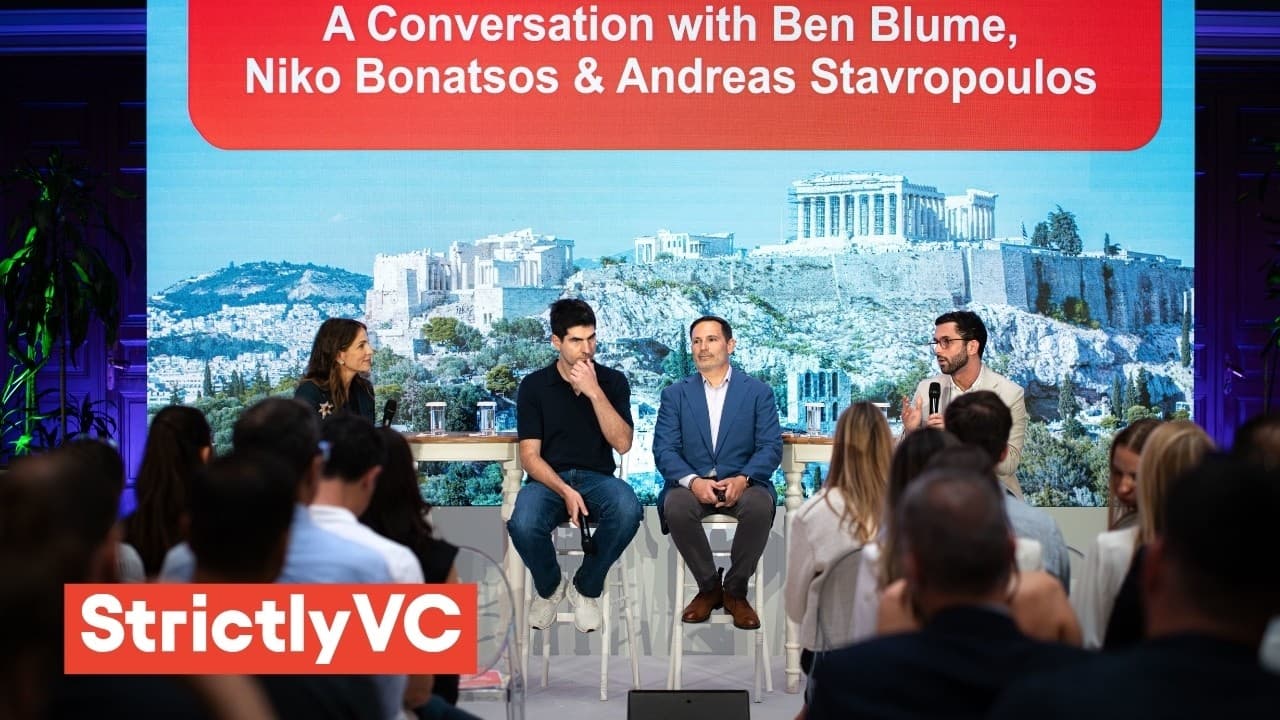
- The event is taking place in Athens, which has seen significant momentum in the tech community over the last decade, particularly in the last few years, and it's exciting to witness this growth 10s.
- The discussion starts with the news of the SpaceX IPO, which is a big offering, and the possibility of OpenAI or Anthropic following suit, and the impact this will have on the startup market 4m42s.
- Ben thinks that SpaceX is a unique asset and these companies are not necessarily representative of the next large-scale software companies, but their scale and liquidity events are great for the entire market and early-stage investors 6m6s.
- Ben also believes that these events generate wealth and returns that can go back into the next generation of companies, and it's exciting to see what the people who worked on and invested in SpaceX will do next 6m6s.
SpaceX IPO and Its Implications for the Startup Market
- Andreas, an investor at DFJ, is interested in seeing the SpaceX IPO and thinks that it will usher in a new generation of entrepreneurs, similar to what happened with Google's IPO, and that the scale of these events is changing with each subsequent wave of paradigm shifts 8m30s.
- Andreas also notes that the percentage of GDP powered by technology is much higher now than it used to be, and that every business today is a technology business, which is why the scale of these events is increasing 8m30s.
- Durable value is being created in the industry, despite potential corrections and fluctuations, and companies like SpaceX are pushing the boundaries of what is possible with new tech ideas 10s.
- Elon Musk is seen as a generational entrepreneur who has been pushing the boundaries of what is possible, and his success can inspire the next generation of companies to go after larger markets, with immigrant founders being particularly notable for their ability to dream big 1m42s.
- The proposed valuation of SpaceX at $1.75 trillion is being discussed, with some investors like Ross Gerber suggesting that the company may be worth $500 billion and the extra trillion being due to the "Elon factor" 2m6s.
- The valuation of SpaceX is being given good odds in prediction markets, and some secondary market investors believe that the company's IPO could potentially soak up a lot of money from the public market, potentially having a negative impact on companies that go public afterwards 3m30s.
- The conversation around SpaceX's valuation is complex, with some arguing that the company's success could bring more people into the market and have a positive impact, while others are more pessimistic about the potential short-term effects 5m10s.
Consumer Involvement and the Democratization of the Space Industry
- The involvement of consumers in the markets has increased significantly over the last 30 years, with people now trading on their apps on a daily basis, and the SpaceX IPO could capture the imagination and interest of a wide range of people 6m40s.
- The space industry has traditionally been dominated by the government and public sector, but companies like SpaceX are now providing opportunities for investors to get financial access to the industry, which could lead to a widespread interest and imagination 8m0s.
Capital Influx and Investment Trends in AI and Space
- The current investment landscape is characterized by a massive influx of capital, with money flowing into various sectors, including space and AI, and it is unclear whether this influx is justified by future earnings or driven by fear of missing out (FOMO) 10s.
- Investors are seeing a high level of group think, with a significant portion of venture capital money being invested in a small number of companies, and a large amount of money going into a few VC firms, making it challenging for companies outside of the AI and American dynamism or global resilience spaces to secure funding 2m6s.
- The AI sector is experiencing rapid growth, with companies being able to make significant progress with less funding and fewer people than in the past, thanks to the availability of AI code generation and other tools, which is changing the way companies are getting started and capitalizing themselves 4m42s.
- The investment process has become highly competitive, with investors needing to move quickly to secure deals, and the math involved in pricing investments has become increasingly complex, with investors having to balance the need for meaningful ownership with the risk of overpaying for companies 6m10s.
- Experienced investors, such as Andreas and Nico, have noted that the current market conditions are unprecedented, with a high level of enthusiasm and investment in AI and other sectors, and it is unclear how this will play out in the long term, but they emphasize the importance of taking a long-term view and focusing on high-conviction bets 8m20s.
Founder Demographics and Venture Capital Preferences
- The panel discussion also touched on the topic of founder demographics, with younger founders, particularly those in the AI space, being highly sought after by investors, while older founders, such as tenure professors at Stanford, may struggle to secure funding 10m0s.
- Venture capital investors have experienced significant growth in the past, with companies like Tesla raising large amounts of capital, such as a $100 million series A, which seemed unjustifiable at the time but ultimately led to the company becoming iconic 10s.
- Despite the potential for long-term growth, there may be a correction in the market that pushes capital back out, as the current promise and optimism are ahead of the ability to show short-term to medium-term results 42s.
- When evaluating companies, it's essential to consider what a meaningful amount of ownership would be for the fund and to think about the proposition, which may lead to walking away if enough ownership cannot be secured 2m6s.
- The venture capital landscape is complex, with different types of capital and cost of capital, which can distort valuations and round sizes, making it challenging for offers to stack up 4m30s.
- Some investors focus on "first money investing," leading rounds and investing in unique individuals, often referred to as "freaks," who can make rapid progress and work on markets that do not yet have a name 6m15s.
- These investors often focus on specific regions, such as New York, Israel, and NASF, and have made investments at various valuations, including $20 million post, $5 million post, and $6 million post 8m0s.
- Investing in new categories that do not yet have a name requires a deep understanding of what to look for, as larger asset managers may not be able to identify these opportunities 9m30s.
- Investors may look for both talented founders and categories with potential, even if they do not yet have a name, as these can provide opportunities for significant growth 11m20s.
- Investing in startups requires finding unique opportunities and taking risks, rather than following the consensus, as by the time an idea becomes popular, it may be too late to invest, and instead, one might as well buy lottery tickets 10s.
- Having a differentiated strategy as an investor is crucial, and having a smaller fund can be beneficial in finding new opportunities that might be hard to justify with a larger fund, as it allows for more flexibility and less burden from assets under management 2m6s.
- There is a trend of investors targeting young entrepreneurs, even freshmen in college, with the goal of finding the next big thing, as seen in the relationship between Silicon Valley and Stanford, where venture capitalists are actively seeking out new talent, and this phenomenon has been observed and written about by authors like Theo Baker 4m42s.
- The Threshold Venture Fellows program at Stanford, which supports master's students in engineering who want to start companies, has been successful in fostering entrepreneurship, with many of its alumni going on to start real companies, and it has been observed that times of disruption favor lack of experience, making younger entrepreneurs more likely to come up with innovative ideas 6m15s.
- The idea that younger entrepreneurs are more likely to succeed is not a new concept, and it has been observed in the past, such as in the 2000s when the perfect founder was thought to be around 28 years old, and this trend has continued, with many venture capitalists actively seeking out young talent, especially in times of disruption and change 8m50s.
- The presence of venture capitalists on campus, particularly at Stanford, has been a common phenomenon, especially during times of technological disruption, such as in 2009 when the iPhone and app store were still relatively new, and there were more venture capitalists on campus than students 10m30s.
Attributes of Successful Founders in the AI Era
- The current disruption in the market is led by AI native founders who have grown up with new tooling and are creating innovative products, and it is believed that younger founders are better suited to succeed in this space due to their ability to move at a rapid pace and adapt to changing circumstances 10s.
- To build a successful AI company, founders need to have a high level of intensity, be committed to the business, and have the mental dexterity to navigate a constantly changing landscape, and these attributes are more important than age 2m6s.
- The idea that only young founders can succeed in the AI space is not entirely accurate, as people of different ages can also possess the necessary attributes to build a successful AI company, and it is more important to find founders with the right qualities rather than focusing on their age 2m6s.
Future of the AI Industry and Market Dynamics
- There are conflicting views on the future of the AI industry, with some believing that small startups will dominate the market and others thinking that only a few large companies will emerge as leaders, and it is unclear whether the current trends are a temporary blip or a fundamental shift in the industry 4m42s.
- The AI industry is currently experiencing a period of upheaval, with big battles being fought over fundamental models and platforms, but it is likely that the market will settle down as it becomes inefficient for companies to constantly try new things and benchmark new technologies for their downstream clients and partners 6m10s.
- Despite the potential settling down of the market, it is unlikely that the market opportunity will decrease, as the industry will continue to evolve and create new opportunities for growth and innovation 8m30s.
Emerging Platforms and Venture Capital Investing Models
- The emergence of new platforms is expected to lead to the creation of new opportunities that may not have been considered in the past, similar to what happened in the SAS cycle and the cloud cycle, and this could potentially change the typical venture investing model, which is predicated on picking winners from relatively finite and relatively kind of inefficient markets 10s.
Cultural Shifts and Ethical Considerations in Venture Capital
- There is a cultural shift happening in Silicon Valley, with a growing trend of promotionalism, where companies are being pitched with exaggerated annualized recurring revenue (ARR) numbers, and it feels like investors are aware of this but are still investing, which raises questions about shady behavior and the focus on ARR 2m6s.
- The definition of ARR has become complex due to new pricing models, token-based billing, and other factors, making it difficult for investors to cut through the marketing headlines and make informed investment decisions, but sophisticated investors are able to see through these representations and focus on the actual truths behind the numbers 4m30s.
- Some investors are taking a more nuanced approach, recognizing that founders may use creative accounting to paint their business in the best light, but this is not acceptable when deciding which companies to invest in, and investors need to be able to distinguish between marketing hype and actual performance 6m20s.
- The venture capital industry is prone to bad behavior, particularly when there is a lot of money chasing after specific opportunities, and some founders may engage in grifting mentality to achieve short-term gains, but the goal of venture capital is to make 100x plus returns on investment, and investors need to focus on finding the right opportunities 8m40s.
Shifting Focus in Venture Capital and Characteristics of Future Founders
- Venture capital firms have shifted their focus away from consumer internet investing, with many having reduced their investment in this area to almost nothing, and instead are looking for new opportunities such as new consumer fintech ideas that can help restore the American dream 2m6s.
- The current market requires founders who can challenge norms and make the most of the change in enabling technology, with characteristics such as resilience, ability to deal with failure, and a strong origin myth being highly valued 4m42s.
- The next wave of successful founders will be those who can think differently and make the most of new technologies, with a focus on the individuals and their motivations, aspirations, and ability to adapt to changing circumstances 6m15s.
- There is a huge opportunity for AI to interact with the physical world, with the potential impact being orders of magnitude larger than its current impact on the digital world, and robotics is seen as a key area for investment and growth over the next 10 years 8m10s.
- The panel discussion highlighted the importance of looking for white space and areas that are not yet crowded, with a focus on finding new and innovative ideas that can disrupt existing markets and create new opportunities 42s.