

Reflecting on Life and Japanese Principles
- Major life decisions are often not understood by the individual or others at the time they are made, but their true meaning may only become clear after months, years, or even decades 15s.
- Life often requires an individual to experience events first before the underlying purpose or perspective can be fully understood 42s.
- During the 2020 COVID-19 pandemic, Nandiki Gangadhar Reddy sought happiness and positivity by studying Japanese life principles, noting that Japanese people are known for longevity and management success 1m25s.
- Three Japanese principles—Ikigai (purpose), Kaizen (progress), and Wabi-sabi (acceptance)—provided a framework for understanding how past struggles and successes held specific meanings 1m55s.
- Ikigai is defined as the purpose that motivates an individual to wake up and work toward a goal each day 2m25s.
Career Transition and the Cyclone Experience
- In 1995, Nandiki Gangadhar Reddy began a government job at Hindustan Shipyard Limited in Visakhapatnam, which was considered a stable and desirable career path 2m35s.
- The 1999 super cyclone in Odisha caused massive destruction, washing away infrastructure and leaving the region without electricity or communication networks 3m15s.
- Upon witnessing the devastation in his hometown, where over 80% of homes were destroyed, Nandiki Gangadhar Reddy concluded that nature must be respected and questioned whether it was possible to build affordable, resilient housing that does not harm the environment 3m55s.
- Four months after the cyclone, Nandiki Gangadhar Reddy resigned from his government position, a decision that was met with confusion and criticism from family, friends, and colleagues 4m25s.
- Reflecting on this decision in 2020, Nandiki Gangadhar Reddy identified his resignation as an expression of Ikigai, which served as the driving force behind his future career path 4m55s.
Continuous Improvement Through Kaizen
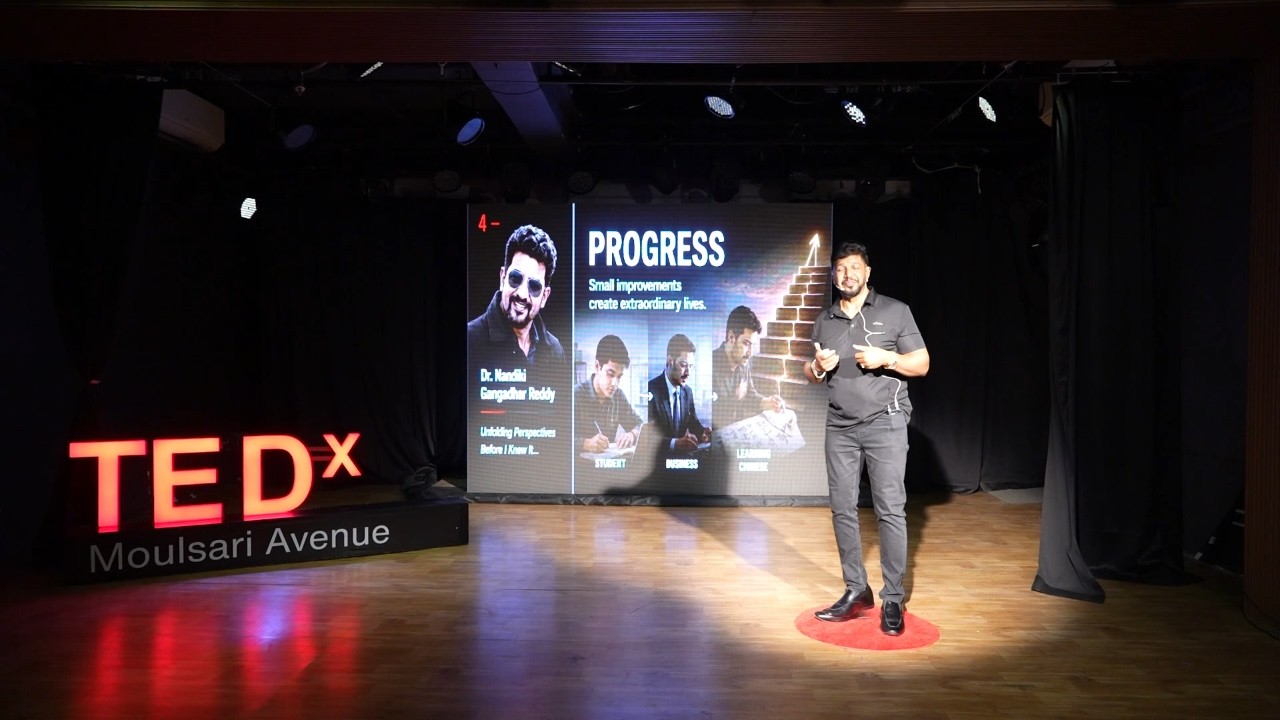
- The concept of Kaizen, a Japanese term for continuous improvement, is presented as a fundamental driver of progress and success 0s.
- Academic success during school and college was initially attributed to intelligence or luck, but was later identified as the result of daily, consistent study habits 25s.
- The habit of completing daily tasks before sleep was instilled by a mother, serving as the foundational practice of Kaizen 1m25s.
- Kaizen facilitated a career transition from engineering to entrepreneurship by allowing for the incremental acquisition of diverse skills such as negotiation, procurement, HR, and production management 1m50s.
- Fluency in the Chinese language was achieved within six months by dedicating 20 minutes daily to study during commute and personal time, which enabled a technical partnership with a Chinese firm in 2008 2m25s.
Acceptance and Business Resilience
- The principle of acceptance, referred to as Wabi-sabi, involves acknowledging that plans, factories, and individuals are inherently imperfect 3m15s.
- Accepting uncertainty and technical disruptions without complaint is necessary to maintain focus on corrective actions and continued progress 3m35s.
- Business challenges, such as the introduction of GST and demonetization, required navigating significant economic shifts 4m5s.
- During the COVID-19 pandemic, a difficult decision was made to prioritize the protection of employees over the protection of the business 4m20s.
- During the COVID-19 lockdowns, a decision was made to pay all employees their full salaries regardless of the duration of the lockdown. 0s
- Following the end of the pandemic, employees returned with increased loyalty and enthusiasm, leading to a 50% increase in productivity. 5s
Evolution of Personal and Professional Goals
- The concept of "kaizen," or continuous development, was attributed to the influence of the speaker's mother, while the concept of "wabi-sabi," or acceptance, was attributed to the influence of the speaker's father. 18s
- The father remained calm and supportive during significant life changes, such as the decision to leave a government job. 25s
- Kaizen involves vertical evolution, where achieving one goal, such as academic success, leads to the pursuit of higher objectives. 45s
- Business growth followed a similar trajectory, moving from the development of eco-friendly bricks to achieving scalability and replicability. 55s
- Kaizen can also evolve horizontally, allowing for the pursuit of parallel interests, such as the transition into movie production. 1m5s
Pursuing Acting and Physical Fitness
- After being unable to secure acting roles in the past, the decision was made in 2018 to produce regional films independently, which eventually earned state awards. 1m12s
- The pursuit of acting roles led to a new purpose: improving physical fitness to better suit film characters. 1m25s
- Through a process of daily gym sessions and dietary adjustments over three years, 15 kilograms were lost, resulting in improved fitness at the age of 56. 1m32s
- Missing a workout or deviating from a diet due to travel is managed by focusing on corrective steps rather than worry. 1m42s
Cultural Parallels and Universal Wisdom
- A conversation with a Japanese monk on a flight prompted a reflection on whether these Japanese principles exist within Indian heritage and culture. 1m52s
- Parallels were drawn between Japanese concepts and Indian philosophy, equating "ikigai" to "dharma," "kaizen" to "karma," and "wabi-sabi" to "shanti." 2m12s
- A verse from the Bhagavad Gita was identified as containing these same principles, with the first line addressing "ikigai" (dharma), the second and third lines addressing "wabi-sabi" (acceptance), and the final line addressing continuous improvement through action. 2m30s
- The core message shared by beautiful civilizations across different countries, cultures, and time periods is to live in dharma, progress through karma, and embrace peace. 0s
- Gratefulness is a universal quality that belongs to all of humanity rather than being restricted to any specific country or location. 15s
- The Japanese concepts discussed do not necessarily draw their inspiration from Indian heritage, nor is there a claim that they do. 0s
- A collective wish is expressed for all people to be happy, free from illness, and enlightened, while hoping that no one has to face the difficulties of life. 35s