The Corson Technique for Academic Assistance
- Many common study tips, such as sitting in the front of the class or scanning textbooks, are considered basic and do not address the needs of detail-oriented learners seeking advanced academic strategies 0s.
- The Corson Technique, named after former Cornell University president and chemistry professor Dale Corson, is a method for seeking help from professors 1m15s.
- Instead of approaching a professor with a vague statement of confusion, students should analyze their problem sentence by sentence to identify the exact point where their understanding breaks down 1m45s.
- Pinpointing the specific source of confusion demonstrates preparation and effort to the professor while training the student to better recognize and isolate their own knowledge gaps 2m15s.
Spaced Repetition Systems
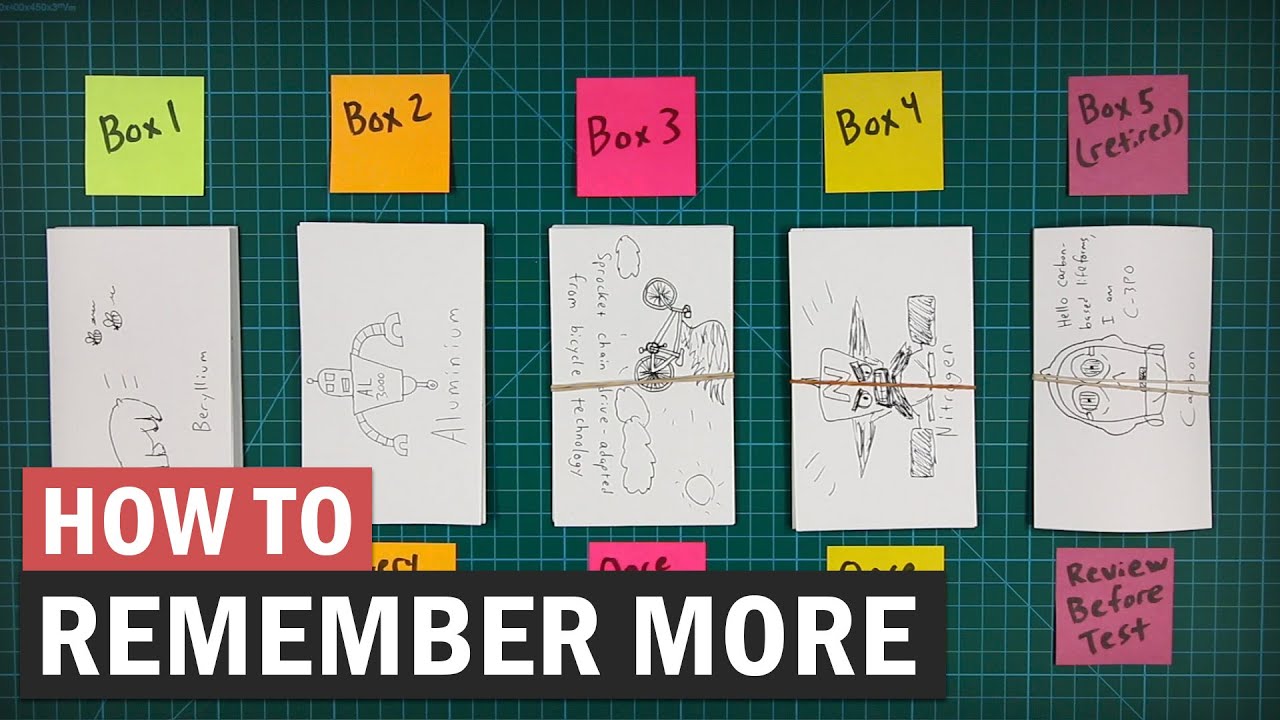
- Spaced repetition is a study technique that involves reviewing information at increasingly longer intervals of time 2m35s.
- This method is efficient because it forces the brain to recall information just before it is forgotten, which strengthens memory encoding 3m5s.
- Under a spaced repetition system, facts that are well-known are reviewed less frequently, while facts that are difficult to recall are reviewed more often 2m45s.
- Utilizing spaced repetition software (SRS) is recommended over manual methods like index cards for managing these study intervals 3m20s.
- Software such as WaniKani has been used effectively to learn large volumes of vocabulary and Kanji 3m35s.
- Anki is a free, generalized software available at AnkiSRS.net that allows users to create custom flashcard sets for spaced repetition study or download shared decks created by others 0s.
- Utilizing spaced repetition systems is generally more efficient for studying than traditional linear paper-based flashcard methods 25s.
Advanced Memorization and Cognitive Techniques
- The Method of Loci is an advanced memorization technique dating back to Greek and Roman times that leverages the brain's capacity for spatial memory through visualization 42s.
- This technique involves associating data with specific locations, such as rooms in a house, to aid in recall 55s.
- While the Method of Loci can be difficult to implement, it serves as an alternative for large datasets when other study methods have proven ineffective 2m6s.
Overcoming Procrastination and Akrasia
- Akrasia, a concept discussed since the time of Plato, refers to a lack of self-command that leads to procrastination 2m25s.
- Picoeconomics explains that humans engage in hyperbolic discounting, where the perceived value of a task decreases as its reward is delayed, causing individuals to prioritize short-term, non-aligned activities over long-term goals 2m35s.
- One method to overcome akrasia is the use of a commitment device, such as the app Beeminder, which binds a user to completing tasks on a specific schedule 3m5s.
- A second method to combat akrasia is to introduce immediate, short-term rewards for completing tasks, such as eating a treat after reading a paragraph, watching a television episode after finishing an assignment, or using gamification tools like HabitRPG 3m45s.
Time Management and Distraction Control
- The Pomodoro Technique involves setting a timer for 25 minutes to focus exclusively on a single task 0s.
- Individuals can improve upon the classic Pomodoro structure by experimenting with different time intervals, such as the "Tock" method, which utilizes 45-minute work sessions followed by 15-minute breaks 35s.
- Keeping a piece of paper nearby during study sessions allows individuals to record distractions as they occur, which helps in addressing urgent matters during breaks and identifying recurring patterns of distraction over time 1m15s.
- Identifying common distractions enables proactive solutions, such as enabling "do not disturb" modes on phones or using browser extensions like Stay Focused to block distracting websites 1m45s.
Focused and Diffused Thinking Modes
- Learning new concepts effectively requires utilizing both focused and diffused modes of thinking 2m6s.
- Focused thinking utilizes the prefrontal cortex to concentrate on specific data or problems, while diffused thinking allows the brain to connect unrelated ideas and nodes to better understand new information 2m35s.
- Focused thinking is most effective for processes or problems that are already understood, whereas combining both modes is necessary for learning new material 3m15s.
Strategies for Lecture Engagement and Pacing
- Students should gauge the speed at which a professor presents material relative to their own ability to process and record information 3m30s.
- If a professor moves through material too quickly, reading the relevant textbook chapter before the lecture can help mitigate the difficulty of keeping up 3m50s.
- Reviewing material that outlines upcoming lecture content allows students to identify relevant textbook sections and prime their brains for the lecture 0s.
- If the pace of a class is too fast, students should ask their professors for help or ask questions during the lecture 5s.
- Professors are available to assist students, and students are encouraged to take advantage of that resource 12s.
Independent Problem Solving
- Problem sets should be started alone rather than with a partner 15s.
- Working on assignments with a partner can prevent students from identifying specific gaps in their own understanding 35s.
- When working in a group, a student may latch onto a partner's answer if they do not fully understand a problem, leading them to believe they understand the material when they do not 45s.
- Completing work alone first allows students to pinpoint areas of confusion and address them before collaborating with others to finish the assignment 55s.