8 Best AI Chatbots in 2026, Ranked by Use Case
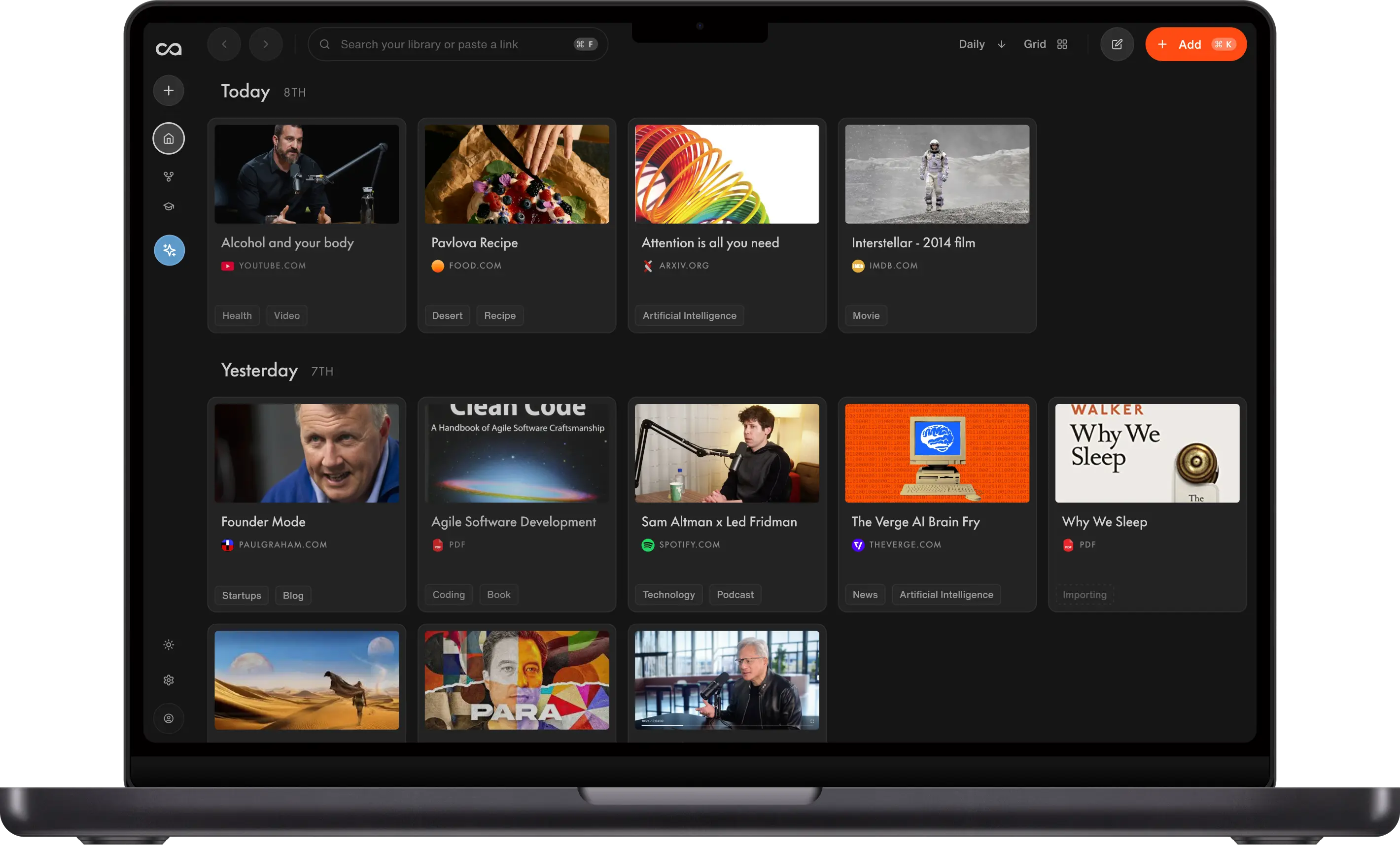
Most AI chatbots answer from the open web and forget what you already saved. We ranked eight by where answers come from and how they compound: Recall for chatting with your own library first, Claude for automation and code, ChatGPT for everyday chat, Perplexity for cited web research, and Gemini for Google Workspace.
Last updated: August 2026
What is the best AI chatbot?
The best AI chatbots in 2026 are Recall for talking to a personal knowledge base from trusted sources, not only the open web, Claude for automation and code, ChatGPT for everyday chat, Gemini and Copilot for office ecosystems, Perplexity for open-web research, DeepSeek for low-cost technical work, and Grok for real-time X context.
What to use when
- Recall if you want an AI chatbot that uses your saved articles, videos, podcasts, PDFs, and notes as context, with library-wide chat and model choice.
- Claude if you want automation, agentic workflows, coding help, long-form writing, and careful reasoning.
- ChatGPT if you want the default all-around AI chatbot for everyday questions, drafting, and broad capability.
- Gemini if you live in Google Docs, Gmail, Drive, and Android.
- Perplexity if you mainly need researched answers with web citations.
- Microsoft Copilot if AI must act inside Outlook, Word, Excel, Teams, or Windows.
- DeepSeek if cost-sensitive coding and technical reasoning matter most.
- Grok if the question depends on what is happening right now on X.
Get started with Recall for free
See why Recall is the best ChatGPT alternative: chat grounded in your saved sources, with a knowledge base that compounds over time.
Best AI chatbots compared (2026): ranked by context source, how answers compound, model approach, and the main tradeoff.
| Chatbot | Best for | Context source | How answers compound | Model approach | Main tradeoff |
|---|---|---|---|---|---|
| Recall | Personal AI knowledge base | Your articles, video, PDFs, notes | Library chat cites your saves first, then the live web | Multiple frontier models | Needs a save habit |
| Claude | Automation, workflows, code, writing | Prompt, projects, MCP | Projects and tool use carry work forward | Anthropic | Not a lasting personal library |
| ChatGPT | General-purpose everyday AI | Prompt, uploads, memory | Memory and custom GPTs help, then context fades | OpenAI models | Weak as a durable knowledge base |
| Gemini | Google Workspace and multimodal Google work | Google files and apps | Context stays inside Google Workspace | Weak outside Google files | |
| Perplexity | Cited open-web research | Live web | New searches, not a compounding personal archive | Multiple models on paid | Web-first, not your library |
| Microsoft Copilot | Microsoft 365 automation | Outlook, Office, Teams | Context stays inside Microsoft 365 | OpenAI-based in Microsoft | Weak outside Office files |
| DeepSeek | Low-cost reasoning and code | Prompt and code | Strong per-session reasoning, no personal archive | DeepSeek | No personal knowledge layer |
| Grok | Real-time X context and trends | X and the live web | Fresh trends, not your saved sources | xAI | Useful now, not a lasting library |
Legend: ✓ strong fit · ✗ gap · ~ partial. Scroll horizontally on small screens.
For ChatGPT-specific alternatives ranked by use case, see best ChatGPT alternatives. For the broader knowledge-base category, see best AI knowledge bases.
What is an AI chatbot?
An AI chatbot is a conversational interface to a large language model. You ask a question or give a task, and it responds with text, code, images, or tool actions depending on the product.
In 2026, the biggest split between chatbots is where context comes from:
- Your library: Answers grounded in articles, notes, PDFs, and media you saved (Recall)
- Public model knowledge: Everyday Q&A, drafting, coding, and automation from training data (Claude, ChatGPT, Gemini)
- Live web: Research with citations from the open internet (Perplexity, Grok for X)
- Work apps: Context inside Google Workspace or Microsoft 365 (Gemini, Copilot)
Why personal context matters in AI chatbots
Everyone has access to the same frontier models. The edge is no longer "which chatbot is smartest." It is what context the chatbot can see.
Ask a general AI chatbot a research or recommendation question and it often answers from the open web. That web context is not neutral. Tinuiti's Q1 2026 AI Citation Trends Report found that Reddit alone accounted for about 24% of all Perplexity citations in January 2026, and more than 5% of ChatGPT citations, with Reddit's share of AI citations growing at least 73% from October 2025 to January 2026. In other words, a large share of "the internet" that chatbots lean on is community discussion, not your notes, papers, or the sources you already trusted.
That is useful when you want public consensus. It is a weak default when the answer should come from what you personally read, saved, and verified. Generic chat pulls from Reddit threads, blogs, and whatever the model retrieves today. Your own library is different: the podcast episode you finished, the PDF you annotated, the article you bookmarked six months ago, the notes you wrote after a meeting. Those are the sources that make an answer yours.
Personal context matters because:
- Shared AI is commoditized. Claude, ChatGPT, Gemini, and the rest of the pack are available to everyone. Your saved knowledge is not.
- Open-web answers over-index on popular forums. Reddit and similar sources show up in AI citations far more often than most people realize, especially on Perplexity and ChatGPT.
- Chat history is not a knowledge base. Past conversations fade. A durable library compounds.
- Better questions need better ground truth. "What did I already learn about this?" is a different job from "What does the internet think?"
This is why Recall ranks first on this list. It is still an AI chatbot, but the context layer is your library first: save what you learn, then chat with that knowledge using the model you choose. Talk to the internet when you need fresh public answers. Talk to your own knowledge when you need yours.
How to choose an AI chatbot
Choose by job and context first, not by model brand alone.
- Personal context: If the chatbot should know what you have already saved and learned, start with Recall.
- Job to be done: Automation, workflows, and code (Claude), everyday Q&A (ChatGPT), Google work (Gemini), cited research (Perplexity), Microsoft work (Copilot).
- Ecosystem: Choose the assistant that already sits where your files and meetings live.
- Citations: Prefer Perplexity when you need inspectable web sources; prefer Recall when citations should point to your own saves.
- Model flexibility: Recall keeps your knowledge constant while you switch between leading models for each task.
Best AI chatbots in detail
1. Recall
Recall is best for: people who want a personal AI knowledge base they can talk to: a chatbot layered on a library of what they have saved, not only on public training data.
Recall features:
- One-click capture: Save articles, YouTube, podcasts, PDFs, and notes from Chrome, Firefox, or mobile
- AI summaries on save: Build usable context without rereading everything
- Library-wide chat: Ask questions across your full archive, with citations to your sources
- Multi-model AI: Chat with leading models on your knowledge, the open web, or both
- Automatic organization: Tags and a knowledge graph so context stays findable as the library grows
- MCP access: Connect the same knowledge to Claude, ChatGPT, Cursor, and other assistants
Recall pricing: free tier with unlimited saves; Plus from about $10/mo for full AI and library chat.
Knowledge type: Your saved articles, videos, podcasts, PDFs, and notes, plus the live web when you want it.
How answers compound: Library-wide chat cites your own sources first, so last year's saves can answer today's question. Tradeoff: it is most useful once you have a save habit.
Where Recall fits: Most AI chatbots start every hard question without your reading history. Recall makes your saved knowledge the context layer, then lets you choose the model. That is the difference between asking the internet and asking an AI that knows what you have already learned.
Go deeper: ChatGPT alternative comparison · best AI knowledge bases
2. Claude
Claude is best for: automation, agentic workflows, coding, long-form writing, and careful reasoning when you need an AI that can execute multi-step work, not only answer a chat prompt.
Claude features:
- Automation and agentic workflows: Strong at multi-step tasks, tool use, and finishing work across files and systems
- Coding support: Excellent for reading codebases, debugging, refactoring, and implementation help
- Long-context writing and analysis: Strong for large docs, careful edits, and complex briefs
- Artifacts and projects: Useful for iterative work products you refine over time
- MCP ecosystem: Can use external tools and knowledge sources, including your Recall library
Claude pricing: free tier; Pro from about $20/mo.
Knowledge type: The current prompt, project files, and tools you connect, including MCP.
How answers compound: Projects, artifacts, and tool use carry work forward inside Claude. Tradeoff: that context is not a lasting personal library unless you add one.
Why Claude ranks #2: If Recall wins on personal context, Claude wins on getting work done. It is especially strong when chat turns into automation, workflows, and code, not just a back-and-forth Q&A.
Claude + Recall: Claude is an excellent standalone assistant. For knowledge-heavy automation, pair it with Recall through MCP so Claude can use your saved library as context while it writes, codes, or runs workflows.
3. ChatGPT
ChatGPT is best for: the default general-purpose AI chatbot most people should use for everyday questions, drafting, and broad capability when a personal library is not the main need.
ChatGPT features:
- General assistant: Strong default for a wide range of tasks
- Tools and modes: Browsing, image generation, and advanced modes on paid plans
- Custom GPTs: Task-specific chat experiences
- Broad ecosystem: Huge prompt library and third-party integrations
ChatGPT pricing: free tier; Plus from about $20/mo.
Knowledge type: The current prompt, uploads, memory, and custom GPTs.
How answers compound: Memory and custom GPTs help across chats, then context still fades. Tradeoff: it is weak as a durable knowledge base of what you read and saved.
ChatGPT vs Claude vs Recall: ChatGPT is the strongest everyday generalist. Claude is stronger for automation, workflows, and code-heavy execution. Recall is stronger when answers should come from a durable library of sources you saved yourself.
4. Gemini
Gemini is best for: people whose work already lives in Google Workspace, Android, and Google Search.
Gemini features:
- Google app integration: Gmail, Docs, Drive, and related workflows
- Multimodal input: Strong image and mixed-media handling
- Free access: Capable free tier for many users
- NotebookLM adjacency: Related Google research workflows for uploaded sources
Gemini pricing: free tier; Advanced from about $20/mo.
Knowledge type: Google Docs, Gmail, Drive, and multimodal Google input.
How answers compound: Context stays useful inside Google Workspace. Tradeoff: it is weaker when the sources that matter live outside Google files.
Gemini vs Recall: Gemini wins when Google Workspace and Android are already your home. Recall wins when answers should come from a personal multimedia library you control, not only Google files.
5. Perplexity
Perplexity is best for: researching new topics on the open web when citations matter.
Perplexity features:
- Cited answers: Links you can verify
- Deep research: Multi-step web investigation on paid plans
- Focus modes: Narrow search to academic, social, or other source types
- Multi-model options: Model choice on paid tiers
Perplexity pricing: free tier; Pro from about $20/mo.
Knowledge type: The live open web, with citations.
How answers compound: Each search can find new sources. Tradeoff: it does not build a personal archive that gets more valuable over years.
Perplexity vs Recall: Perplexity finds new web sources. Recall chats across sources you already saved and trust. Many people use both.
6. Microsoft Copilot
Microsoft Copilot is best for: AI that must work inside Outlook, Word, Excel, PowerPoint, Teams, Edge, and Windows.
Copilot features:
- Microsoft 365 actions: Draft and transform work inside Office apps
- Meeting and email context: Useful when work already lives in Microsoft
- Windows and Edge integration: System-level assistant surfaces
- Business plans: Team and enterprise controls
Copilot pricing: free consumer tier; Pro from about $20/mo; business plans vary.
Knowledge type: Outlook, Word, Excel, Teams, and other Microsoft 365 files.
How answers compound: Context stays useful inside Microsoft 365. Tradeoff: it is weaker when the sources that matter are articles, videos, and PDFs you saved yourself.
Copilot vs Recall: Copilot wins when Microsoft 365 is the workplace. Recall wins when the context that matters is a personal knowledge library of articles, videos, podcasts, and PDFs rather than Office files alone.
7. DeepSeek
DeepSeek is best for: low-cost reasoning, math, and coding when price-to-performance matters.
DeepSeek features:
- Strong technical reasoning: Competitive on code and structured problems
- Low-cost API: Attractive for builders and high-volume use
- Free chatbot access: Useful for evaluation
- Single-vendor model family: Less ecosystem breadth than ChatGPT or Claude
DeepSeek pricing: free chatbot; low-cost API usage.
Knowledge type: The current prompt, code, and technical problems.
How answers compound: Strong per-session reasoning. Tradeoff: there is no personal knowledge layer that compounds across months.
DeepSeek vs Recall: DeepSeek is compelling when cost-sensitive coding is the job. Claude is usually the better default for automation and day-to-day coding assistance. Recall is stronger when those technical answers should still ground in a personal library of sources you saved.
8. Grok
Grok is best for: questions that depend on real-time X context, trends, and current events.
Grok features:
- X-native context: Strong when the signal is on X
- Conversational style: Fast, informal answers
- Image and media features: Varies by plan and rollout
- xAI model family: Separate from OpenAI, Google, and Anthropic defaults
Grok pricing: free access varies; X Premium tiers may include Grok.
Knowledge type: Real-time X context, trends, and current events.
How answers compound: Fresh public signal. Tradeoff: useful now, not a lasting library of what you already trusted.
Grok vs Recall: Grok wins for live X context and trends. Recall wins when the answer should come from sources you already saved and verified, not from what is trending right now.
Bottom line
Choose Recall when you want an AI chatbot that can set context from what you have already learned: save sources once, then chat across your library with the model you choose. Pick Claude for automation, workflows, and code, ChatGPT for general-purpose everyday chat, Gemini or Copilot for office ecosystems, Perplexity for open-web research, DeepSeek for low-cost technical work, and Grok for real-time X context.
When to keep ChatGPT
Stay with a general AI chatbot like ChatGPT when:
- You need a fast everyday answer and do not care which of your past sources it came from
- The task is drafting, brainstorming, or broad Q&A without a personal corpus
- You are not ready to build a save habit yet
Move to Recall when answers should come from what you personally saved, and that library should get more valuable every time you chat with it.
FAQs
Best AI chatbot by use case
What is an AI chatbot
Recall vs other AI chatbots
See more tools on the Recall comparison hub or the full comparison table.
Ready to get started?
Save, summarize and chat with your content.
No credit card required · 30 Day Refund on Premium · 24 Hour Support