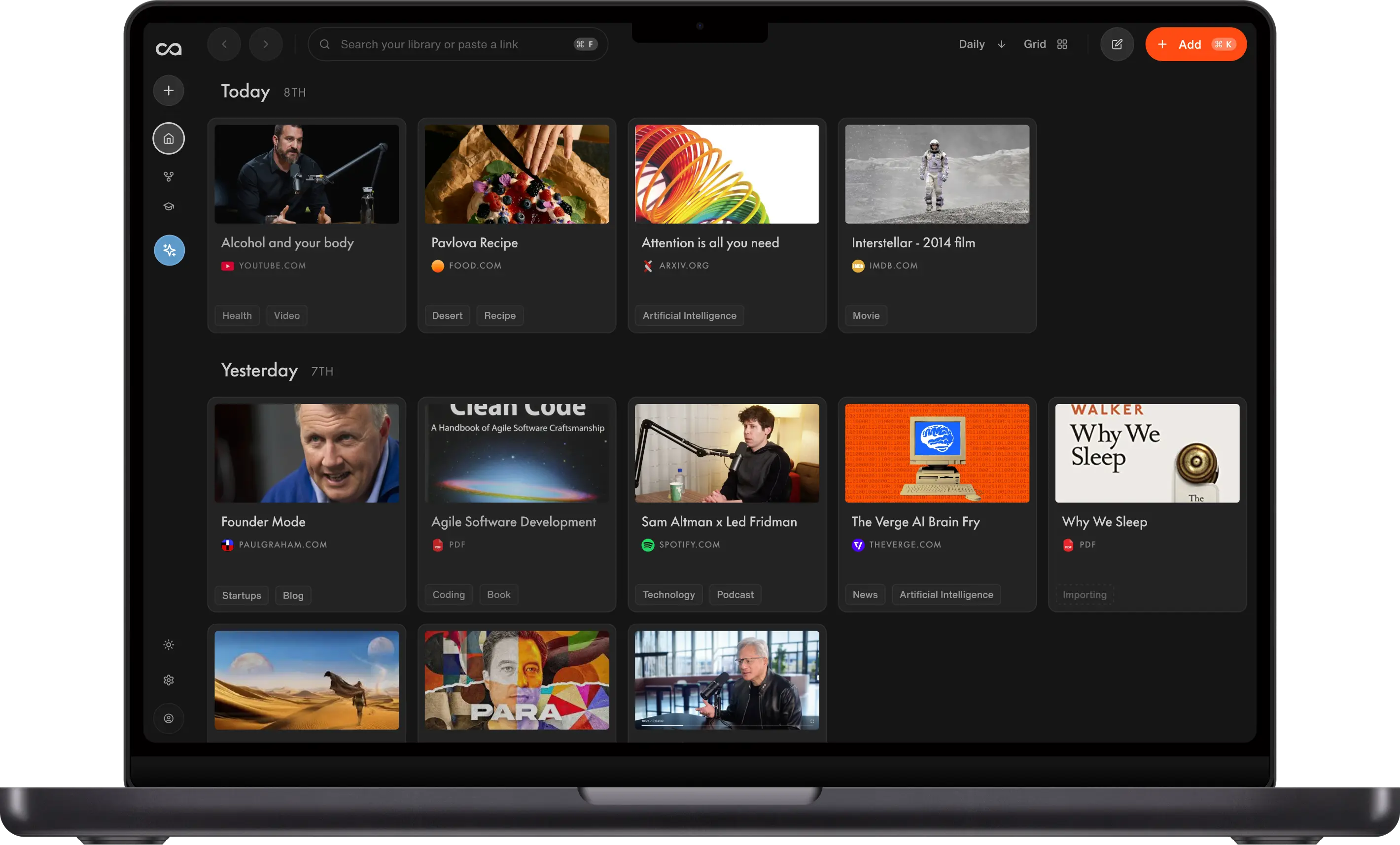
Best ChatGPT Alternative for Research and Writing: Recall
Looking for a ChatGPT alternative? Recall is the best ChatGPT alternative for research, writing, and knowledge management. It saves, summarizes, and organizes everything you read into one searchable knowledge base you can chat across, with your choice of AI model. Keep using ChatGPT or Claude on top of it via MCP.
Last updated: June 2026
What's the best ChatGPT alternative?
The best ChatGPT alternative for research and writing is Recall, because its answers are grounded in your own content and notes first, and only look to the web when needed. ChatGPT is a strong conversation tool. Recall is a personal AI knowledge base. It saves what you read, watch, listen to, and write, organizes it for you automatically, and lets you chat with all of it. That is the core difference. ChatGPT is a chatbot that answers mainly from the open web and its training data, while Recall is a personal AI knowledge base with chat built in.
Research means building on knowledge you have already gathered, and writing means leveraging your own sources, notes, and ideas. A chatbot does not have your saved knowledge as context. Recall does, so every answer starts from what you already trust, then expands to an internet search when it helps. You also pick the best AI model for the task, from OpenAI, Anthropic, Google, or open-source, on top of the same knowledge base.
You do not have to choose. With Recall's MCP server, ChatGPT or Claude can read your Recall knowledge base directly, so you keep your favorite chatbot and give it your knowledge.
Choose ChatGPT for one-off drafting, brainstorming, coding help, and quick questions, when you do not need a knowledge base of your own saved sources and research.
Choose Recall when your work depends on your own knowledge. You get one searchable knowledge base of everything you read, AI summaries on capture, automatic organization, and the option to query all of it from ChatGPT or Claude via MCP.
Want a ranked roundup of every option instead of a one-to-one comparison? See the 11 best ChatGPT alternatives in 2026 guide.
Looking for the short version? Our ChatGPT alternative landing page covers the highlights and lets you start free.
ChatGPT vs Recall, side by side
Here is how Recall vs ChatGPT compares across the jobs that matter for research, writing, and knowledge management.
Get started with Recall for free
See why Recall is the best ChatGPT alternative: chat grounded in your saved sources, with a knowledge base that compounds over time.
| Use case | ChatGPT | Recall |
|---|---|---|
| Best for | General-purpose chat, drafting, coding help | Research, writing, and lifelong knowledge management |
| Remembers your sources | No. Limited memory, no knowledge base of saved content | Yes. Everything you save, searchable for years |
| Capture from the web | No one-click save of articles, videos, PDFs | Browser extension and mobile save and summarize any page |
| Knowledge-base chat | No. Only what is in the current context window | Yes. Chat with your knowledge, the web, or both, with citations |
| Automatic summaries on save | No | Yes. AI summary the moment you save |
| Automatic organization | No. Manual chats and projects | Yes. AI-generated categories and tags |
| Rich note-taking | Partial. Canvas for drafts | Yes. Block editor for notes, highlights, tables, code, to-dos |
| AI model choice | Partial. OpenAI models only | Yes. OpenAI, Anthropic, Google, and open-source |
| Content types | Partial. Text, images, files in-session | Yes. Articles, videos, podcasts, PDFs, social posts, and notes. See everything Recall supports |
| Generate new content (images, drafts, code) | Yes. Image generation, drafting, code, and data analysis | No. Built to save, organize, and chat with your knowledge, not generate media |
| Use with ChatGPT or Claude | Not applicable | Yes. MCP server gives ChatGPT or Claude read access to your knowledge base |
Verify limits and pricing on each product's website before subscribing.
What is ChatGPT?
ChatGPT is OpenAI's general-purpose AI assistant, a conversational interface backed by a large language model. It was launched in November 2022, and you use it to ask questions, draft documents, brainstorm, get coding help, and work with images and files inside a chat session. It remains the strongest general-purpose chatbot and the reference product the whole category is measured against.
Main strengths of ChatGPT
- General-purpose chat with strong reasoning, drafting, and brainstorming across almost any topic.
- Ecosystem depth, including the largest third-party tool library, GPTs, plugins, and native image generation.
- Multimodal in-session work with text, images, and uploaded files within a conversation.
Where ChatGPT falls short for knowledge work
- It is a generalist. For almost every specific job such as research, writing from your own sources, and knowledge management, there is an alternative that beats it on that axis.
- It has no permanent knowledge base of what you save and read, so sources you researched last month are not there next time.
- There is no automatic organization and no retention system. Once a chat scrolls away, the knowledge is effectively gone.
What is Recall?
Recall is a personal AI knowledge base that saves, summarizes, organizes, and lets you chat with your articles, YouTube videos, podcasts, PDFs, and notes, all in one place. You save content from the web, Recall summarizes and organizes it for you automatically, and you can chat with everything you have saved using the AI model of your choice.
Main features of Recall
- One-click capture. Save and summarize articles, videos, podcasts, and PDFs from the browser extension or mobile apps.
- Knowledge-base AI chat. Ask questions across your full knowledge base, a single card, or the open web. You choose the scope.
- Automatic summaries. AI summaries the moment you save, so new material is searchable and ready to chat about.
- Automatic organization. Categories and tags generated from content, in a hierarchy that grows with your knowledge base.
- Rich note-taking. Block-style editor for notes, highlights, and AI outputs, including tables, to-do lists, and code blocks.
- Multiple AI models. Recall Plus picks the best model per task. Recall Max lets you choose OpenAI, Anthropic, Google, or open-source models.
- Spaced repetition. Built-in quizzes and review scheduling so what you save actually sticks.
Recall started in 2022 with a simple idea. You should be able to save everything you learn over a lifetime, from deep research to daily reading to recipes, and have it connect automatically. See About Recall for more.
Why Recall is the better ChatGPT alternative for research, writing, and knowledge management
The difference comes down to memory and structure. Below are the three jobs people most often turn to ChatGPT for, and why Recall does each one better.
1. Why Recall is the best AI for research
Research is the work of building on knowledge you have already gathered, but in ChatGPT you paste sources in one at a time and lose them when the session ends. Recall flips this. You capture sources as you find them, including articles, YouTube videos, podcasts, and PDFs, each gets an automatic summary, and you can then ask questions across all of them at once. Recall grounds every answer in the material you chose and saved first, then expands to an internet search when it needs to, so research compounds instead of resetting. This works for general-purpose research, market research and analysis, and legal research alike, with every answer grounded in your own sources where traceable citations matter.
Here is what a research workflow looks like in Recall:
- Save your sources. Capture the articles, videos, podcasts, and PDFs you find as you go, each summarized automatically.
- Add your own notes. Jot down your ideas, highlights, and takeaways alongside the sources they relate to.
- Chat and research. Open chat with your knowledge base, pick the AI model of your choice, and start researching. Your outputs come with citations to both your saved sources and the external web, and you save them back into your knowledge base, creating a loop where every project makes the next one richer.
2. The best AI for writing, with your voice, notes, and references in one place
Good writing means leveraging your existing knowledge, including your past notes, the sources you are drawing on, and your earlier drafts. ChatGPT starts each draft cold, with none of that in its context. Recall keeps your highlights, summaries, and notes in a unified block editor alongside the sources they came from, so you can draft with your research one click away. Then you can use AI chat for writing to pull exact quotes and facts from things you saved weeks ago, grounded in your own knowledge base rather than the open web. For pure drafting and voice-matching, Claude is also excellent, and you can run it on your Recall knowledge base via MCP.
Here is what a writing workflow looks like in Recall:
- Save your inspiration. Collect the articles, references, and examples that spark ideas, each summarized automatically.
- Add your own notes. Capture your ideas, thoughts, voice, and writing style so the AI has your own material to draw from.
- Chat and generate. Open chat with your knowledge base, scope it to your own content, pick the AI model of your choice for writing, and generate your draft.
- Save it back. Keep the finished content in Recall so it is there for future reference and your next piece.
3. The best AI for knowledge management, a system of record rather than a scroll of chats
This is the clearest gap. ChatGPT has no knowledge base of what you have learned. Recall is built as that knowledge base, with automatic summaries and organization so everything you save stays searchable, plus spaced-repetition review to retain what matters. You get one system of record instead of hundreds of separate chat threads.
How Recall is built differently (7 key differences from ChatGPT)
Beyond a chat thread that resets, Recall adds capture, organization, and memory ChatGPT does not cover:
1. Knowledge-base chat and model choice
Chat with your full knowledge base, one card, or the web. Recall Plus picks the best model per task; Recall Max lets you choose OpenAI, Anthropic, Google, or open-source.
2. Automatic organization
Recall generates categories and tags as you save, so you are not filing every item into a chat or project by hand. Learn more.
3. Rich note-taking
Notes, highlights, summaries, and saves share one block-style editor (tables, to-dos, code blocks via /). Learn more.
4. One-click capture in the browser
The Recall extension summarizes, tags, and saves from any page, with side-panel chat. ChatGPT relies on paste, upload, or a browsing session that does not become a knowledge base. See everything Recall supports.
5. Spaced repetition for long-term memory
Built-in quizzes and review scheduling help material stick, not just sit in a chat history. Learn more.
6. Knowledge graph to discover connections
Related saves link automatically across your knowledge base; explore or edit connections in a graph view. Learn more.
7. Augmented browsing to resurface content
While you read online, Recall highlights terms that match past saves and links you back to your knowledge base. Learn more.
You do not have to choose. Use Recall with ChatGPT or Claude via MCP
The best setup is not Recall instead of ChatGPT. It is Recall as the memory layer for the assistant you already use. Recall's MCP (Model Context Protocol) server gives ChatGPT or Claude secure, read-only access to your knowledge base, so the assistant can search your cards and read their content directly in the chat.
This solves the core weakness of any chatbot. It finally has access to your knowledge, not just its training data.
How it works. The MCP integration is read-only (scope kb:read), authenticated through a browser-based OAuth flow, with no API key required. You approve access once on a Recall authorization page.
Connect to Claude
- Go to Settings then Connectors (or Customize then Connectors) in Claude.
- Click Add custom connector, name it Recall, and add the Recall MCP server URL from the Recall MCP docs.
- Click Connect and follow the browser prompts to authorize.
- Enable Recall in the connector or tools menu of a new chat.
Connect to ChatGPT
- Go to Settings then Apps and enable Developer mode under Advanced settings.
- Click Create app, name it Recall, and add the Recall MCP server URL from the Recall MCP docs.
- Choose OAuth if prompted, create the connector, and authorize in the browser.
- Ask ChatGPT to search or summarize content from your knowledge base.
Full instructions are in the Recall MCP Server docs. Now ChatGPT or Claude can answer "what did I save about X" by drawing on your real knowledge base instead of guessing.
How does Recall compare to other ChatGPT alternatives?
Most alternatives to ChatGPT are just other chatbots. They swap one chatbot for another without giving you a place to keep what you learn. Here is how the popular options map to jobs, and where Recall fits.
- Claude is the best general alternative for reasoning, long-context work, and writing. Pair it with Recall via MCP for memory.
- Perplexity is best for one-off research with cited sources, but it does not build a permanent personal knowledge base.
- Gemini is the best free multimodal option, tied to the Google ecosystem.
- NotebookLM is strong for one bounded project, though it stays scoped to a single notebook. See the NotebookLM alternative comparison.
- Recall is the alternative for people who do not just want a better chat, but a place to keep and reuse what they learn. It is the only one of these built around a lifelong knowledge base, and the only one you can layer underneath ChatGPT or Claude as their memory.
If your search for a ChatGPT alternative is really a search for somewhere your knowledge lives and compounds, that is a knowledge base, not another chatbot. For the full ranked list, see the best ChatGPT alternatives in 2026.
How to switch from ChatGPT to Recall
Export your notes as Markdown, then bulk import the Markdown files into Recall. You can import up to 10,000 Markdown notes at a time.
If you use a bookmark manager, install the Recall browser extension and import your bookmarks. You can import up to 1,000 bookmarks at a time.
Need help? Email support@recall.it. We are happy to guide you through the process.
The bottom line
ChatGPT is the best general-purpose chatbot. But for research, writing, and knowledge management, the job is not "have a better conversation." It is "keep, organize, and retrieve everything you learn." That is a knowledge base, and Recall is built for exactly that. Best of all, you do not have to leave ChatGPT or Claude behind. Connect Recall via MCP and give your favorite assistant a memory.
FAQs
ChatGPT alternatives for research, writing, and knowledge management
Using Recall with ChatGPT
See more tools on the Recall comparison hub or the full comparison table.
Ready to get started?
Save, summarize and chat with your content.
No credit card required · 30 Day Refund on Premium · 24 Hour Support