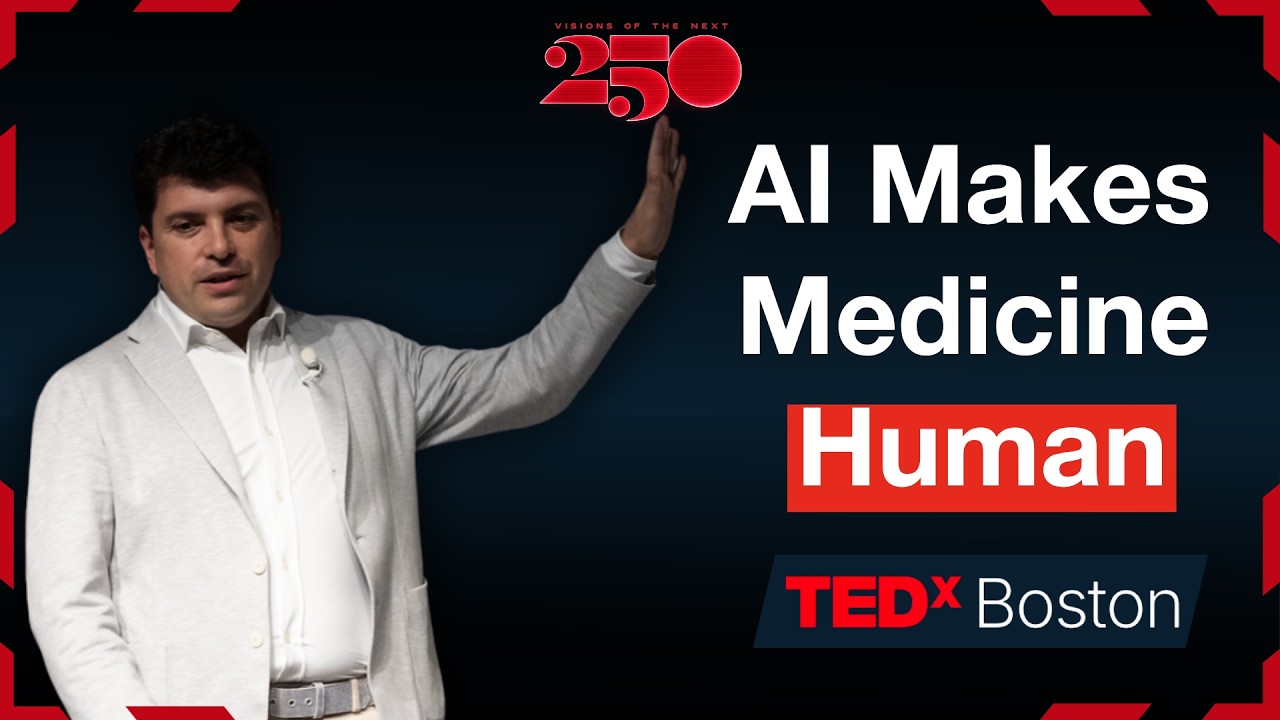


The Vision for AI in Healthcare
- The vision for the next 250 years involves improving the connection between physicians, scientists, and patients, with a focus on using artificial intelligence to revolutionize care and make it more human 10s.
- About 250 years ago, Massachusetts helped launch a revolution, and similarly, it is believed that AI will revolutionize brain care, with the goal of making care more human 2m6s.
- The story of Paul Revere and the lanterns in the Old North Church is used as an analogy to describe how AI can be used to interpret and orchestrate signals, with the goal of transforming a distant threat into an opportunity for the future 4m37s.
- One goal of using AI in healthcare is to give the provider back to the patient, by using machines to carry and record conversations, allowing patients to have more personal interactions with their healthcare providers 6m15s.
AI as a Tool for Personalized and Human-Centered Care
- The current healthcare system requires patients to come to the doctor's office at scheduled moments, but with AI, it will be possible to listen in on patients' struggles and daily lives, and use this information to provide more personalized care 8m30s.
- AI can be used to analyze speech patterns, such as spectrograms, to differentiate between patients with neurologic diseases and those without, and to understand their struggles and needs 10m45s.
- Similarly, AI can be used to analyze motor skills, such as arm movements, to track the progression of diseases like ALS, and to provide more personalized care 12m50s.
- The key to improving healthcare is to bring medical care into the space outside the office, where patients spend most of their time, and to use AI to provide more personalized and human-centered care 15m10s.
AI in Diagnosing and Monitoring Neurological Conditions
- The human brain's ability to connect to people socially is affected by neurological brain disease, which impacts the networks and social connections that people have, and researchers have studied how these networks are affected, with the goal of helping people understand if their social network is deteriorating 10s.
- A map was designed to help communicate with families of patients in coma, using a dashboard to provide information and guide decision-making, and this map has been studied in simulation through about 60 hours of interviews to determine its effectiveness 2m6s.
Innovation in Medical Technologies and Treatments
- The journey of developing new technologies and treatments is ongoing, and the goal is to move beyond the current state of knowledge and into the next generation of innovations, such as implants that allow patients with spinal cord injury or ALS to communicate and manipulate computers 4m30s.
- Advances in medical technology, such as ultrasound-guided images, are improving the ability of surgeons to perform brain surgery and remove tumors, and treatments are becoming more personalized through the use of biology and data to design targeted therapies 6m20s.
Iterative Development and Real-World Application of New Technologies
- The development of new treatments and technologies is an iterative process that involves co-design and testing in real-world settings, with the goal of bringing conversation and connection back to people and making them feel more connected to their communities 8m10s.
- The use of data and analytics is also improving the ability to monitor patients and provide personalized care, with examples including the analysis of EKGs from hundreds of thousands of patients to identify high-risk individuals and provide targeted interventions 10m40s.
Principles and Frameworks for a New Healthcare Revolution
- The goal is to transition from identifying hidden health risks, such as the possibility of a stroke, to providing care, and to do so by following certain principles 10s.
- Every revolution needs principles, and in this case, having a set of guiding principles, similar to a bill of rights, is essential for moving forward 42s.
- One key principle is to think about connecting healthcare providers from a traditional office space to a more expansive, wall-less environment, allowing for greater collaboration and knowledge sharing 1m6s.
- This concept of an "office without walls" can be further expanded to create an "institute without walls", where institutions like the Mass General Brigham Neuroscience Institute can connect with others across the country 1m30s.
- The vision is to create a free institute of learning health systems without walls, where healthcare providers can learn from hundreds of thousands of patients, rather than just those they have seen personally 2m6s.