

Early Life and Engineering Career
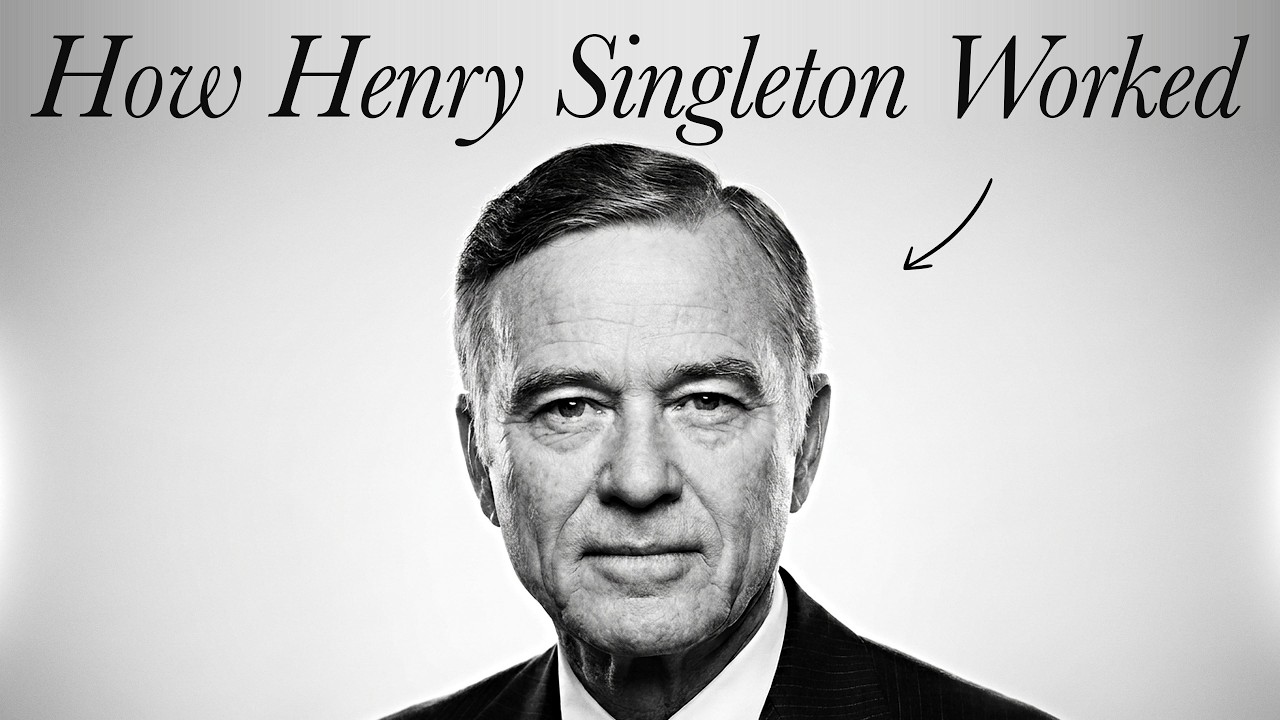
- Henry Singleton was a mathematician who possessed a doctorate in electrical engineering and programmed the first computer at MIT. 0s
- During World War II, Singleton developed technology that enabled Allied ships to evade radar detection. 0s
- In the 1950s, Singleton created a guidance system that remains in use for most commercial and military aircraft. 0s
Founding and Growth of Teledyne
- Singleton founded the conglomerate Teledyne in the early 1960s. 0s
- Unlike many conglomerates of the 1960s, Teledyne operated under a highly unusual model that included aggressive stock repurchases, eventually resulting in the company buying back over 90% of its own shares. 25s
- Singleton avoided paying dividends, prioritized cash flow over reported earnings, maintained a decentralized organizational structure, and never split the company's stock. 25s
- Known as "the Sphinx," Singleton was reluctant to communicate with journalists or analysts. 25s
- Over his nearly 30-year tenure at Teledyne, Singleton achieved an annual compound return of 20.4% for his investors. 25s
- An investment of one dollar in Teledyne in 1963 would have been worth 180 dollars by the time Singleton stepped down in 1990. 42s
- Charlie Munger described Singleton’s financial returns as "utterly ridiculous" and significantly higher than those of his peers. 42s
Principles of Capital Allocation
- Successful CEOs must excel at both operational efficiency and the deployment of generated cash. 42s
- Warren Buffett noted that many CEOs are not skilled in capital allocation because they typically rise to leadership through roles in marketing, production, engineering, administration, or politics, rather than through experience in financial allocation. 42s
- Singleton utilized an extreme form of decentralization, maintaining a small corporate staff while concentrating authority and responsibility within individual business units. 1m25s
- Singleton believed that capital allocation is the most important job of a CEO and that long-term success is measured by the increase in per-share value rather than total company size. 1m25s
- Singleton held that cash flow determines long-term value, decentralized organizations foster entrepreneurial energy, and independent thinking is vital to success. 1m25s
- Singleton viewed interactions with the outside world as distracting and believed that a company's own stock can sometimes be the best investment opportunity. 1m25s
- Regarding acquisitions, Singleton practiced both patience and occasional boldness. 1m25s
- Unlike other high-profile CEOs who focused on powerful ideas, Singleton maintained a pragmatic focus on cash flow, which he identified in a 1979 interview as the key to his business. 1m45s
Management Philosophy and Legacy
- Henry Singleton attributed his approach to cash generation and asset management to his own independent thinking rather than copying others 0s.
- Warren Buffett described Singleton as having the best operating and capital deployment record in American business, noting that his performance surpassed the combined achievements of top business school graduates 5s.
- Singleton maintained a focus on capital allocation and adapted to changing macroeconomic conditions over a period of nearly 30 years 23s.
Academic Background and Early Professional Path
- Born in 1916 in Texas, Singleton was a mathematician and scientist who earned bachelor’s, master’s, and PhD degrees in electrical engineering from MIT 36s.
- During his time at MIT, Singleton programmed the first student computer for his doctoral thesis and won the Putnam Medal in 1939 as the top mathematics student in the country 46s.
- Singleton was a skilled chess player capable of playing the game blindfolded 56s.
- After graduating in 1950, Singleton worked as a research engineer at North American Aviation and Hughes Aircraft before joining Litton Industries under Tex Thornton 1m4s.
- Singleton left Litton Industries at age 43 in 1960 after realizing he would not succeed Thornton as CEO 1m13s.
Teledyne Acquisition Strategy
- In July 1960, Singleton and his colleague George Kozmetsky founded Teledyne 1m25s.
- Teledyne began by acquiring three small electronics companies, which provided the base to secure a large naval contract 1m30s.
- Teledyne became a public company in 1961, entering the market during the conglomerate era when high price-to-earnings (PE) ratios allowed companies to use their stock as currency for acquisitions 1m36s.
- During the 1960s, the lack of private equity competition and the ability to acquire companies at lower PE multiples than the acquirer's own stock created an arbitrage opportunity 1m48s.
- Between 1961 and 1969, Singleton acquired 130 companies across diverse industries, including aviation electronics, specialty metals, and insurance, using Teledyne stock for all but two of these purchases 2m5s.
- Singleton’s acquisition strategy focused on profitable, growing companies with leading positions in niche markets, while avoiding turnaround situations 2m17s.
- Teledyne’s specialty metals division focused on high-margin products sold by the ounce rather than the ton 2m28s.
- In 1967, Singleton acquired Vasco Metals and appointed its president, George Roberts, as president of Teledyne, while Singleton retained the roles of CEO and chairman 2m34s.
- After George Roberts joined, Singleton shifted his focus away from operations to concentrate on strategy and capital allocation 2m43s.
- In mid-1969, Singleton stopped all acquisitions and dismissed his acquisition team because rising acquisition prices and falling stock multiples made his stock less attractive as currency 2m50s.
- Following this shift in strategy, Teledyne ceased making material purchases and stopped issuing new shares of stock 3m5s.
Operational Management and Decentralization
- Henry Singleton prioritized flexibility in his management approach, frequently adjusting strategies based on real-time conditions rather than adhering to a fixed plan 0s.
- Singleton viewed his primary responsibility as acting in the company's best interest on a daily basis, using the metaphor of "steering the boat" each day 0s.
- Rejecting contemporary trends like synergy and integration, Singleton implemented extreme decentralization by breaking the company into its smallest possible components 25s.
- Teledyne operated with a lean headquarters staff of fewer than 50 people, despite having over 40,000 total employees, and notably lacked human resources or investor relations departments 42s.
- After the company's acquisition phase slowed, Singleton shifted focus to optimizing existing operations for free cash flow rather than prioritizing reported earnings, which was the standard Wall Street metric at the time 1m12s.
- To incentivize cash generation, the company created a unique metric called the "Teledyne return," which averaged cash flow and net income to determine bonus compensation for business unit general managers 1m25s.
- Singleton warned that Teledyne’s quarterly earnings would fluctuate because the accounting practices were specifically designed to maximize cash flow rather than reported earnings 1m42s.
- Beginning in 1970, these initiatives resulted in consistent profitability across diverse market conditions, with 129 out of 130 business units reporting a profit in 1978 1m55s.
Capital Allocation and Share Repurchases
- Cash generated by business units was sent to headquarters, where Singleton made unconventional and effective capital allocation decisions 2m15s.
- Singleton initiated a series of share repurchases starting in 1972, arguing that the company's stock was undervalued and that buying back shares provided a better return than other investment opportunities 2m25s.
- Between 1972 and 1984, Singleton conducted eight separate tender offers, repurchasing 90% of Teledyne's outstanding shares 3m5s.
- Although stock buybacks were considered a sign of weakness by Wall Street at the time, Singleton ignored this orthodoxy, earning him the reputation as the "Babe Ruth of repurchases" 2m45s.
- Singleton viewed share repurchases as a way to "coil a spring," believing that buying stock at attractive prices would eventually lead to a surge in value for shareholders 3m15s.
- Through these repurchases, Singleton generated a 42% compound annual return for Teledyne shareholders 3m30s.
Business Efficiency and Cost Control
- Companies utilizing the Ramp platform typically reduce their expenses by 5% and increase their revenue by 16%. 0s
- A dedicated focus on cost control can enable businesses to pursue new opportunities and gain a compounding competitive advantage over rivals. 5s
Investment Strategy and Portfolio Concentration
- Henry Singleton maintained a lifelong fascination with the stock market, which he began to act upon in the mid-1970s by managing the stock portfolios of Teledyne’s insurance subsidiaries during a severe bear market. 42s
- Singleton employed an idiosyncratic investment strategy characterized by high concentration, with over 70% of his equity portfolios invested in only five companies and 25% allocated to a single firm, Litton Industries. 56s
- Wall Street observers were concerned by Singleton’s portfolio concentration, often speculating that he was preparing for new acquisitions. 1m8s
- Singleton focused his investments on companies he understood well that were trading at or near record-low price-to-earnings ratios. 1m14s
- Charlie Munger noted that Singleton, similar to himself and Warren Buffett, was comfortable with portfolio concentration and invested only in businesses he understood. 1m20s
Management Style and Independent Thinking
- Singleton managed his time by avoiding day-to-day responsibilities and rigid job definitions, preferring the freedom to act in the best interest of the company at any given time. 1m30s
- Rather than relying on detailed strategic plans, Singleton prioritized flexibility and the ability to react to unpredictable outside influences. 1m45s
- Singleton’s management philosophy centered on steering the company daily rather than planning far into the future. 1m55s
- Singleton maintained an independent mindset throughout his life, famously remarking two years before his 1997 death that if many Fortune 500 companies were performing large share repurchases, there was likely something wrong with the practice. 2m6s
- The life and management style of Henry Singleton are documented in the books The Outsiders by William Thorndike and Distant Force by George Roberts. 2m25s
- Warren Buffett and Charlie Munger held Singleton in high regard, with Munger describing him as the smartest person he had ever met and noting that Singleton achieved many business successes before they did. 2m35s
Comparison with Warren Buffett
- Henry Singleton and Warren Buffett shared a management approach, with Singleton’s practices at Teledyne serving as a precursor to Buffett’s methods at Berkshire Hathaway 0s.
- Both leaders designed their organizations to prioritize capital allocation over daily operations, viewing themselves primarily as investors rather than managers 25s.
- Their companies were highly decentralized, maintaining minimal corporate staff and few layers of management between operating units and top leadership 35s.
- Singleton and Buffett personally made all major capital allocation decisions and focused their investments on industries they understood well 45s.
- Neither leader provided quarterly guidance to analysts, opting instead to issue informative annual reports that included detailed business unit information 55s.
- Both men utilized insurance company float as a tool to create shareholder value, with insurance serving as the primary business for both organizations 1m5s.
- By operating unconventional businesses, both leaders attracted long-term, like-minded shareholders 1m15s.
- Singleton was characterized as a rugged individualist with a unique management philosophy who often moved in a different direction than the broader market 1m25s.
Strategic Vision and Talent Management
- Teledyne was founded to capitalize on the transition from analog to digital technology, with the goal of applying semiconductors to various fields of commerce 1m55s.
- Singleton was a student of business history, drawing lessons from the growth of companies like Ford and General Motors and the strategies of successful corporate acquisitions 2m15s.
- Singleton possessed a rare combination of skills, including mathematical genius, engineering talent, financial analysis, and the strategic creativity of a tournament chess player 2m35s.
- A core component of Singleton’s success was his commitment to surrounding himself with highly talented, creative, and capable people 2m55s.
- Singleton’s professional network included Claude Shannon, a fellow MIT student who served on the Teledyne board for approximately 26 years 3m15s.
Intellectual Foundations and Early Career
- Henry Singleton was a highly accomplished mathematician who ranked first in his class of 820 students and won the Putnam Award, a prestigious and difficult mathematics competition 0s.
- Charlie Munger described Singleton as the smartest person he had ever met 0s.
- Singleton is recognized for his technical expertise and his contributions to the science of information technology, which serves as the foundation for modern digital computer technology 0s.
- Before founding Teledyne, Singleton worked for Howard Hughes, where he demonstrated a pilot training fire control simulator and held late-night meetings with Hughes 25s.
- Singleton developed an interest in financial markets during the 1940s and 1950s, spending time in brokerage houses to observe stock tickers and study how capital is allocated and how shares are valued 55s.
- He observed that companies with steady growth rates were often rewarded by the market with increasing price-to-earnings (PE) multiples 55s.
- Singleton believed that digital and semiconductor technology would become the dominant force in control systems and electronic fields 1m15s.
- While working at Litton, Singleton proposed that the company enter the semiconductor field to control the design of components, but the president of Litton rejected the idea, citing a crowded and competitive market 1m15s.
- At age 43, Singleton and George decided to leave their positions and invest $450,000 of their own capital to start a new electronics company 1m35s.
Compliance and Operational Efficiency
- Vanta provides automated compliance and security monitoring services designed to help startups and enterprises streamline workflows and secure contracts 0s.
- Customers using Vanta report an average return on investment of 526% by automating compliance processes 15s.
Core Business Strategies
- Henry Singleton entered the semiconductor industry in 1960 during a business crisis, prioritizing long-term growth over immediate financial gain 42s.
- Singleton believed that manufacturing electronic control systems required an internal capability in component development to enhance system design and provide better insight into component utility 1m5s.
- Teledyne was built on three core strategies: identifying the future importance of digital semiconductor electronics, acquiring financial companies to establish a strong fiscal base, and utilizing stock buybacks 1m25s.
- Growth through acquisition was a central component of Teledyne’s strategy from its first year of operation 1m55s.
- Singleton possessed a high level of mental acuity, illustrated by his ability to play chess without looking at the board and his capacity to identify errors in move sequences recalled by his opponent 2m10s.
- When asked if he intended to create another Litton, Singleton stated his goal was to build a company comparable to General Electric 2m35s.
- Singleton diversified Teledyne by acquiring companies outside of his original electronics, government, and military markets to ensure overall profitability 2m48s.
- Singleton compared Teledyne to a living plant, where individual companies acted as branches that grew and expanded, ensuring that no single business unit became overly significant to the whole 3m0s.
- Teledyne’s growth functioned as a flywheel, where new technologies opened paths to related fields, often leading managers of individual units to recommend further acquisitions 3m15s.
Operational Expansion and Profit Centers
- Teledyne expanded its operations into oceanography and offshore petroleum exploration by utilizing geophysical and seismic products to profile geological strata for oil drilling 0s.
- The company organized its business into 130 distinct profit centers, with only one center reporting a financial loss during the previous year 15s.
- Henry Singleton emphasized talent management as a primary key to success, focusing on the managerial capabilities of the individuals leading the businesses he acquired 45s.
- Teledyne maintained a "management inventory" to identify and promote high-performing individuals, operating under the belief that the company's success was directly tied to the success of its people 1m5s.
- Managers who met their performance targets were granted autonomy, as Singleton believed in allowing successful employees to manage their operations without corporate interference 1m25s.
- Teledyne encouraged its employees to view external large corporations as their primary competition rather than competing against one another internally, framing the growth of earnings as a competitive game 1m40s.
- When acquiring companies, Teledyne preferred that the original owners or managers remain in their positions because of their deep knowledge of their specific fields, markets, and production technologies 2m5s.
- In instances where original owners were ready to retire, Teledyne sought to replace them with relatives or top technical executives who possessed sufficient knowledge of the business 2m25s.
- Teledyne implemented a unique financial and operations reporting system to monitor the performance of its various business units on a monthly basis, allowing the company to identify and address potential issues early 2m45s.
- Henry Singleton prioritized speed in his decision-making, evidenced by the acquisition of 90 companies during the three-year period between 1966 and 1969 3m0s.
- Meetings with Singleton were characterized by brevity and a high degree of candor, which served as the foundation for his professional relationships 3m15s.
Frugality and Operational Discipline
- Henry Singleton prioritized efficiency in meetings and maintained a strong aversion to wasting time and money. 0s
- To demonstrate the value of frugality, Singleton frequently took colleagues to inexpensive poker parlors for lunch and expected them to pay the bill. 7s
- Singleton once suggested that staff members use Ford Pintos as company cars, despite the vehicle's poor reputation for safety and its small size, which made it difficult for taller employees to fit inside. 25s
- A core expectation for those working with Singleton was a comprehensive, "A to Z" knowledge of their business operations. 55s
- Singleton valued leaders who could provide exact numerical answers regarding their company's performance, such as monthly sales figures, without needing to consult others. 1m20s
- The corporation operated on the principle of breaking companies down into the smallest possible units to improve management control, increase local accountability, and motivate performance. 1m45s
- Singleton was willing to exit businesses when they were no longer viable, as demonstrated by the closure of the television operation after competition from Japanese manufacturers became too severe. 2m15s
- The acquisition of Packard Bell for $16.5 million in common stock and the assumption of $5 million in debt was initially profitable before the business environment changed. 2m18s
Evolution of Acquisition Strategy
- During the 1960s, the company focused on aggressive growth, acquiring over 130 companies. 2m45s
- By 1969, the company ceased acquisitions because Singleton believed the prices of target companies had become unreasonable due to increased competition from other conglomerates. 2m55s
- The decision to stop acquiring companies was also influenced by a business recession, declining earnings per share, a depressed stock market, and a lack of attractive acquisition targets. 3m15s
- After acquiring approximately 150 companies, the strategy shifted toward organizing and consolidating existing assets rather than purchasing entire new companies. 3m35s
- Following the consolidation phase, the company transitioned its strategy to purchasing pieces of companies through the stock market. 3m45s
Stock Market Investments and Autonomy
- By 1970, Teledyne ceased the direct acquisition of entire companies because the firm determined that market prices for full ownership were often inflated 0s.
- Henry Singleton argued that purchasing individual stocks offered better value than acquiring entire companies, noting that acquisition premiums often forced multiples up to 12 or 14 times earnings 25s.
- Singleton maintained that paying 15 times earnings for a company would only yield a 6% to 7% return, a rate he could achieve through Treasury bills without the risks of acquisition 55s.
- Teledyne’s investments in stocks were intended solely to generate high returns rather than to serve as a strategy for future takeovers 1m15s.
- Despite public speculation that Teledyne was using stock purchases as a guise for future hostile takeovers, Singleton explicitly denied these intentions and dismissed critics who doubted his stated strategy 1m35s.
- Singleton was known for his obsession with operational details, exemplified by his personal involvement in the design, shape, and proportions of the Teledyne logo 2m25s.
- Teledyne operated under a philosophy of high autonomy for individual company presidents, placing significant trust and responsibility on them to ensure the success or failure of the business 2m55s.
- Singleton held a strong conviction that people were the most important factor in a business and believed that competent managers should be left alone to perform their jobs without interference 3m15s.
- By 1977, Teledyne had become the largest shareholder in nine Fortune 500 companies 3m50s.
- Although Teledyne held enough shares in six of those corporations to effectively exert control, Singleton never sought board seats or attempted to exercise that potential influence 4m5s.
Shareholder Relations and Passive Ownership
- Henry Singleton faced speculation that he intended to take over corporations in which he held significant shares, leading to unease among some managers 0s.
- Despite being the largest shareholder of Curtiss-Wright, Singleton assured the company's management that he had no intention of interfering in their affairs 10s.
- A spokesperson for Curtiss-Wright noted that Singleton remained scrupulous in avoiding involvement in the company's internal affairs 25s.
The Teledyne Return Metric
- Singleton developed a performance metric known as the "Teledyne return," which was calculated as the average of a business unit's cash return and its profit 42s.
- The Teledyne return was defined as the sum of net income and cash flow divided by two 1m15s.
- The primary purpose of the Teledyne return was to prevent managers from optimizing solely for accounting earnings, as Singleton believed economic results were often worse than income statements suggested if cash flow was low 1m28s.
- Teledyne operated as a collection of decentralized businesses, and the Teledyne return allowed Singleton to grant managers operational autonomy while maintaining a single metric to evaluate economic value creation 1m48s.
- The metric served to discourage managers from boosting reported earnings by consuming working capital, such as through excessive inventory accumulation or generous credit extensions, which would otherwise cause cash flow to deteriorate 2m6s.
Mentorship and Strategic Communication
- Singleton’s broader philosophy centered on the idea that subsidiaries existed to generate cash, while his role at headquarters was to allocate that cash 2m26s.
- Singleton acted as a teacher to his organization, frequently holding one-on-one sessions with managers to explain his business philosophy, financial strategies, and the impact of their actions on the company 2m36s.
- These teaching sessions occurred in various settings, including over coffee, at lunch, in his office, or while he was working on his Apple computer 3m5s.
- Singleton was regarded as a brilliant strategist who often employed creative ideas that contradicted the prevailing management methods of the time 3m23s.
- Claude Shannon described Singleton as someone who worked in silence and avoided discussing his strategies, comparing his approach to playing a game where one does not reveal their moves to others 3m38s.
- Singleton compared his strategic approach to playing golf 4m3s.
Long-Term Perspective and Personal Discipline
- Henry Singleton expressed a strong aversion to short-term thinking, prioritizing permanent gains over quick, temporary increases in earnings or stock prices 0s.
- Singleton rejected the practice of selling one division to buy another simply to manipulate price-to-earnings multiples, viewing such strategies as repulsive and contrary to his focus on long-term economic possibilities 35s.
- At the time of his death, Singleton was the third-largest landowner in the United States, having maintained a policy of never selling any real estate he acquired throughout his life 1m15s.
- Following his retirement from Teledyne, Singleton spent his final years managing his ranch, where he personally signed every check for expenses as a form of discipline 1m35s.
- Singleton believed that personally managing and reviewing every business expense provided valuable insight into the operations of the business 1m55s.
Professional Reputation and Intellectual Legacy
- Warren Buffett described Singleton as having the best operating and capital employment record in American business, suggesting that the collective achievements of the top 100 business school graduates would not match Singleton's record 2m25s.
- Buffett expressed that it was a failure of business schools not to study Singleton’s career 2m45s.
- Charlie Munger characterized Singleton as a genius with an awesome intellect, estimating his raw intelligence to be in the top 1,000th of 1% and describing him as the smartest human being he had ever known 2m55s.
- Munger distinguished between raw intelligence and accumulated experience, noting that while Singleton possessed superior raw intelligence, Buffett had a longer history of dedicated investment experience 3m15s.
- Singleton did not start his company until he was 43 years old and began investing cash in his 50s, whereas Buffett began investing at age nine 3m30s.
Personal Character and Analytical Approach
- Henry Singleton first met his future employer at MIT half a century ago during a recruitment drive for engineering doctorate graduates 0s.
- Singleton’s academic records stood out from his peers because he achieved a perfect score of 100 in every course and final exam, whereas other graduates typically scored in the 80s or 90s 15s.
- During his initial interview, Singleton distinguished himself by asking detailed questions about the company’s projects and operations in Southern California rather than simply reciting his own accomplishments 35s.
- Although Singleton began his career as an engineer, an unexpected opportunity led him to transition into a role focused on finding, acquiring, merging, and managing other companies 53s.
- As a CEO, Singleton utilized his analytical skills to evaluate the true value, stock prices, competition, and growth potential of various corporations 1m10s.
- Singleton worked from a standup desk with a computer and developed a deep, comprehensive understanding of markets and corporations 1m20s.
- Singleton frequently frustrated Wall Street and the business media by ignoring them and maintaining a preference for anonymity despite his business success 1m27s.
- Contrary to the perception that he was solely a "numbers guru" uninterested in the human element of business, Singleton demonstrated a focus on people when making investment decisions 1m40s.
- Singleton invested in Apple because he believed the company name would be less intimidating to potential customers than other computer brands 2m5s.
- Singleton also reasoned that Apple’s founders were uniquely committed to succeeding, whereas the founders of other failing computer startups would likely just walk away 2m20s.
- Those who knew Singleton personally experienced his warmth and sincere consideration, which existed beneath his reserved exterior 2m30s.