
Origins and Evolution of Merchant Banking Dynasties
- Merchant banking dynasties typically originate with a pioneer who begins with nothing and achieves significant wealth, such as the Rothschilds, who started as coin changers, or the Warburgs, who began in the grain trade 0s.
- The transition from commodity trading to banking often involved a shift from physical goods to credit, with early merchant bankers frequently operating as coin changers before establishing formal banking houses 25s.
- A common practice among early merchant bankers was to lend money based on personal character and trust, sometimes without requiring collateral if the borrower was deemed reliable 18s.
- Family involvement was a central feature of merchant banking, as the sons of the founder typically became partners in the firm, leading to the establishment of multi-generational banking houses 35s.
The Culture of Secrecy and Discretion
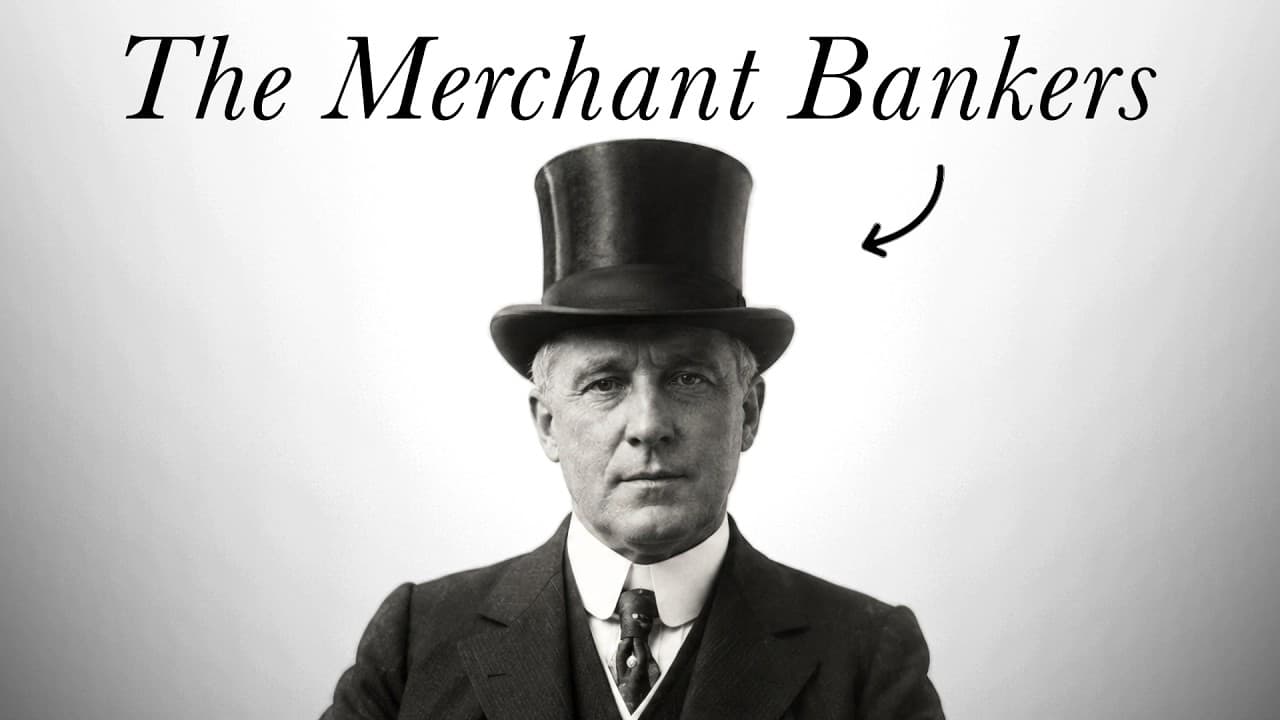
- The book The Merchant Bankers, written by Joseph Wechsberg and published in 1966, examines the history and business practices of several prominent banking families, including the Rothschilds, Barings, Lehman Brothers, Hambros, and Warburgs 1m15s.
- Merchant banking is characterized by a long-standing, gentlemanly approach to conducting business that has persisted across centuries and multiple family dynasties 2m6s.
- Despite the fame of many merchant banking names, the specific mechanisms of how these institutions operate and generate profit remain largely obscure to the general public and even to many individuals working within the industry 2m45s.
- The concept of merchant banking is often associated with international intrigue, the financing of empires, and the influence of world powers, kings, and dictators 0s.
- Merchant banking is characterized as a highly private business that resists formal definition, with practitioners often preferring to remain mysterious or avoiding specific titles altogether 15s.
Operational Mechanisms and Business Strategies
- Most merchant banking firms originated as family businesses, often transitioning from trading physical commodities to dealing in credit 32s.
- Merchant bankers discovered that selling their signature on financial instruments was more profitable and efficient than trading physical goods like silk 55s.
- The foundational mechanism of merchant banking involved guaranteeing transactions by accepting bills of exchange in return for a commission, which required the banker to cover the costs if a transaction failed 1m15s.
- Success in merchant banking required a combination of boldness, instinct, judgment, and access to exclusive information, including secrets 1m30s.
- Different merchant banking dynasties often arrived at similar business strategies independently, and many of these families eventually formed long-term professional relationships with one another 1m45s.
Core Values of Trust and Reputation
- Integrity, common sense, and commercial honor were considered the most vital assets, with character being valued more highly than immediate wealth 2m15s.
- Merchant bankers prioritized long-term relationships over short-term gains, often choosing to absorb financial losses rather than compromise their reputation or damage a multi-generational partnership 2m35s.
- The industry relied on absolute confidence between family members and partners, which was essential because much of the business was conducted without formal documentation 3m5s.
- Merchant banking is viewed as an art rather than a science, and practitioners intentionally maintain secrecy to protect what they refer to as the "magic" of their operations 3m25s.
- A recurring motto in the industry is "We must not let in daylight upon magic," reflecting a preference for discretion and the tendency to keep the majority of their thoughts and activities private 3m40s.
- Examples of this culture of secrecy include the Rothschild family, who restricted access to their archives, and the Baring family, who historically omitted their name from their letterhead 4m0s.
Modern Financial Platforms and First Principles
- SpaceX is recognized as one of the most valuable businesses globally, with a core operational theme of consistently questioning and controlling costs to enable new revenue-generating opportunities 0s.
- Ramp is a financial platform designed to assist businesses in managing expenses through first principles thinking, with data indicating that the median company using the platform reduces expenses by 5% and grows revenue by 16% 5s.
Case Study in Rapid Transaction Execution
- A merchant banker once received an urgent Friday afternoon call from a prominent Norwegian ship owner who required £200,000 within 30 minutes to secure the release of a ship held by an Amsterdam shipyard 55s.
- Failure to pay the shipyard would have resulted in the ship being detained over the weekend, costing the owner at least £20,000 in charter fees, crew expenses, and lost profits 1m15s.
- The merchant banker facilitated the transaction by calling a bank in Amsterdam and instructing them to pay the shipyard on his behalf, ensuring the ship's immediate release 1m30s.
- The entire transaction was completed in approximately three minutes without the use of formal contracts or paperwork 2m0s.
- A young German bank manager observing the interaction expressed shock and dismay, noting that such an action would have resulted in his immediate dismissal from his own bank due to the lack of verification regarding the caller's identity, the client's creditworthiness, and the absence of authorization from superiors 2m25s.
- The incident, documented in 1966, serves as an illustration of the distinct operational methods and mindset that differentiate merchant bankers from other professionals in the finance sector 2m55s.
The Role of Trust and Intermediary Services
- Merchant bankers prioritize fast, personal service to secure credit for clients, noting that larger banks would likely take a week to process similar requests through bureaucratic channels and committee meetings 0s.
- The merchant banking business model relies fundamentally on trust and reputation, which are considered the most valuable assets of the firm 35s.
- Charlie Munger identified trust as one of the greatest economic forces on earth, a concept that aligns with the historical practices of merchant banking 45s.
- Merchant banks operate without large internal bureaucracies, instead utilizing a vast external network and the prestige of their name to facilitate transactions 1m5s.
- The primary function of a merchant bank is to act as an intermediary; they provide access and credit to clients by leveraging the trust that banks have in the merchant bank, even when those banks do not trust the client directly 1m45s.
- Warren Buffett emphasized the importance of reputation during his testimony regarding the Salomon Brothers scandal, stating that while a firm can afford to lose money, it cannot afford to lose its reputation 1m25s.
Relationship Building and Professional Intuition
- Discretion and the ability to keep secrets are essential to the merchant banking business, as access to information is a critical component of their ability to generate profit 2m5s.
- Merchant bankers often spend time with clients discussing topics unrelated to business, such as farming, roses, horses, politics, and family, to build relationships 2m25s.
- During these social interactions, merchant bankers carefully scrutinize potential clients to assess their character, which informs the decision of whether to provide credit and what level of security to require 2m45s.
- Merchant banking is described as an abstract art rather than a concrete science, relying on a combination of experience, flair, analysis, and instinct 3m10s.
- Within the industry, mistakes are viewed as inevitable, and while employees may be terminated for incompetence, they are not fired for making occasional mistakes 3m25s.
Unorthodox Business Practices and Philosophy
- Merchant banks differentiate themselves from large corporations by prioritizing speed in decision-making, even if it occasionally leads to errors 0s.
- The business environment for merchant bankers is described as competitive, aggressive, and non-routine, requiring individuals to learn as they progress 12s.
- Merchant banking is characterized by a lack of set patterns and a consciously unorthodox approach to business 24s.
- The scope of merchant banking is broad, as these institutions attempt to cater to any business concern involving money 32s.
- Merchant banking is not taught in schools, and the quality of a merchant bank is limited by the quality of the people employed there 38s.
- Unlike large banks that rely on deposits, merchant bankers rely on their own wits 46s.
- Relationships are a fundamental component of the industry, as they often dictate how business is conducted and how rules are applied 52s.
Flexibility and the Power of Personal Connections
- While merchant banks may have formal policies, such as minimum deposit requirements, these rules are often malleable for friends or established contacts 1m3s.
- A personal connection with someone who has a long-standing relationship with a bank can allow an individual to bypass standard requirements 1m35s.
- Trust is the primary offering of a merchant bank, and the industry relies heavily on the custom of verbal contracts rather than extensive paperwork 1m51s.
- Merchant bankers are described as trustful optimists, and trust is viewed as a significant economic factor that simplifies business transactions 2m6s.
- A core philosophy of merchant banking is to simplify matters, which is contrasted with the tendency of lawyers to complicate them 2m22s.
- Charlie Munger advised entrepreneurs to avoid letting lawyers kill deals, emphasizing that trust in a partner can facilitate high-value transactions 2m45s.
- An example of this trust-based approach involved Warren Buffett wiring money for a deal without an email or legal consultation, ultimately resulting in a profit of several hundred million dollars 3m0s.
Strategic Management and Business Models
- The primary assets of a merchant bank, specifically the expertise of its staff and its network of outside contacts, are not recorded on the balance sheet 0s.
- Merchant banks prioritize reputation and maintain an advantage over larger banks by gathering detailed information on potential business partners, including their business operations, customer base, and financial statements 10s.
- These banks maintain flexibility by intentionally limiting their headcount and the overall size of the organization 42s.
- Merchant banks exercise caution regarding their areas of expertise, often declining business opportunities in regions or sectors where they lack sufficient knowledge 42s.
- A core practice of merchant banks is the careful management and protection of their public image, emphasizing the importance of appearing industrious and frugal while maintaining secrecy 1m5s.
- The business model of a merchant bank is defined by activities involving money where the firm can leverage its reputation, discretion, and professional relationships 1m35s.
- Special situations departments within these banks often nurture promising ideas from their inception as private companies through to their eventual success as public entities 1m35s.
- While merchant banks historically provided only capital to the companies they supported, they now provide both money and advice, with the latter often being considered the more valuable contribution 1m35s.
- Merchant banks act as "marriage brokers" by arranging amalgamations, a process described as economic cross-fertilization 1m35s.
- These banks typically avoid taking control of the companies they invest in, preferring to hold minority interests and leaving operational management to the existing leadership 2m6s.
- Merchant banks are opportunity-driven and willing to pursue any venture that generates profit, acknowledging that such pursuits sometimes result in financial losses 2m6s.
- Many merchant banking houses maintain a tradition of reminiscing about the historical successes and "colorful coups" of their ancestors 2m25s.
- Despite the emphasis on manners and societal standing among later generations of merchant bankers, the original founders of these institutions were often cutthroat merchants who operated in aggressive and sometimes illicit ways 2m25s.
Historical Perspectives on Wealth and Power
- The origins of wealthy family dynasties often trace back to individuals who started with nothing and built their fortunes through aggressive, unconventional, or illicit means, despite how later generations may view their own status 0s.
- In the context of the series Game of Thrones, the character Bronn is identified as an entrepreneurial figure who rises from poverty in Flea Bottom to a position of significant power over the course of the show 35s.
- A dialogue between Jaime Lannister and Bronn highlights the disconnect between established, wealthy families and self-made individuals, with Bronn asserting that the ancestors of great houses were often "cutthroats" rather than the refined figures their descendants imagine 1m15s.
- Historical merchant banking dynasties, such as the Rothschilds and the Barings, frequently built their initial wealth through activities like smuggling gold or illegally transporting materials through war blockades 2m6s.
The Intangible Assets of Merchant Banking
- Ideas serve as the lifeblood of merchant bankers, who rely on the collection of information and the cultivation of trust and reputation to identify and execute business opportunities 2m25s.
- Merchant banks are characterized by a lack of physical assets, relying instead on the skills, intelligence, and reputations of the people working within the firm 2m48s.
- The business structure of merchant banks is described as highly efficient and unbureaucratic, allowing for the rapid arrangement of complex financial transactions, such as securing large sums of money in a matter of minutes 3m2s.
Informal Communication and Relationship Management
- Merchant banking operations are characterized by a high degree of secrecy, with important decision-making processes kept internal to the family or partnership 0s.
- The business model relies on quiet, direct conversations between partners rather than formal committee meetings, long speeches, or bureaucratic chains of command 18s.
- Information management in these banks is informal, often relying on the partners' personal knowledge rather than extensive paper files or documentation 25s.
- Merchant bankers prioritize long-term relationships, maintaining loyalty to old customers and friends even during periods of tight money 55s.
- The reputation of the merchant banker serves as a "magic bridge" of trust between buyers and sellers who may not trust one another directly 1m7s.
Modern Technology and Compliance Solutions
- AppLovin is an advertising platform that utilizes first-principles thinking to connect businesses with over a billion potential customers in mobile games 1m20s.
- AppLovin ads consist of full-screen videos with an average retention time of 35 seconds, and the platform is designed for quick setup and rapid scaling 1m35s.
- Vanta provides AI-powered security and compliance automation to help companies manage the complexity of security needs as they grow 2m6s.
- Vanta automates compliance monitoring and provides a single source of truth, which can help businesses secure contracts that require security certification 2m15s.
- Vanta customers report an average return on investment of 526% by using the platform to streamline security and trust-building processes 2m30s.
Key Success Factors and Historical Milestones
- The core strategy of a successful merchant banker is to acquire information slightly earlier than competitors 2m45s.
- Founders of merchant banking firms are often described as eccentric and, in some cases, cutthroat 2m55s.
- The transfer of the Spanish-Mexican silver treasure is cited as the most significant financial transaction in the history of merchant banking 3m15s.
The Ouvrard Affair and International Finance
- Gabriel Julian Ouvrard was a controversial 19th-century French entrepreneur and financier known for his ability to navigate complex political landscapes and work for various European leaders, regardless of their ideologies 0s.
- Ouvrard’s career was marked by extreme volatility, including periods of immense wealth, bankruptcy, and multiple arrests, including one five-year prison sentence 15s.
- In the early 19th century, Spain was obligated by the Treaty of October 19, 1803, to pay Napoleon an annual subsidy of 72 million francs, a sum that was widely considered impossible for Spain to raise 1m5s.
- Ouvrard proposed a plan to satisfy this debt by transporting silver and gold stored in Veracruz, Mexico, to Paris 1m35s.
- The primary obstacle to this plan was a British naval blockade, which prevented the direct transport of the precious metals 1m45s.
- To bypass the blockade, Ouvrard leveraged his connections with the Baring family, a prominent merchant banking firm, to negotiate a deal with the British government 2m5s.
- The British government agreed to allow the transport of the silver and gold on the condition that British vessels were granted access to trade with Latin American ports 2m20s.
- The operation was successfully executed over three years, and by 1808, nearly all the gold and silver had been removed from the Mexican treasury 2m30s.
- Despite orchestrating the scheme, Ouvrard received no financial gain from the operation, as Napoleon eventually confiscated his property and imprisoned him 2m35s.
- Merchant bankers of this era maintained extensive networks of contacts, ranging from prime ministers to local officials, which allowed them to acquire proprietary information and facilitate complex international deals 2m50s.
SG Warburg and Management Philosophy
- The Baring family maintained an extensive intelligence network that provided them with advanced information, allowing them to execute audacious business deals that appeared calculated and well-informed in hindsight 0s.
- Merchant banking is described as a profession that relies heavily on an intuitive understanding of human nature, specifically the ability to assess the trustworthiness and reliability of potential business partners 23s.
- SG Warburg, a prominent merchant banker, prioritized the study of history, philosophy, and classical literature over modern finance, management, or economics, believing these subjects provided superior preparation for his work 42s.
- Warburg maintained that a classical education fosters logical thinking and the ability to perceive information accurately, emphasizing that deep thinking is characterized by lucidity and simplicity rather than complexity 1m15s.
- Warburg intentionally avoided business publications and newspapers, arguing that reading newspapers leads to a loss of memory and that he could acquire necessary information by keeping his ears open to what others told him 1m55s.
- As an enthusiastic nonconformist, Warburg valued being correct over conforming to popular opinion and insisted that theory and practice must always align 2m25s.
- Warburg actively avoided surrounding himself with "yes-men," a management philosophy echoed by Steve Jobs, who removed Pixar board members specifically because they never disagreed with him 2m35s.
- In Warburg’s professional philosophy, influence is considered more important than power, and he acknowledged that talented individuals are often complex and difficult to understand 3m5s.
- When building his company, Warburg prioritized hiring young people and granting them significant authority to influence the organization, a strategy also utilized by the founder of Honda 3m15s.
- Warburg prioritizes youth and team spirit within his organization, specifically recruiting men in their late 20s whom he values with the same enthusiasm others reserve for collecting art. 0s
- The "nursery principal" is a core component of Warburg's management style, requiring younger staff to attend important meetings and produce detailed memos that he personally reviews and corrects. 15s
- Warburg emphasizes the importance of detail, stating that "the good lord lives in the detail," and maintains an organization that operates with the precision of a Swiss watch. 30s
- Despite his meticulous preparation for success, Warburg does not dwell on victories, often returning to his work and concerns within 24 hours of a successful deal. 45s
- Warburg views new ideas as the "bloodstream" of a merchant bank and maintains a consistent personality, described by others as being the same person at home as he is in business. 55s
- Key guiding principles for Warburg include choosing the harder path when faced with a decision and practicing daily self-reflection to identify personal mistakes and areas for improvement. 1m15s
- Warburg defines happiness as the fulfillment of duties rather than the fulfillment of desires, and he views management as a complex task due to the unfathomable nature of people. 1m35s
Fee Structures and Professional Conduct
- Merchant banking fees are typically not discussed until an operation is completed, functioning similarly to a surgeon who saves a life before sending a bill. 1m45s
- Fees for merchant banking services, which cover both financing arrangements and professional advice, typically range from 0.5% to 2% of the total transaction value. 2m0s
- Clients pay a premium for Warburg’s services because of his ability to provide clarity and concise, meaningful communication without superfluous words. 2m15s
Raphael Mattioli and Unorthodox Routines
- Raphael Mattioli, described as a "master of paradox," maintains an unorthodox lifestyle and professional routine. 2m35s
- Mattioli’s home, bank, and publishing house are all located on the same block, allowing him to go days without crossing a street. 2m45s
- Mattioli’s daily schedule involves arriving at the bank after 11:00 a.m., returning home for lunch and a siesta, and working in his office from 5:00 p.m. until 10:00 p.m. or later. 3m0s
- Mattioli prefers working during late evening hours when the bank is empty, believing this time is most conducive to constructive banking. 3m15s
Leadership Styles and Personal Philosophies
- A specific merchant banker is noted for his fondness for paradox and a tendency to confuse others, while also adhering to the principle that one should be willing to admit when they do not understand a subject, even if they are an expert in it 0s.
- This banker maintains a distaste for "yes-men," with managing directors reporting that they hesitate to agree with him because the consequences of doing so can be unpleasant 15s.
- The banker expresses that he does not want employees to think exactly like him, as he views paying someone to replicate his own thoughts as a waste of money 32s.
- He shows little regard for weekends or holidays and often reacts with increased harshness when executives request time off, once describing a broken leg suffered by an employee on the final day of a vacation as "poetic justice" 42s.
- The banker believes that money is meaningless unless it is actively being used 1m5s.
Artisanal Banking versus Mass Production
- Merchant bankers often advocate for reading history and philosophy rather than business publications or newspapers to prepare for their profession 1m11s.
- Merchant banking is described as a personalized, artisanal process, likened to a handmade Rolls-Royce, whereas Wall Street is characterized as a more impersonal, mass-production system similar to a Cadillac 1m25s.
- Merchant bankers leverage their relationships and information to act as individual, opportunity-driven investors who will incubate companies when they identify a market gap 1m38s.
- Lehman Brothers, prior to its collapse, demonstrated this approach by conducting a months-long study of the potash industry, developing the American Potash and Chemical Corporation, and eventually selling it to the Standard Oil Company of New Jersey 1m47s.
- A recurring observation in merchant banking history is that the ventures for which it is most difficult to raise capital often prove to be the most successful 2m18s.
- Investment banking is viewed by some practitioners as a field driven by imagination rather than accounting 2m33s.
- A common mistake noted among merchant bankers is the failure to maintain a long-term view on assets they own, despite their emphasis on long-term relationships 2m45s.
- The industry is characterized by the inevitability of making mistakes, and practitioners must be comfortable with this reality to succeed 2m55s.
- Some bankers reflect that they could have been billionaires had they retained ownership of 20% stakes in the giant companies they once held 3m8s.
- A perspective shared by investor Nick Sleep is that the most successful investors are essentially entrepreneurs who never sold their holdings 3m18s.
- Merchant bankers frequently pursue opportunities that are ignored by more conventional banking institutions 3m26s.
- There is a strong preference for secrecy, discretion, and a lack of bureaucracy, with a widespread aversion to putting agreements or ideas in writing to avoid future conflict 3m34s.
The Case of Ivar Kreuger and Philip Lehman
- Ivar Kreuger was a Swedish engineer who established a global match monopoly and utilized corporate charisma to orchestrate one of the most significant Ponzi schemes in history 8s.
- The biography titled The Match King: Ivar Kreuger, the Financial Genius Behind a Century of Wall Street Scandals details the life and activities of Ivar Kreuger 12s.
- During a meeting at Lehman Brothers, Ivar Kreuger requested that the firm act as his banker 35s.
- Philip Lehman, the patriarch of the bank, was known for possessing an intuitive ability to judge people 28s.
- While Ivar Kreuger spoke at length during the meeting, Philip Lehman took only a few notes on a piece of paper 38s.
- Philip Lehman declined the request to bank for Ivar Kreuger, stating that he maintained a rule against investing in or supporting anything he could not understand based on his notes 45s.
- Philip Lehman explicitly told Ivar Kreuger that his proposal was too complex 52s.
- Several months after his meeting with Philip Lehman, Ivar Kreuger died by suicide 55s.