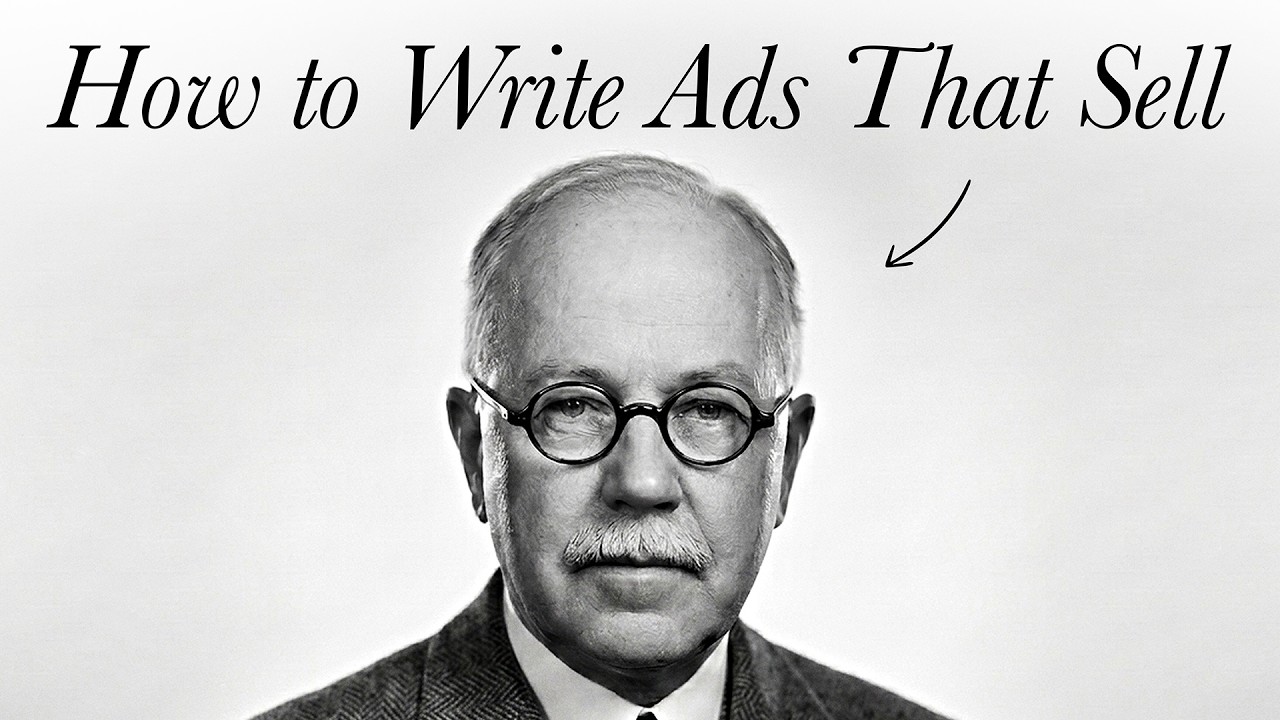


The Life and Works of Claude Hopkins
- Claude Hopkins wrote his autobiography, My Life and Advertising, as a business story intended to provide instructive guidance to successors and save them from the difficulties he experienced during his career 0s.
- Hopkins believed that individuals who gain extensive knowledge through a lifetime of excessive application have an obligation to record their research and findings for others 15s.
- The author claims that his primary qualification for writing these works is that he worked significantly longer in the field of advertising than his peers, allowing him to learn from a deep immersion in the industry 35s.
- Scientific Advertising, a book written by Hopkins approximately four decades before his autobiography, is often bundled with his life story 1m15s.
- David Ogilvy, a prominent figure in advertising, credited the work of Claude Hopkins as the foundation for the advertising agency he established 1m35s.
- Scientific Advertising is considered a highly influential text in the field, with estimated sales reaching between 8 and 10 million copies 1m55s.
- Albert Lasker, the founder of the firm where Hopkins worked, initially prohibited the publication of Scientific Advertising because he believed it revealed proprietary trade secrets 2m25s.
- Lasker kept the manuscript for Scientific Advertising in a safe for 20 years, only allowing its release after he had finished his career and left his advertising agency 2m45s.
Work Ethic and Professional Philosophy
- The motivation for revisiting these books was to improve the ability to distill complex ideas into concise, effective headlines, specifically for creating short clips from long-form conversations with founders 3m25s.
- A compilation of notes and highlights from two books written by a prominent historical copywriter has been consolidated into a single volume to distill key advertising and marketing principles. 0s
- The subject of these books is considered one of the greatest copywriters in history, known for repeating a core set of fundamental ideas throughout his work. 35s
- The copywriter began supporting himself at age nine and maintained a rigorous work schedule of 16 hours a day starting in junior high. 1m5s
- In his professional career, the copywriter frequently worked until 2:00 a.m., considered any day ending before midnight a holiday, and utilized Sundays for work to avoid interruptions. 1m20s
- The copywriter attributed his success in advertising not to exceptional natural ability or intelligence, but to the exceptional number of hours he dedicated to his craft. 1m45s
- By working significantly more hours than his peers, the copywriter argued that he gained more experience, made more mistakes, and achieved more successes, which accelerated his learning. 2m5s
- The copywriter sacrificed other aspects of his life to excel in the advertising profession, a commitment spanning five decades. 2m35s
- Les Schwab, a founder of a successful tire chain, shared a similar philosophy to the copywriter, emphasizing the importance of working with gusto, in volume, and through constant repetition. 3m5s
- Growing up in poverty after his mother was widowed when he was 10, the copywriter did not attend college, instead gaining his education through the "school of experience." 3m25s
- A railroad section foreman influenced the copywriter by teaching him the importance of maximizing every hour of the day and treating work as play. 3m45s
- The concepts of treating work as play and making the most of every hour are recurring themes that the copywriter emphasized across books written decades apart. 4m5s
Treating Work as Play
- A railroad section foreman mentored a young man named Claude, highlighting the fundamental differences between himself and his helpers 0s.
- The helpers viewed their labor as a burden, working only out of necessity, counting the hours until they could quit, and spending their earnings on leisure activities 15s.
- In contrast, the foreman approached his work with enthusiasm, treating it like a game rather than a chore 30s.
- Beyond his railroad duties, the foreman dedicated his evenings to building his own home and cultivating a garden, eventually marrying and living a life he described as blissful 40s.
- The foreman observed that while his peers spent their evenings loafing and discussing politics, he utilized that same time to improve his own property and increase its value 1m5s.
- The foreman argued that the distinction between work and play is merely a matter of mental attitude, as both require effort and involve a struggle to excel 1m45s.
- Influenced by these lessons, Claude Hopkins adopted a perspective where he viewed his professional work with the same passion others reserve for hobbies like golf 2m5s.
- Claude Hopkins noted that individuals perform best at the activities they enjoy most, suggesting that work can be cultivated into a form of play 2m20s.
- Claude Shannon, known for creating information theory and inventing the first wearable computer, shared a similar philosophy, with his biography titled "A Mind at Play" 2m45s.
- Both Claude Hopkins and Claude Shannon concluded that success is achieved when a person views their life's work as a fascinating game 3m15s.
- While the recognition gained from athletics is fleeting, the success achieved through dedicated work provides lasting satisfaction 3m35s.
Business Efficiency and Cost Management
- The business entity Ramp assists companies in applying first principles thinking to evaluate and manage costs, a practice notably utilized by SpaceX 3m50s.
- Companies utilizing the Ramp platform report a median expense reduction of 5% and a median revenue growth of 16%. 0s
- A disciplined approach to cost control, as demonstrated by SpaceX, can enable businesses to pursue new opportunities and gain a compounding competitive advantage. 5s
- Ramp is marketed as a platform designed to increase the speed and efficiency of finance teams. 22s
The Power of Product Samples
- A historical account describes a young boy who, out of necessity following his father's death, sold homemade silver polish door-to-door. 55s
- The experience of selling silver polish revealed that while only one in ten people purchased the product based on a verbal pitch, nearly everyone bought it after a live demonstration. 1m15s
- The lesson derived from the silver polish sales experience is that a high-quality product serves as its own best salesperson and that selling without samples is difficult. 1m25s
- Estee Lauder utilized a strategy of shifting funds from her advertising budget into product production to provide free samples to potential customers. 2m6s
- The practice of giving away free samples relies on the quality of the product and the human psychological tendency toward reciprocity. 2m45s
- Providing free samples encourages customers to return for future purchases and generates word-of-mouth marketing, which served as a primary growth engine for Estee Lauder’s business. 3m0s
Understanding Human Nature in Advertising
- A core principle in advertising and business is the necessity of avoiding the mistake of judging humanity solely by one's own perspective. 3m35s
- Personal preferences in advertising often lead to significant financial losses, as individual tastes rarely align with the broader public. 0s
- Advertising strategies should be submitted to the court of public opinion rather than relying on the personal opinions of the advertiser. 15s
- Success in advertising is achieved by focusing on words that generate sales and revenue, rather than relying on intuition or personal bias. 42s
- Professionals are advised to move away from the expense side of a business and position themselves on the revenue-generating side to ensure better compensation. 1m15s
- Testing products is essential because personal judgment regarding a product's potential success is often inaccurate compared to the actual response of the public. 1m55s
- Understanding human nature, psychology, and the incentives that drive people is more important for advertising success than formal education. 2m35s
- Some of the most successful individuals in advertising were described as "ignorant" or lacking formal education but possessed deep "street smarts" and an intuitive understanding of human motivation. 3m5s
- Effective advertising copy can be highly persuasive even if it requires significant grammatical editing. 3m35s
- Viewing business as a game is presented as a key to maintaining devotion and success in one's professional life. 4m5s
Principles of Professional Excellence
- Intense interest in a subject is considered an essential requirement for achieving excellence in that field 0s.
- Individuals who are passionate about their work are more likely to think about it during their off-hours, read relevant trade journals, and build professional relationships with others who share their interests 15s.
- High salaries are typically earned by those who bring in orders, such as salesmen, or those who reduce costs within a factory to increase profits 42s.
- Demonstrating the ability to generate profits allows an individual to command a reasonable share of those profits 54s.
The Power of Truth in Advertising
- Many advertising agency founders utilized blueprints or ideas from predecessors to build their own companies 1m3s.
- Claude Hopkins admired John Powers, whose core advertising principle was to tell the truth in an interesting and fascinating way 1m17s.
- In the early 1900s, John Powers earned a salary of $12,000 per year while working for Wanamaker, which was considered an exceptionally high amount at the time 1m35s.
- John Powers once advised a bankrupt clothing company to publicly announce their financial situation and state that their only path to salvation was through immediate, large-scale sales 1m55s.
- Despite concerns from the clothing dealers that the announcement would attract creditors, John Powers insisted on the truth, threatening to quit if they did not follow his advice 2m6s.
- The resulting advertisement, which candidly admitted the company's debt and need for sales to avoid failure, created a sensation because truth was a rarity in advertising at the time 2m23s.
- The store was saved because thousands of people flocked to the business to make purchases after reading the advertisement 2m36s.
- Successful people often find value in unexpected places by thinking about business from first principles rather than relying on formulas 2m48s.
Modern Advertising and Compliance Platforms
- AppLovin is an advertising platform that connects businesses with over a billion potential customers in mobile games 3m5s.
- AppLovin advertisements consist of full-screen videos that maintain an average viewer retention time of 35 seconds 3m13s.
- The AppLovin platform allows users to launch campaigns quickly without complex setups or specialized expertise by setting a specific goal for the system to achieve 3m22s.
- Businesses can achieve significant revenue growth and scale their advertising spend by utilizing the AppLovin platform 0s.
- Vanta provides AI-powered security and compliance automation to help companies manage security complexity and meet the requirements necessary to sign contracts with new customers 15s.
- Vanta customers report an average return on investment of 526% by automating compliance and security controls 45s.
Direct Sales and Consumer Proximity
- Claude Hopkins demonstrated an exceptional work ethic early in his career by employing unconventional methods to secure a position at a company with one of the largest advertising budgets in the United States 1m12s.
- To secure the job, Claude Hopkins had dozens of people send letters testifying to his skills and authored a daily newspaper column on advertising to ensure the hiring manager was aware of his expertise 1m35s.
- A core principle in advertising is to maintain minimal distance between the advertiser and the end buyer to observe firsthand what appeals to them and what they reject 2m6s.
- The most effective advertisers and agency founders often have backgrounds as door-to-door salesmen or direct response advertisers 2m25s.
- Claude Hopkins studied the techniques of traveling salesmen and street vendors, including those selling questionable remedies, to understand the specific appeals that successfully persuaded crowds 2m35s.
- The fundamental advice for selling goods is to stay as close as possible to the end buyer and to study the methods used by salesmen, canvassers, and even deceptive sellers 3m5s.
- A dramatic demonstration is considered more persuasive than any logical argument 3m15s.
- Financial success is viewed as a natural byproduct of providing service, a concept attributed to Henry Ford 3m25s.
Customer-Centric Advertising
- Many companies and billboards fail because they focus exclusively on the brand or product rather than the needs of the consumer 0s.
- Effective advertising should not center on the company or its products, but rather on what the company can do for the customer 15s.
- Claude Hopkins argued that salesmanship—which he defined as advertising in print—should be based on providing service rather than seeking personal profit 30s.
- Advertising that makes a selfish appeal to consumers often meets resistance, whereas appeals that appear unselfish are significantly more effective 55s.
- Advertisers should create content as if they are speaking to a single individual rather than addressing people in the mass 1m20s.
- Treating all customer inquiries with a generic response is a mistake; instead, inquiries should be handled with specific information tailored to the individual's expressed interest 1m45s.
- When a customer inquired about a sewing machine, Claude Hopkins improved the company's response by sending a catalog dedicated specifically to sewing machines, along with a list of local owners the customer could contact to verify the product's quality 2m6s.
- Advertising must treat people as individuals, centering on their specific desires, just as one would when interacting with a person in a face-to-face setting 2m35s.
- A key principle in advertising is to communicate the pains taken to excel and create a product, even if those processes are not unique to the business 3m5s.
- When Claude Hopkins was hired to help Schlitz Beer, which held the fifth-largest market share at the time, he began by conducting research at the brewery to understand the product and its manufacturing process 3m25s.
Marketing Ordinary Production Processes
- A brewery maintained high standards of purity by using filtered air, white wood pulp filters, and cleaning pumps and pipes twice daily. 0s
- Bottles were cleaned four times by machinery, and water was sourced from artisan wells 4,000 feet deep. 10s
- Beer was aged in vats for six months, and a mother yeast cell was developed through 1,200 experiments to optimize flavor. 18s
- Although the brewery claimed these processes were standard industry practices, they had never been communicated to the public. 35s
- By advertising these common but previously untold production details, Schlitz moved from fifth place to nearly first place in the market within a few months. 55s
- Manufacturers often fail to market their methods because they are too close to their own processes and view them as ordinary, failing to realize that the public may find them impressive. 1m15s
- Success in advertising and business is often achieved by serving others better and offering more help than competitors. 1m35s
- Advertising is more effective when it focuses on the customer's perspective rather than asking the customer to take a chance on the business. 1m45s
Avoiding Selfishness in Advertising
- Albert Lasker, a highly successful and charismatic figure in advertising, recruited talent by offering significant incentives, such as purchasing a car for a new hire's spouse. 2m0s
- Advertising efforts are often met with resistance when they focus on the advertiser's own advantage, whereas unselfish consideration of customer desires attracts people. 2m45s
- The two primary faults in advertising are identified as boasting and selfishness, while focusing on service encourages people to listen. 2m55s
- People are likely to ignore advertisements that focus on promoting the advertiser's own advantages rather than the needs of the consumer 0s.
- Business owners should avoid writing their own advertising copy because they are too close to their own operations and interests 25s.
- A manufacturer's proximity to their factory often blinds them to the customer's perspective, leading them to highlight irrelevant details like the age of the business or the size of the plant 42s.
- Effective advertising requires studying the consumer and communicating information that the consumer actually wants to know 1m5s.
- Many companies fail to adopt the basic premise of focusing on the customer's perspective, a principle that has been documented for approximately one hundred years 1m25s.
The Dangers of Expanding Outside Competence
- Business owners who achieve success in one area often mistakenly believe they are "super businessmen," leading them to fail when they attempt to expand into unrelated industries 1m48s.
- This tendency to stray outside one's "circle of competence" is a recurring issue that leads successful individuals to lose money in new ventures 2m6s.
- Warren Buffett, who frequently cited David Ogilvy as a genius, was a shareholder in the public company Ogilvy & Mather 2m25s.
- Warren Buffett advised Ogilvy & Mather against their acquisition spree, suggesting instead that the company should buy back its own stock 3m5s.
- David Ogilvy sold his equity in his own company too early, resulting in Warren Buffett making more money from the company's appreciation than Ogilvy did 2m55s.
Effective Customer Engagement Strategies
- Claude Hopkins emphasized the importance of letting people try products through samples and demonstrations, provided they are executed correctly 3m25s.
- Providing unsolicited product samples is ineffective because products distributed without a request lose their perceived value and respect. 0s
- A more effective strategy involves requiring potential customers to exert effort, such as filling out a form or providing an email address, before receiving a product or service. 15s
- Attempting to enter a competitive market by simply asking consumers to buy a specific brand is considered a selfish and ineffective appeal. 58s
- To successfully persuade customers to switch from their preferred brands, businesses must provide exceptional service that competitors fail to offer. 1m12s
- Establishing a distinct personality for a brand, such as associating it with a specific individual, is more effective than presenting a company as a soulless corporation. 1m35s
- People are more inclined to relate to and trust individual human beings than they are to relate to corporate entities. 1m55s
- Founders and creators are encouraged to act as the primary representatives of their companies, as they possess the deepest knowledge of their products and serve as the guardians of the company's identity. 2m6s
Addressing Problems and Desires
- Advertising strategies should focus on selling "painkillers" rather than "vitamins," meaning they should address immediate problems rather than focusing on preventative measures. 2m35s
- Historical experience indicates that consumers are generally motivated to cure existing troubles but are less likely to take action for the sake of prevention. 2m55s
- Advertising success depends on understanding human nature, specifically the preference for positive rewards over the prevention of disasters 0s.
- People are generally more motivated by the pursuit of happiness, beauty, and cheer than by efforts to avoid negative outcomes 7s.
- Effective advertising campaigns rely on selecting the correct psychological appeal, which focuses on the prospect's ambitions rather than picturing affliction or disaster 17s.
- Claude Hopkins attributed his significant financial success, including earning a million dollars on Pepsin, to his application of these specific psychological principles 35s.
Simplicity and Persistence in Advertising
- The concept of "genius has the fewest moving parts" is highlighted as a core principle for successful business operations 47s.
- Albert Lasker achieved substantial financial success by focusing exclusively on high-quality copywriting that drove sales, rather than maintaining large art departments or extensive staff 53s.
- Claude Hopkins operated his business independently, working from a country house without a clerk or secretary, and earned hundreds of thousands of dollars annually during his career 1m12s.
- Success in advertising is often the result of making small, individual mistakes and learning from each one to ensure the same error is never repeated 1m27s.
- Developing enduring advertising principles requires a significant investment of time and personal sacrifice 1m37s.
- Advertisers are advised to "forget yourself entirely" and avoid selfish phrases, such as demanding that customers insist on a specific brand or avoid imitations 1m51s.
- Effective copy should mirror what a skilled salesman would say to a prospect in person, avoiding boastful language that the buyer cannot sympathize with 2m6s.
- Once an advertisement is proven to be effective, it should not be changed, as the audience is a "moving parade" rather than a "standing army" 2m20s.
- While advertisers may grow bored with their own consistent messaging, they must remember that the customer base is constantly changing and does not read every single advertisement 2m43s.
Multiplied Salesmanship Principles
- Increasing sales and staying close to the money-making process is a path to significant wealth, provided one captures the value created by their efforts 0s.
- Claude Hopkins demonstrated the value of investing in one's own work by purchasing $13,000 worth of shares in a project he was advertising; this investment eventually yielded $200,000 in dividends and was later sold for $500,000 12s.
- Dedicating extensive time and effort to a singular focus allows an individual to derive unique insights and achieve a level of effectiveness that others cannot replicate 35s.
- A deep, all-absorbing commitment to learning salesmanship and business can serve as both an occupation and a form of recreation 50s.
- Advertising is defined as "multiplied salesmanship," and its principles should be evaluated based on the standards of a salesman 1m15s.
- Because mediocre advertising impacts an entire business, every advertising question should be answered by asking if the approach would help a salesman sell the goods to a prospect in person 1m30s.
- Restricting advertising copy to a specific number of words is considered an "unthinkable handicap," similar to limiting a salesman's speech when a prospect is standing before them 1m50s.
- Advertisements should be directed at a single individual who has already expressed interest, rather than addressing a mass audience 2m6s.
- People are willing to dedicate time to content if it is made interesting, and the principle "the more you tell, the more you sell" suggests that long-form copy can be highly successful if it provides relevant information 2m25s.
- Successful advertising requires the creator to study the consumer, place themselves in the buyer's position, and avoid boasting or showing off 2m50s.
Coaxing Consumer Action
- Scientific advertising principles emphasize that individuals are inherently selfish and prioritize their own interests over those of a business or advertiser. 0s
- Effective advertising avoids direct requests for purchases, which are often perceived as unpopular, and instead focuses on providing service, wanted information, and clear advantages to the user. 15s
- Successful salesmanship involves illustrating the customer's perspective and the benefits of a service until the customer naturally decides to purchase the product. 42s
- A historical example of this strategy involved a hairbrush manufacturer who employed 2,000 door-to-door salespeople to offer free samples rather than asking for a sale. 1m5s
- By offering a choice of free samples, the salesperson encouraged the customer to reciprocate the gift, which frequently resulted in a purchase. 1m30s
- A core principle of advertising is that people can be coaxed into action but cannot be driven, as they ultimately act to please themselves. 1m45s
- Once an effective advertising approach is found, it should be repeated consistently rather than changed, as the methods used to acquire previous customers remain the best way to attract new ones. 2m0s
- The principle that "the more you tell, the more you sell" is a proven concept that consistently yields results in testing. 2m15s
- Isidor Sharp, the founder of Four Seasons, defined excellence as the capacity to endure pain, reflecting the perseverance required to build a premier luxury hotel brand from scratch. 2m45s
The Importance of Headlines
- The primary purpose of a headline in advertising is to identify and attract the specific audience that the advertiser intends to reach. 3m30s
- Addressing the reader directly by name is an effective way to capture the attention of the intended audience 0s.
- Headlines function similarly to those in newspapers, serving as the primary tool for readers to decide what content they wish to consume 5s.
- Headlines should not be misleading, as they are intended to reveal an interest rather than conceal it 13s.
- Because people are hurried and seek to be amused or benefited, they will remain unaware of products that might interest them unless the headline effectively communicates that value 21s.
- A significant portion of time should be dedicated to crafting headlines, as approximately 80% to 90% of people will read the headline but not the body copy 35s.
- It is common to spend hours on a single headline and to discard dozens of options before selecting the one that will successfully attract the right readers 48s.
- The headline acts as a door that must be opened to ensure the audience engages with the product description or sales pitch 1m1s.
- Effective salesmanship is impossible without first securing a hearing from the audience 1m10s.
- Content must be entertaining before it can successfully educate or inspire, as one cannot "save souls in an empty church" 1m25s.
- A product is essentially an idea designed to improve someone's life, and identifying the main appeal to the customer requires extensive research 2m5s.
- Steve Jobs demonstrated the power of a concise headline with the iPod, using the phrase "a thousand songs in your pocket" to immediately pique interest and encourage further engagement 2m25s.
- The financial return of an advertisement can vary significantly based on the headline used, with a successful change in the headline sometimes multiplying returns by five to 10 times 2m55s.
- Changing a headline can increase advertising returns by five to 10 times, with some observations showing differences as high as 19 to one. 0s
Psychological Incentives and Specificity
- Effective advertising requires addressing only the specific people the advertiser seeks to reach. 12s
- Understanding human psychology is essential for a competent advertiser because human nature is perpetual and its principles are fixed and enduring. 20s
- Curiosity is identified as one of the strongest human incentives and should be utilized whenever possible in advertising. 42s
- People often judge the value of an item based on its price; for example, a painting that was ignored by passersby attracted a crowd once its high price of $750,000 was revealed. 53s
- Humans are tribal by nature and prefer to belong to groups, making offers limited to specific classes of people—such as war veterans, lodge members, or executives—more effective than general offers. 1m25s
- Individuals are highly motivated to maintain perceived advantages associated with group membership. 1m42s
- An identical offer can yield multiplied returns simply by changing the way it is presented, such as adjusting the headline, targeting a specific group, or altering the price. 1m50s
- Using specific numbers and facts is more effective than using platitudes or generalities, which are often ignored by consumers. 2m10s
- Claims like "best in the world" or "lowest prices" are often viewed as expected and lack impact, whereas definitive statements are more likely to be accepted. 2m25s
- A clothing seller increased effectiveness by stating a specific net profit of 3% rather than claiming to have the "lowest prices in America," as the specific figure suggested the items were sold at a minimal margin. 2m45s
- A razor manufacturer achieved a sensational increase in sales by advertising a "78 second shave" instead of the generic "quick shave" claims used by competitors, as the specific number implied actual test results. 3m15s
Research and Dedication to Craft
- The main appeal of an advertisement should be contained within the headline. 3m35s
- The most significant benefit a customer receives from a product should be clearly stated in the headline of an advertisement 0s.
- Steve Jobs utilized this strategy by highlighting the specific benefit of having "10,000 songs in your pocket" in his headline 5s.
- Successful advertising writers must conduct thorough research and gather comprehensive information about their subject matter 11s.
- A writer may need to spend weeks reading through numerous volumes of material to find the single, crucial fact that serves as the foundation for a successful campaign 16s.
- The process of finding a key idea often involves reviewing dry or technical scientific literature that was not originally intended for advertising purposes 32s.
- The concept that "genius is the art of taking pains" emphasizes that significant effort and hard work are essential for success in advertising 45s.
- David Ogilvy discovered the basis for a highly successful Rolls-Royce campaign by reading an obscure engineering document that was not meant for public consumption 1m15s.
- The famous Rolls-Royce advertisement featured the line, "At 60 miles an hour, the loudest noise in this new Rolls-Royce comes from the electric clock" 1m32s.
- Although a final advertisement may appear simple, it is often the result of months of research and the analysis of large volumes of data 1m50s.
- Advertising is described as a field that requires significant dedication and is not suitable for those unwilling to put in extensive work 2m3s.
- Claude Hopkins' books, My Life in Advertising and Scientific Advertising, are recommended resources for those interested in the field 2m10s.