

Introduction 0s
- Chinese companies are aggressively developing autonomous vehicles, with the country issuing 16,000 test licenses for driverless cars and opening around 20,000 miles of roads nationwide for autonomous vehicle testing in August 6s.
- One of the biggest players in the development of autonomous vehicles is Chinese technology giant Baidu, which has more than 500 robo taxis in Wuhan operating on its ride-hailing platform Apollo Go 16s.
- Baidu's robo taxis have been tested on China's roads, demonstrating their ability to navigate complex scenarios, such as driving up a ramp, making a U-turn, and negotiating around bikers and timid drivers 30s.
- Autonomous vehicle companies linked to China have also been testing their technology on US streets, particularly in California, where they have had relative freedom to develop and test their cars for years 58s.
- However, the Department of Commerce has raised concerns about national security risks associated with Chinese-connected vehicles, leading to an investigation and proposed ban by the Biden administration in September 1m19s.
- The proposed ban is motivated by concerns about the large amount of data collected by autonomous vehicles, including sensitive information about individuals' locations and activities, which could be sent back to the PRC or the Chinese military 1m41s.
- The increased scrutiny around Chinese-connected vehicles could have significant implications for the industry in the future, prompting CNBC to investigate the activities of these companies on California's roads 1m56s.
U.S. presence 2m11s
- Chinese autonomous vehicle companies have had a presence in the United States for nearly a decade, with the first major event being the launch of Baidu Apollo in California in 2016 2m11s.
- The push into the US was part of a broader Chinese plan to make the country a world leader in critical technologies, including electric vehicles, batteries, AI, chips, and autonomous vehicles, as outlined by Xi Jinping in 2016 2m45s.
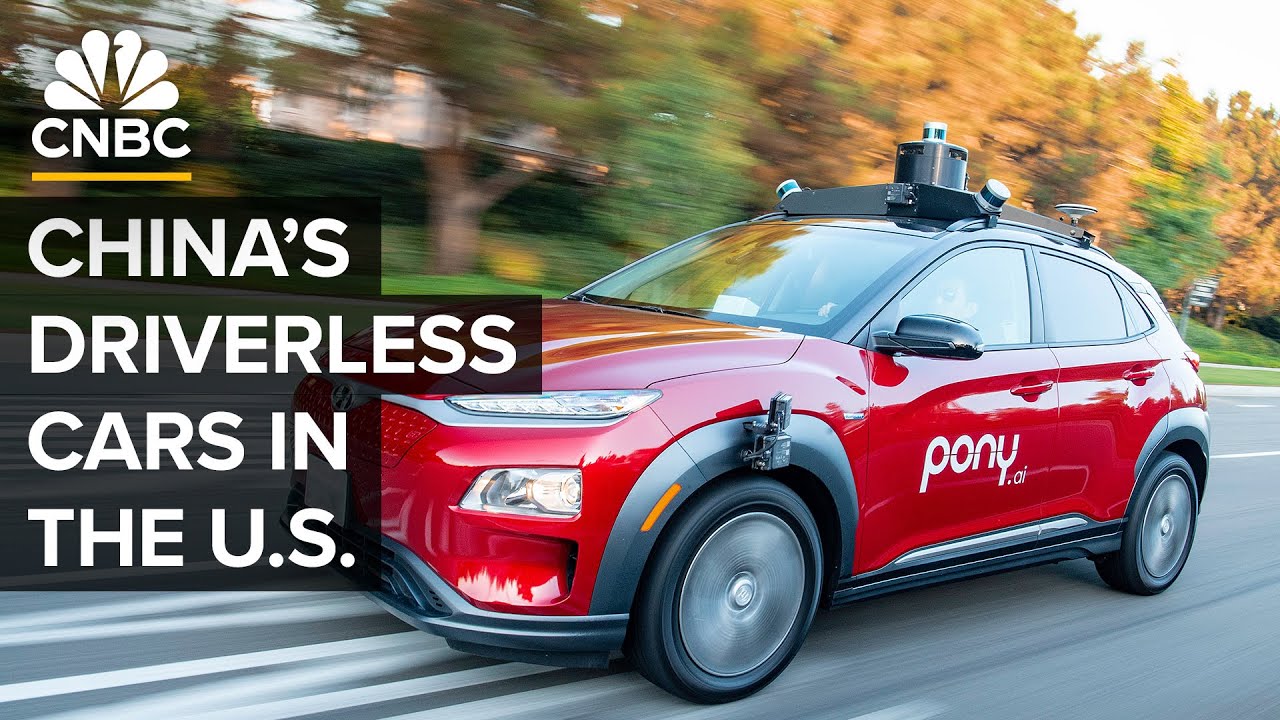
- Several China-linked companies, including Didi, WeRide, Pony.ai, Baidu, and AutoX, have established research labs in the US and have been granted licenses by California's Department of Motor Vehicles to test their autonomous vehicle technology 3m22s.
- These five companies have collectively logged over 1.6 million test miles on California's roads between 2017 and 2023, gathering valuable data to train their autonomous vehicle algorithms 3m42s.
- However, experts say that 1.6 million miles is nowhere near the amount of testing they would expect from a company with ambitions to bring a product to market 4m4s.
- China has several companies testing in the US, but they're not really making the progress that would be expected, with some companies, such as Tusimple, experiencing accidents and no longer being in operation 4m18s.
- Pony.ai had plans to commercialize a robotaxi service in California in 2022, but the goal was never realized after the company's driverless testing permit was suspended by California's DMV in 2021 4m33s.
- AutoX operated a grocery delivery pilot program in San Jose in 2018, but nothing has been mentioned on the company's website about the service since 4m55s.
- The testing efforts of Chinese self-driving car companies in the US are extremely spotty, with no continuous testing profile, unlike more advanced companies like Waymo and Zoox 5m9s.
- DMV data shows that the collective amount of test miles logged by China-linked AV companies operating in California was significantly less than the miles logged by US competitors Cruise and Waymo individually between 2021 and 2023 5m38s.
- There was an 84% decrease in the number of test miles driven by China-linked outfits between 2021 and 2023, and today, there is very little evidence or intention among Chinese autonomous vehicle makers to launch products in the United States 5m57s.
Why are they here? 6m21s
- Chinese autonomous vehicle companies were in the US to tap into Silicon Valley's talent pool and expertise in the field, as the region is considered the cradle of autonomous vehicle technology 6m32s.
- They hired people who had previously worked for companies like Apple, Tesla, Waymo, or Cruise, with the goal of building a world-class company and applying the knowledge gained to their massive home market in China 6m40s.
- The regulatory framework for autonomous vehicle testing was more established in California than in China during the early days of the technology, with California approving its first rules for testing self-driving cars on public roads in 2014 7m6s.
- Chinese companies, such as Autox, Weride, Pony.ai, Baidu, and Jiyue, enjoy tremendous support from regulators at the provincial and city levels, who aim to accelerate the commercialization of autonomous vehicle services 7m30s.
- In contrast, US regulators prioritize safety, and the approval process for licenses is more cautious, despite having better technology 7m53s.
- The presence of Chinese autonomous vehicles in the US has raised concerns about national security and competitiveness, as the data collected by these vehicles could be used for malicious purposes, such as surveillance or cyber attacks 8m27s.
- Missy Cummings, a former military officer and senior safety adviser, notes that the data collected by autonomous vehicles is sensitive and could be used to gather information about patterns of life, vehicles, and supply chains 8m32s.
- Representative Marc Veasey of Texas has expressed concerns about the dangers posed by Chinese autonomous vehicles operating in the US and has urged the government to take action 10m7s.
- The companies operating in the US claim that they are only collecting data to improve their vehicles, but this explanation is met with skepticism, given the Chinese government's history of using companies to spy and collect data 10m25s.
- The data collected by Chinese companies in California has not been publicly disclosed, and it is likely that the knowledge and experience gained will be transferred back to their headquarters in China 11m5s.
- California's DMV has stated that it did not treat Chinese companies differently than other companies when granting licenses to test autonomous vehicles, and there are no restrictions or post-supervision on what companies do with their data 11m43s.
Protecting American interests 12m14s
- A proposed bill aims to address concerns about connected cars from China and Russia by covering systems and components that connect vehicles to the outside world, including Bluetooth, cellular, satellite, Wi-Fi modules, and automated driving systems, with prohibitions on software taking effect on cars model year 2027 and hardware on cars model year 2030 12m14s.
- The bill comes on top of sky-high tariffs on Chinese vehicles introduced by the Biden administration earlier this year, which Chinese companies have been able to circumvent by exporting components to countries with free trade agreements with the US and then shipping Chinese cars from those countries into the US 12m41s.
- The proposed ban would focus on the components, hardware, and software used in vehicles, rather than the origin of production, effectively shutting the door on anything that resembles a Chinese vehicle 13m10s.
- Cummings suggests that the proposed ban is a good start, but more needs to be done to protect the public's privacy, including preventing companies from selling data collected by cars with driving assist systems 13m26s.
- Veasey agrees that guardrails are needed and notes that China has not allowed American companies to test on their roads, which suggests that the data being collected is a concern 14m0s.
- Lei Xing, who has been covering the Chinese auto market for over 20 years, worries that the ban may stifle the progress of autonomous vehicle technology, which relies on sensors that collect significant amounts of data 14m19s.
- China has been stricter than the US about foreign companies operating on its roads, heavily regulating the use of high-resolution maps and data necessary for driverless systems due to national security concerns, with no foreign firm currently qualified for mapping in China 14m48s.
- Tesla has been dealing with this hurdle, but reportedly scored a deal with Chinese tech giant Baidu to access Baidu's high-resolution mapping and navigation technology for Tesla's Full Self-Driving suite of driver assistance features 15m8s.
- Other American companies, such as Waymo, Cruise, and Zoox, have not been able to obtain permits to operate in China, which may put the US in a better position than China as tensions rise 15m59s.
- Many Chinese autonomous vehicle companies rely on chips and technologies from companies like Nvidia and Qualcomm, which could be cut off, hampering China's ability to compete with US leaders in the field 16m24s.
- China has begun producing its own semiconductors after the US banned the export of advanced chips to China in 2022, in an effort to hedge against this potential vulnerability 16m42s.
What will this ban mean? 16m54s
- The proposed ban on Chinese connected vehicles in the US may require Chinese companies operating in the country to rethink their business strategies and potentially rebrand as American companies to avoid being affected by the ban 17m16s.
- The California DMV is aware of the proposed ban and will update its regulations accordingly for affected companies testing in the state, should the law be passed 17m5s.
- The ban may lead to a bifurcation of the world into two camps, with China and the US/Western countries developing their own systems for future technologies, including autonomous vehicles 17m33s.
- Signs of Chinese autonomous vehicle players pulling back from the US are already apparent, with companies like Didi and WeRide delaying or canceling their US IPO plans 18m7s.
- The ban may complicate matters for American and Chinese companies that partner on autonomous vehicle technology, such as Waymo and Geely's Zeekr 18m35s.
- The ban could also impact consumers, as some vehicles sold in the US are assembled in China, and US automakers may be less competitive in the global market due to higher prices 19m6s.
- The US Department of Commerce estimates that the ban could result in 1,700 to 26,000 fewer vehicles being sold annually in the US 19m16s.
- Multinational companies may be impacted by the ban, as they may no longer be able to source components from Chinese companies at a lower cost 19m26s.
- There may be a need for stricter rules on how the US deals with Chinese companies, particularly when it comes to sensitive technologies like autonomous vehicles 19m48s.
- In the near future, autonomous car players are expected to focus on their home markets, with US companies focusing on the US market and Chinese companies focusing on the Chinese market 20m11s.
- Chinese companies may eventually extend their autonomous vehicle applications to friendly countries in Southeast Asia, South America, and the Middle East 20m37s.