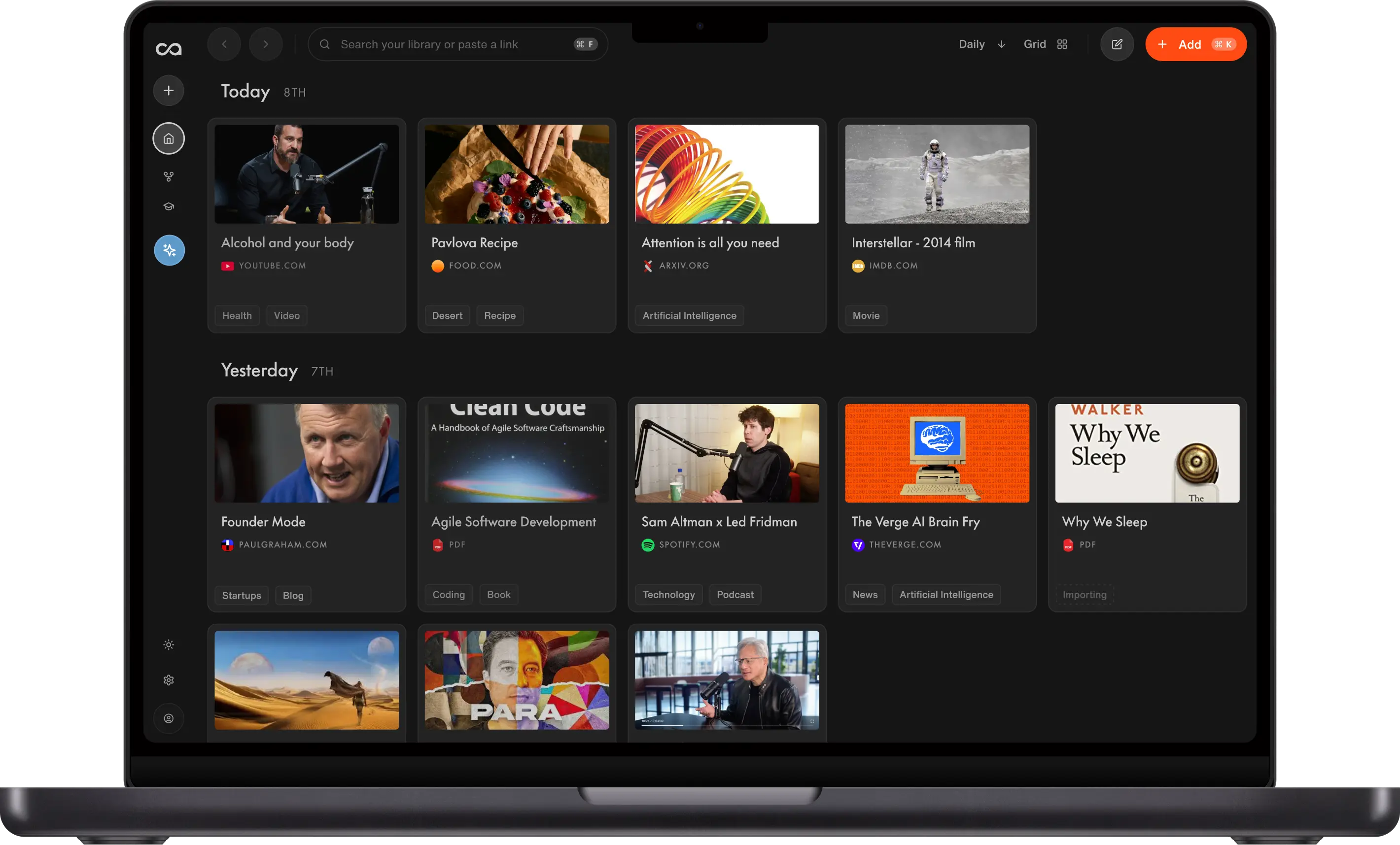
Looking for the best second brain app? Data from more than 700,000 Recall users shows that AI is turning the second brain from a place you save things into a place you use them. Since the ability to chat with your second brain launched, 52% of monthly savers now come back to their saved content, and revisits per item saved have increased 3x. Quizzes built on active recall and spaced repetition stick: 64% of people return after their first quiz, and 93% after their tenth.
This report examines what people save in a second brain and whether they return to use it. We published it because now is an unusually good moment to start a second brain, and the honest version of that case needs numbers attached, including the ones that might put you off starting at all.
The analysis uses two sources: product usage data and a user survey.
- Product usage. Totals from Recall analytics between 1 April 2025 and 18 September 2026. These are group figures, not anyone's personal activity. The analytics available for this study begin in April 2025. Recall started in 2022.
- A user survey. 966 voluntary responses collected from 2023 to 2026, used to understand why people use Recall and who they think would benefit from a second brain. Participation was voluntary, so these answers describe the people who chose to respond. Figures based on the survey are labeled as such.
One rule about plans, because it changes almost every number. Free accounts are capped each month on how much you can save and how much you can chat, and most other ways back into a library sit behind a paid plan, so a free user who looks uninterested may simply have run out of room. Anything about using a library, coming back to it, or using a feature is therefore reported for paying users only. What people save covers everyone, because saving is the one thing every account can do.
This report cannot reveal what any particular person saved. No saved content was read and no individual account was examined. Categories of saved content come from item type and the domain of a source URL, never from the substance of a note, video, or article. Written survey answers were grouped into themes by hand, which is separate from reading a saved library. No usage figure is published for a group smaller than 50 people. Survey themes are reported only as a share of the full set of answers, without breaking respondents into smaller groups. We publish no breakdowns by country, employer, job title, or any other small group. Recall's privacy policy governs the underlying data.
Study period: 1 April 2025 to 18 September 2026
Table of contents
- Executive summary
- Why anyone builds one
- What goes in
- What happens to it afterwards
- The verdict
- Method, limits, and credits
Executive summary
This report asks one question. What do people put in a second brain, and what makes them come back to it?
Four terms, used throughout.
- A save is anything added to an AI knowledge base: a video, an article, a PDF, a post, or a written note.
- A retrieval is coming back to something already saved, by asking a question about it, opening it again, or searching for it.
- A review is a quiz on something already saved. It uses active recall and spaced repetition: you answer from memory, and the question comes back on a schedule before the forgetting curve drops it.
- The knowledge graph is a visual map of a second brain, showing saved items as points with lines between the ones that are related.
-
Retrieval actions per 100 items saved in a second brain nearly tripled after chat launched. Retrieval rose from 10 actions per 100 items saved in August 2025 to 28 by August 2026. Separately, the share of users who saved something in a month and also retrieved saved content that month nearly doubled, from about 27% in April 2025 to about 52% in August 2026. These figures measure two different things: retrieval actions relative to saves, and the share of savers who retrieved at all. Both shifts begin in the months after chat launched in August 2025, which is context rather than proof of an effect from chat, since this is observed usage and not an experiment.
-
About 1 in 40 saved items is a note the person wrote. In December 2025 we shipped a notes editor, so people could write their own notes next to what they saved. That lifted the share to about 4% for five months, then it fell back. Over the report's 90-day comparison period, 2.5% of what people saved was their own writing. The rest is material they saved because it taught them something.
-
YouTube is about half of recent saves. Social saves do not follow audience size. YouTube is 49% of saves in the report's 90-day comparison period. Across the six social platforms (X, LinkedIn, Instagram, TikTok, Reddit, and Facebook), X accounts for about 5% of the combined audience and 28% of social saves. Its share of saves is about 5.4 times its share of the audience. Facebook accounts for 29% of the audience and 10% of social saves, so its share of saves is about 0.4 times its audience share. Audience figures are third-party estimates.
-
People say a second brain is for lifelong learners, not everyone. Of 792 survey answers, 33% named students and 26% named self-directed learners, the two groups we treat here as lifelong learners. 23% said researchers, and about 3% said anyone. People could name more than one group, so these shares add up to more than 100%.
-
The quiz habit gets stickier: 64% come back after the first quiz, and 93% after the tenth. A review is a scheduled quiz on something already saved. Of paying users who finish a first quiz, 64% come back for a second. Each quiz after that, a larger share comes back. By the tenth quiz, 93% of the people who have come that far come back for another. The first return is the hard step. After that, the habit holds.
-
Opening the knowledge graph is not a monthly habit. Of the people who open it in a month, the share who open it again the next month fell from about 45% to about 30%, even though most look more than once in the first weeks. Keeping it as a monthly habit is the part that thins out. Opening the graph is not counted as retrieval.
What a second brain is, and why now
Think of a second brain as everything you read, watch, or hear that you actually want to keep, saved somewhere separate from your own memory, where you can get to it again when you need it.
That is the whole idea. Not a filing system you maintain for its own sake. The point is peace of mind. The article you half remember is not gone. The video you watched in March is still there. The information turns up when you need it, rather than when an algorithm decides to show you something like it again.
The name "second brain" was popularized by Tiago Forte, who describes it as moving knowledge out of your own memory and into a trusted external system. His team spent three weeks testing that idea in Recall. Their account of using Recall complements this report's statistics with examples of the experience behind them.
For measurement, we need something narrower, so throughout this report a second brain means a library of items a person deliberately saved and can later search, query, test themselves on, or reopen. In the data, a second brain is mostly a place to keep content people were already going to consume, alongside a much smaller amount of their own writing.
Why now
For years the practice Tiago Forte popularized, a trusted store outside your own memory, was easy to abandon. Filing took more effort than it returned. People saved, then never came back, which is why "second brain" earned a reputation as productivity theater. Three things changed.
-
You cannot see where an AI answer came from. You ask a model and get a finished paragraph, assembled from sources you usually never check. Deana Burke logged those citations on TikTok and recognized almost none of them. A Northwestern audit of four AI search engines found about 1 in 6 cited sources showed signs of being written by another AI. You can already start the other way. Save the sources you trust, and use AI on that library instead of on the open web.
-
Retrieval became a conversation. In this dataset, chatting with the library is now the main way users come back, and it is the strongest thing we can find that separates a used library from an abandoned one. Remembering the right folder or keyword is no longer the bottleneck, which is why a library that used to sit unused can start earning its keep.
-
The idea got a new and more technical audience. Andrej Karpathy's description of an LLM wiki, a personal corpus you keep ingesting, compiling, and querying with a model, put the same practice in front of people who would never have called it a second brain. The vocabulary changed from note-taking to context engineering. The behavior is the one measured here.
Who builds one, and why
Product usage data shows the types of content people save and whether they return to use it. The survey adds a different perspective: who users think would benefit from a second brain and what benefits they say they receive from Recall.
Who they think it is for
The survey asked people who they thought would benefit most from a tool like Recall. Of the 966 survey responses, 818 included an answer to this question, and 792 named at least one specific group.
Each bar shows the percentage of those 792 answers that named a particular group. The percentages add up to more than 100% because most answers name more than one group. Students and self-directed learners are shown separately as two kinds of lifelong learner; their percentages are not added together.
Almost nobody says it is for everyone. About 3% said "anyone" or "everyone". People who use a second brain have a specific person in mind, and that person is usually a lifelong learner, in school or teaching themselves.
A small group named a difficulty rather than a job. One in twenty answers named people who find remembering or concentrating hard, unprompted, using words like neurodivergent, ADHD, brain fog, and overwhelm. The survey did not ask specifically about these difficulties, and the answers describe who respondents think might benefit, not verified information about those people's health. This is a small share of a self-selected sample, but it is the only group here defined by difficulty rather than by occupation. We will not break this group down into smaller subgroups or compare it with other user characteristics. The theme touches on health and was inferred from answers given as early as 2023.
What they say they get from it
To understand what users get from a second brain, we use a second survey question: "What is the main benefit you receive from Recall?"
Of the 966 survey responses, 831 included an answer to this question. Of those, 815 described an actual benefit; the remaining answers said the respondent had not used Recall enough yet to answer. We read the written answers and grouped them by the benefits people described. A single answer often names two or three benefits, so the percentages in the table do not total 100%.
Summarizing what you save is one of Recall's core features, and one of the biggest reasons people show up and start a second brain. The benefit is peace of mind: your content is summarized for you, organized for you, and kept in one place.
We also grouped the kinds of content people mentioned struggling with in their survey answers. References to YouTube tell us about the content people save, while references to summarization tell us about the benefits they want. The table below reports content types separately from the benefits above.
Here is a sample of responses from our 2023 to 2026 survey, in which users described the benefits they get from a second brain like Recall:
- "having a place to go back to interesting topics and not letting them become forgotten"
- "Getting the information I want condensed instead of longwinded babbling."
- "Staying on top of topics that I consider important, but to which I cannot devote all the time of formal study."
- "It brings together a number of my unconnected systems i.e. notes, pkm and journal and through the integrated AI makes them richer."
- "Quick insights and access to the thoughts, ideas and facts that I collect throughout the day, everyday"
The same survey asks how people would feel if they could no longer use Recall. Across 862 answers, 35% said very disappointed, 45% somewhat disappointed, and 19% not disappointed. Quarter by quarter, the very disappointed share rose from the low 20s in 2024 to around the 40% mark that Sean Ellis proposed as a product-market-fit threshold.
What people actually save
The fair window: last 90 days
Recall did not support every source equally for the whole study period. YouTube worked properly throughout. Full social support arrived partway through, and the data shows roughly when. Saves from TikTok, Instagram, Facebook, and Reddit all jump sharply in August 2025, and social's share of everything saved climbed from about 1.5% to 2% of items in mid-2025 to about 5% to 6% by the summer of 2026.
Uneven support affects the comparison between sources. If we measured the whole study period, we would be comparing YouTube, which people could save throughout, with social platforms that were fully supported only later. That would understate social platforms' share of saves. The source comparison below therefore uses a 90-day period when all the listed sources could be saved in the same way. References to the "last 90 days" describe this report's comparison period, not a rolling total that updates as you read.
Unit: saved items in the report's 90-day comparison period. The podcast share is an underestimate because some podcast links are classified as web pages.
The striking share is the small one. About 1 in 40 items is something the user wrote. A second brain is built almost entirely out of material that taught its owner something, and that is the point of it. People are keeping the talks, articles, and videos they learned from, so a library is closer to a personal syllabus than to a notebook.
Social platforms, last 90 days
Share of social saves in that comparison period, not of everything saved. Social itself is about 6% of items saved then.
Saving is not proportional to audience
The types of content saved in one product reflect that product's strengths and audience. Recall became known for summarizing YouTube, so "YouTube is half of saves" partly reflects the users it attracted. To put the social-save figures in context, we compare each platform's share of the combined audience with its share of saves from those platforms. If saving simply tracked platform popularity, those two percentage shares would match.
Audience figures are third-party estimates, compiled by Sprout Social from DataReportal and company disclosures for 2026. They are not strictly comparable to each other, because LinkedIn reports total users while the others report monthly users, so read the last column as a rough scale rather than an exact multiple. This comparison is the six social platforms only: X, LinkedIn, Instagram, TikTok, Reddit, and Facebook. YouTube is not in this comparison.
The audience shares and save shares do not match. Platforms where people post arguments and explanations account for a larger share of saves than of the audience, while Facebook accounts for a smaller share. X accounts for about 5% of the combined audience and 28% of social saves. Its share of social saves is about 5.4 times its share of the combined audience of these six platforms. Facebook has roughly six times X's audience and roughly a third of its saves; its share of saves is about 0.4 times its audience share.
This is the closest thing to evidence that saving is a judgment rather than a reflex. People are not keeping what they see most of. They are keeping the material that inspired them or taught them something that they need to come back to.
From collecting to using
The monthly usage charts are easier to read alongside product changes, so they mark three launch dates. The two chat launches introduced different capabilities. Our analytics recorded fewer chat interactions before August 2025, reflecting use of an earlier version. The charts mark the launch, not the first recorded chat interaction.
August 2025 was basic chat. Talk to your knowledge base. Ask what you saved, in plain language. That was the whole feature.
December 2025 was a real notes editor. Writing your own thinking alongside what you saved became something the product was actually good at. Notes could include tables, to-do lists, code blocks, and more.
Recall 2.0 launched in April 2026 with expanded chat capabilities. You can chat with your whole knowledge base, a single card, or the internet. You can choose Claude, ChatGPT, or Gemini, or let Recall pick a model.
The first measure is the share of monthly savers who also retrieved saved content that month. It rose from about 27% in April 2025 to about 52% in August 2026. Among those same monthly savers, the share who used chat rose from about 26% to about 42%.
A second measure compares the number of retrieval actions with the number of items saved in each month. It is expressed as retrieval actions per 100 items saved, rather than the percentage of users who returned.
From April through July 2025 that ratio averaged about 18. August 2025 is the low point, at 10, and it is also the month chat launched and social support jumped, so it is the weakest comparison. Within two months the ratio reached 25. It fell back over the December holidays, climbed through the spring, and has run at 28 to 30 since Recall 2.0. That is about three times the August low, and about 1.6 times the April-to-July average.
Both lines in the monthly-saver chart, the share who retrieved and the share who chatted, step up in the two months after chat launched, and neither has returned to its old level. We are not claiming the launch caused all of it. Other things shipped, the audience changed, and libraries mature on their own. But the shift from collecting to using saved content coincides with the introduction of chat as a way to use a second brain.
The next chart compares the ways paying users who saved at least one item returned to their saved content. Chat was the most common: 81% queried their library in natural language, 54% reopened a source, and 15% used search. These groups overlap because a person can use more than one method.
These figures come from observed usage, not a controlled experiment. We cannot tell whether chat encourages people to return to their saved content, or whether people who would return anyway are simply more likely to use chat.
What happens when people connect MCP
MCP, the Model Context Protocol, is how Claude, ChatGPT, or Cursor connects to a library you already keep. Recall's MCP server is read-only. It lets that assistant search what you saved, read a specific item, and look across the knowledge base, from inside the tool you were already using. Connection instructions are in the Recall MCP docs, and a comparison of knowledge-base servers is in our memory MCP guide.
Between 1 April 2025 and 18 September 2026, about 3% of users used MCP.
MCP users appear to be people who already use their library extensively. Among the paying users in this comparison, 84% of those who used MCP reopened a saved source, compared with 53% of those who did not use MCP. We are not claiming MCP caused that difference. The MCP group is small, and people who choose to connect an assistant may differ from those who do not.
Once you start reviewing, you keep reviewing
These quizzes use active recall and spaced repetition. Active recall means you answer from memory instead of rereading what you saved. Spaced repetition brings the question back on a schedule, timed to offset the forgetting curve. Answer well and the next review waits longer. Miss it and it comes back sooner. That return visit is a review.
The chart counts quizzes, from the first through the tenth. Each point is the share of people who had finished that many quizzes and then came back for one more.
After the first quiz, 64% come back. After the second, 75%. The return rate keeps climbing. From about the fifth quiz on, about 9 in 10 of the people who have come that far come back again, and at the tenth quiz 93% do. About half of the people who finish a first quiz do the second within a week, and 42% do it the next day.
The habit gets stickier the more you quiz. The first return is the hard step: 64% come back after the first quiz. By the tenth quiz, 93% of the people who have come that far come back for another.
These figures describe whether people keep reviewing content saved in their second brain. Accuracy in scored review sessions stayed around 76% from the first review through the twelfth. These results do not establish whether people learned the material better or whether reviewing led them to use the rest of their second brain more often.
Opening the graph is not a habit that holds
The graph is a map of connections between things you saved. Recall draws those connections as you save, so related cards can sit next to each other without you linking them by hand.
Of the people who open the graph in a given month, the share who open it again the next month has fallen from about 45% through summer 2025 to about 30% by summer 2026.
Most people do look more than once. 72% open it again within a week of the first time, and the typical person opens it on about 6 different days. That is a look, not a practice they keep. Coming back the next month is the part that thins out.
This does not show that the graph leads someone to a connected item they had not already opened. It shows whether they come back to the map itself.
So should you build a second brain?
For most people who save things online, yes. A second brain summarizes what you save, organizes it for you, and keeps it in one place, so you have the peace of mind that it is there when you need it. It is worth building if any of these sound like you:
- You are curious and a lifelong learner. You keep running into ideas worth holding on to, in school, at work, or on your own.
- You save things you mean to come back to. It does not have to be a paper or a long video. A TikTok recipe you want to cook next week counts.
- Your bookmarks and open tabs have become a graveyard. You already did the saving. What you are missing is a way to find it and use it again.
- You rely on AI for answers that matter. Public AI answers are assembled from the open web, from sources you did not choose and usually never see. A second brain gives your AI a set of sources you picked, and the original is one click away, so you can trust where the answer came from.
It is probably not worth it yet if you save a few things and never come back. The value shows up when you return to what you saved.
If you do build one, three things from the data are worth carrying into whatever tool you choose.
- Pick something you can talk to. Since chat launched, retrieval actions per 100 items saved have nearly tripled, from 10 in August 2025 to 28 to 30 since Recall 2.0. Most people who return to their second brain do so through chat. This is the design choice the data points to most strongly.
- Make saving to your second brain one click, or it will not happen. The AI extension does that from the page you are already on. The types and sources of content in this report reflect what was easy to save. Difficulty does not make you more selective. It makes you stop.
- If you test yourself, the habit gets stickier. A quiz uses active recall and spaced repetition: you answer from memory, and the next question comes back before the forgetting curve drops it. Of people who finish a first quiz, 64% come back for a second. By the tenth quiz, 93% of the people who have come that far come back for another.
How this study was done
Who the study covers. Recall has over 700,000 registered users. The product figures describe aggregate behavior between 1 April 2025 and 18 September 2026, a period that covers hundreds of thousands of those users. Each chart covers the users relevant to its measure; not every registered account appears in every table.
What Recall can save. This matters for reading the mix. Recall captures online sources, video, podcasts, web pages, PDFs, ebooks, images, documents, and posts from six social platforms (X, LinkedIn, Instagram, TikTok, Reddit, and Facebook), alongside notes you write yourself and imports from bookmarks, Pocket, Notion, and Obsidian. The combination is the point: the material you learned from plus your own thinking in one library. The current list, with known limits, is in Recall's supported content docs.
Savers. All users who created at least one item in the window, paying and non-paying.
Paying users. Accounts with a recorded purchase during the study period. Accounts without such a purchase are classified as free or trial accounts. This is "ever purchased", not "currently subscribed". Full retrieval sits behind a paid plan, which is why coming back and feature use are reported for paying users only. The types and sources of saved content are reported for everyone.
Retrieval. Chat, reopening a source, or search. A quiz or a spaced review counts too, where it happened. Opening the knowledge graph does not. That is counted only in the graph section, as a return to the map itself.
Product launches. Three dates are marked on the monthly charts, taken from our own release history rather than inferred from usage data. August 2025 was basic chat with your knowledge base. December 2025 was a rebuilt notes editor. April 2026, Recall 2.0, added chat with the whole library, a single card, the web, and a choice of model. These dates help readers compare product changes with usage trends. They do not establish that a launch caused a change in usage, and other changes shipped in between.
Statistical treatment. These figures describe the observed data. The analysis plan was not registered in advance, and we did not apply statistical weights to the data. We did not calculate confidence intervals or run statistical significance tests. A change in usage over time does not establish what caused it.
Research ethics. No saved library content was read and no individual was identified. Results were not broken down by demographic group, and no individual-level records are released. Recall's privacy policy applies.
Reproducibility. The underlying dataset is private, so an outside researcher cannot independently rerun this analysis. We can keep the definitions consistent across editions of the report, but that does not make the results independently reproducible.
What shapes this data
This is one product's data, and the product shapes it. Three biases matter enough to state plainly.
Recall is strongest on online sources, and historically strongest on YouTube. Video summarization is what Recall became known for, and it is what a large part of the audience arrived for. A "YouTube is half of all saves" finding partly measures what Recall does well and who it attracted, not what people in general most want to remember. The audience comparison above is our attempt to get around that, and it is a partial fix rather than a solution.
Ease of capture is doing some of the work. Anything Recall cannot cleanly extract is under-represented, whatever its value to the person. Paper books, private messages, and long email threads barely appear. Podcasts are visibly undercounted by the classifier.
Pricing shapes both capture and retrieval. Free accounts have monthly caps on saving and on chatting, and most other routes back into a library sit behind a paid plan. So a free user's library size, source mix, and return rate are all partly a measure of their plan. Anything that compares people by how much they saved or how they came back is reported within a plan, not across plans.
What this data does not show
- What anyone saved, believed, or finished reading.
- Whether chat causes people to come back, or whether committed people simply chat.
- Whether connecting MCP caused any outcome.
- Whether reviewing raises scores. Recorded accuracy stays around 76% across repeated sessions.
- Whether people who review then use the rest of the library more.
- Whether opening the graph leads someone to a connected item they had not already opened.
- Behavior before April 2025.
- Second-brain users outside Recall.
Limitations
- The findings describe Recall users, not everyone who saves information online.
- Users who adopt a knowledge tool are more information-intensive than average.
- Recall's capture strengths, especially YouTube, shape the source mix.
- The 700,000 figure refers to registered users. Each percentage uses the users, saved items, or survey answers relevant to that measure within the available study data.
- Paying means "ever purchased in the study period", not necessarily currently subscribed. The group grows as more users make a purchase. A later month includes everyone who has purchased by then, so monthly comparisons involve changing groups of users rather than one fixed group followed throughout.
- Reporting feature use on paying users fixes one bias and introduces another. It removes the monthly caps that made free accounts look uninterested, but paying users chose to pay, so they are more committed than the average person who tries a second brain. Read every paying-only figure as "what this looks like for people who are serious enough to buy a plan", not as a general rate.
- The rise in retrieval after chat is descriptive, not an experiment. Breadth and volume are confounded.
- Launch dates come from our release history, and marking them next to a trend is not evidence that they caused it.
- Support for saving from social platforms changed during the study, which is why the main comparison of saved content uses 90 days.
- Survey answers are self-selected, and theme coding is our judgment.
- Platform audience figures come from third-party estimates that use different definitions of a user.
- Outside researchers cannot independently rerun the analysis because the underlying dataset is private.
- Survivorship. Users still active in mid 2026 are selected for having found value. Retrieval rates can rise over an 18-month window even if nobody changes how they behave. This is the largest threat to the trend.
- Survey responses were collected from 2023 to 2026, while product usage was measured from 1 April 2025 to 18 September 2026. The survey findings and usage findings therefore cover different periods.
Suggested citation
Nair, S. (2026). The Second Brain Report 2026: How People Build and Use an AI Second Brain. Recall. https://www.recall.it/post/the-second-brain-report-2026/
Corrections
Write to support@recall.it if a figure or a definition here is wrong. We will correct it on this page and note the change. We will not change a published number silently.
Authors and reviewers
Author. Sankari Nair, COO at Recall.
Reviewer. Paul Richards, CEO at Recall.
Frequently asked questions
Ready to get started?
Save, summarize and chat with your content.
No credit card required · 30 Day Refund on Premium · 24 Hour Support