YouTube video summary

Tips For Technical Startup Founders | Startup School

Entrepreneurship09 Nov 20234 min summaryFrom Y Combinator
Tips For Technical Startup Founders | Startup School
Y Combinator
YouTube

Intro 0s

  • No bullet points required for this section as it only contains a greeting and background music.

How to Build and Perpetuate as a Technical Founder 9s

  • Diana discusses her experience from starting as a CTO of augmented reality startup to Director of Engineering at Niantic.
  • Presentation on the role of a technical founder and stages of building a startup: ideation, MVP, and launch.
  • The talk draws from insights of other YC technical founders.

What Does a Technical Founder Do? 1m56s

  • Technical founders are deeply committed partners in the startup's journey, not just developers.
  • They lead product development, interact with users, and make critical technical decisions.
  • Early-stage technical founders often handle a wide range of tasks, from coding to IT.
  • They focus on building minimum viable technology for the sake of progress rather than perfection.

How To Build 4m38s

  • In the ideating stage, the goal is to quickly develop a prototype to demonstrate to potential users.
  • A prototype should be simple and can be created using tools like Figma or Envision for software or 3D renderings for hardware.
  • Prototypes like Optimizely's visual editor or Azure Reality's AR algorithms can validate ideas and facilitate user feedback.
  • Common prototyping mistakes include overbuilding and delaying user interaction.

Build an MVP: The Startup Process 8m30s

  • The MVP stage requires building a functional product for launch, typically within weeks.
  • User commitment, often in the form of payment, is a crucial goal during this stage.
  • Hiring too early can be counterproductive; it's essential for founders to stay hands-on to gather insights.
  • Examples include Justin TV's founding team building the initial platform by tackling different system elements themselves.

Principles for Building Your MVP 11m29s

  • "Do things that don't scale" principle suggests using hacks like manual onboarding to launch quickly.
  • The "9010 solution" emphasizes launching a limited but functional product and avoiding scope creep.
  • Simplify the product to limit situations, data types, functionality, user types, or geographic scope.
  • Startups have the advantage of moving faster than big companies with this approach.
  • Examples of simple MVPs include Doordash's initial static website with Google Docs as a back-end and the strategic focus on a single location.

Choose the Tech Stack That Makes Sense for Your Startup 15m4s

  • Balance your product needs with your personal expertise to ship quickly.
  • Keep tech stack simple and choose what allows for fast iteration.
  • Utilize third-party frameworks and API tools for functionalities like authentication, payments, and cloud infrastructure.
  • Avoid building everything from scratch to save time and resources.
  • Cost and scalability concerns of third-party APIs are secondary to moving quickly.
  • Tech stack choices are less important if a product gains users—technical scaling issues can be resolved later.

What Happens In The Launch Stage? 19m43s

  • The goal after launching an MVP is to iterate towards product-market fit.
  • Use both hard data via a simple analytics dashboard and soft data from user interactions to inform decisions.
  • Example of WePay pivoting to an API model after analyzing data and user feedback.
  • Continuous iteration is key, illustrated by Segment's frequent launches and feature additions leading to significant company growth.

When You Launch: The Right Way to Build Tech 22m43s

  • Balance fixing bugs, adding new features, and addressing technical debt.
  • It is okay to incur technical debt for getting closer to product-market fit.
  • Example of Pokémon Go's success despite initial technical challenges.
  • Avoid building complex systems like large companies, and focus on insights from users.
  • Building tech for growth can come from collaboration between engineers and sales/growth teams.

How the role evolved from ideating to hiring 25m36s

  • After achieving product-market fit, focus shifts to scaling and refining technology.
  • The founder's role expands from coding to hiring and setting engineering culture.
  • Communication overhead increases with team growth, affecting the amount of time spent coding.
  • Founders must choose their role between being a technical architect or focusing on people management.

Summary 26m51s

  • Initially, build a prototype as fast as possible.
  • For the MVP stage, build quickly with a non-scalable solution and prioritize iteration speed.
  • Upon launch, iterate with data analytics and user feedback while balancing tech development and addressing tech debt.
  • The startup's primary objective is to move quickly and adapt.
Made with Recall · in 3 seconds

Get a summary like this for anything you read, watch or save.

Recall summarizes any link you paste, then keeps it in your personal library so you can search, chat with it, and never lose a key idea again.

YouTube videosArticlesPodcastsPDFsAnything else
Save this summary

Then save anything you watch or read next.

Bookmark this summary, then save any video, article or PDF you read next.

Save to your library
Browse all from Y Combinator →

Ready to get started?

Save, summarize & chat with your content.

GET STARTED
IT'S FREE

No credit card required · 30 Day Refund on Premium · 24 Hour Support

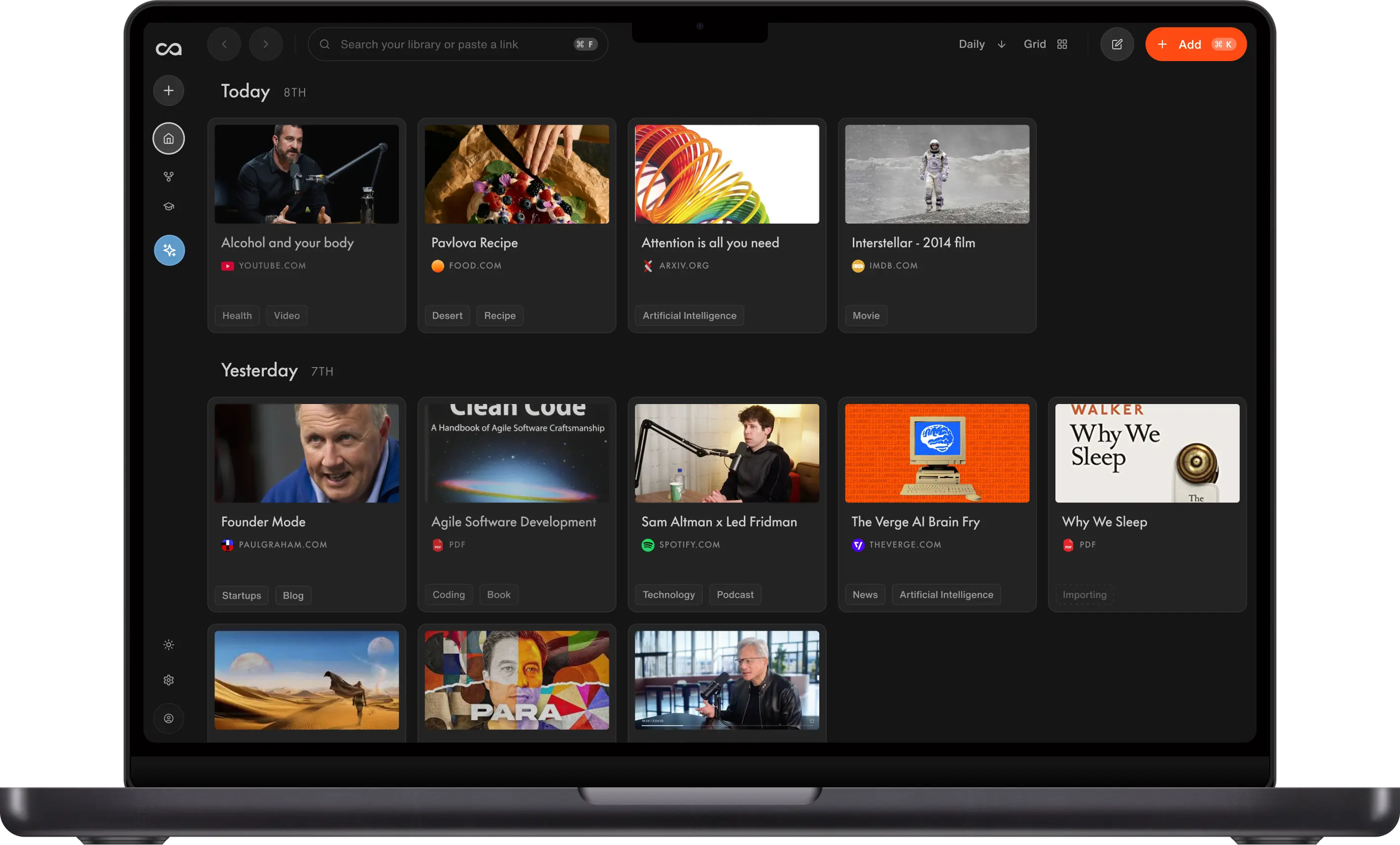
Recall web app on laptop, personal AI knowledge base for summarizing and chatting with your content